The Boy Scraped Frosting Off A Cardboard Box While I Adjusted A Mannequin In My Luxury Boutique. When I Ran Across The Street To Stop The Baker From Chasing Him Away, I Saw His Green Eyes And Realized He Wasn’t Just A Hungry Stranger—He Was The Son I Never Knew My Sister Had.
Chapter 1: The Glass Cage
The silence inside Velvet & Vine was expensive. It was a specific kind of quiet—the kind that smells like cedarwood, pressed linen, and exclusivity.
I stood behind the counter, my fingers idling over the inventory tablet, but my eyes were fixed on the street. It was 6:00 PM in Chicago. The wind off the lake was brutal, cutting through the city like a serrated knife, turning the slush on the sidewalks into treacherous gray ice.
Inside, the thermostat was set to a perfect seventy-two degrees. Soft jazz played from invisible speakers. I adjusted the collar of the cashmere coat on the mannequin in the window. The price tag dangled discreetly: $2,400.
That coat cost more than my father made in three months when I was growing up in the Rust Belt. Now, I sold three of them a week to women who wouldn’t blink at the total.
I was Elena Vance. Thirty-eight, successful, self-made. My life was a curated gallery of beautiful things. I had the loft in River North, the German car, the contacts list full of socialites. I had scrubbed the grit of my childhood from my skin with exfoliants that cost fifty dollars an ounce.
But tonight, looking out that bulletproof glass window, I felt like a fraud.
That’s when I saw him.
He emerged from the alleyway next to Miller’s Bakery across the street. He was small—painfully small. Maybe nine or ten years old. He wore a puffy jacket that was clearly a donation; it was a faded, dirty purple, bubbling in places where the synthetic fabric had melted, and it hung past his knees.
He didn’t walk like the other kids who passed by my store. He didn’t skip or run. He moved with a terrifying economy of motion, shoulders hunched, head down, making himself as small a target as possible.
I stopped adjusting the mannequin. My hand froze on the silk lapel.
The boy stopped at the dumpster behind the bakery. It was a massive, green metal beast that smelled of yeast and rotting fruit even from across the street.
Most people would have looked away. It’s an urban reflex—to edit out the unpleasantness, to unsee the suffering so you can go about your dinner plans. But I couldn’t.
I watched as he checked his surroundings. Left. Right. Up at the windows. He was looking for threats.
Then, Mr. Miller, the owner of the bakery, came out the back door. I flinched, expecting him to yell. But Miller just tossed a heavy black bag into the dumpster, wiped his hands on his apron, and went back inside, locking the heavy steel door behind him.
The boy waited exactly ten seconds.
Then he moved.
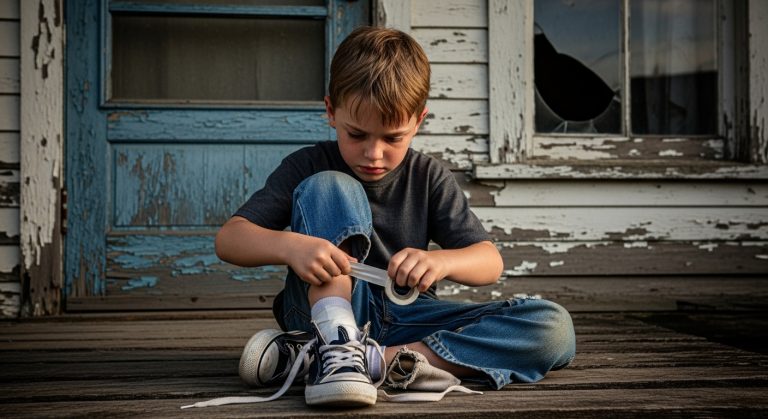
He scrambled up the side of the dumpster. His sneakers were wrapped in silver duct tape—the poor man’s waterproofing. I knew that trick. I had done that trick when I was twelve, walking to school in the snow. The memory hit me like a physical blow to the stomach. The sensation of wet socks, the numbness spreading up the ankles.
He leaned over the rim, his small legs dangling, and fished something out.
A white cake box.
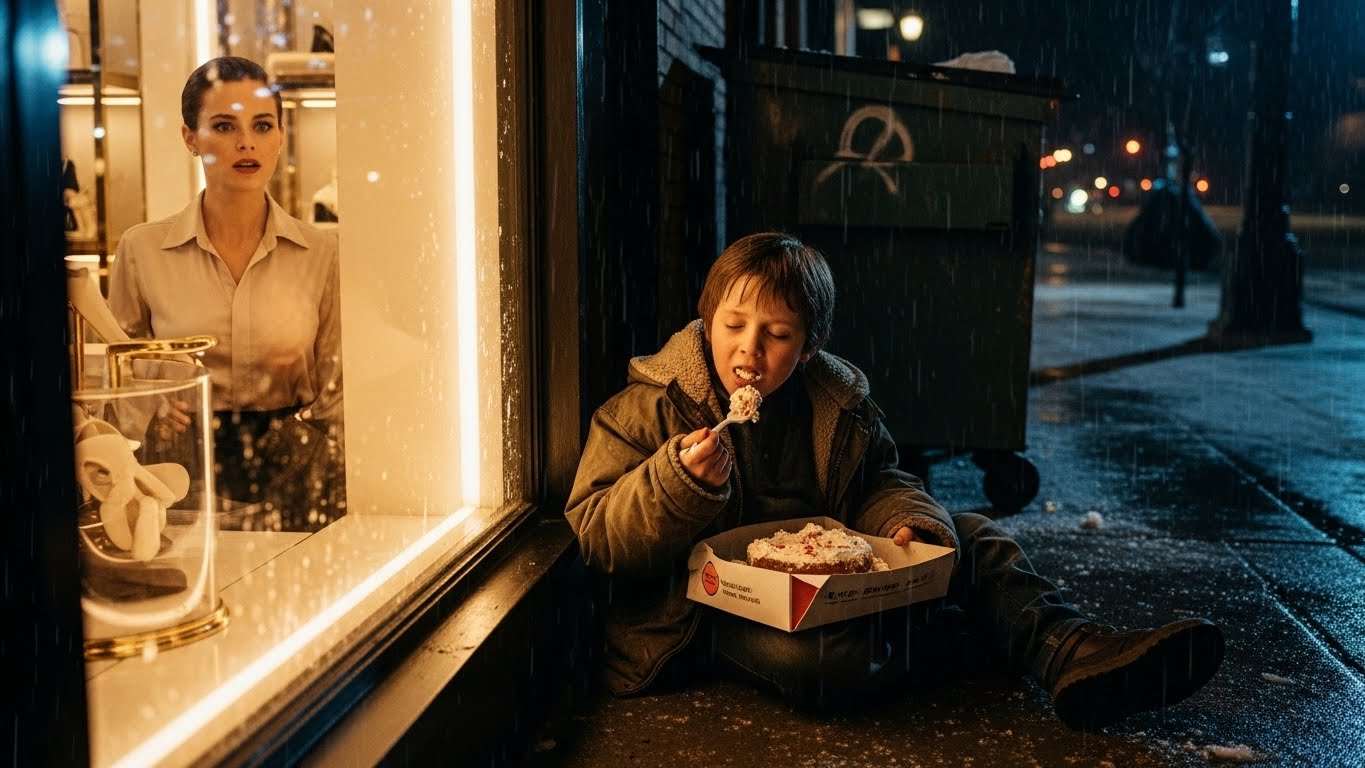
He slid back down to the pavement, landing in the slush. He didn’t run away. He didn’t hide. He sat right there, under the harsh yellow glow of the security light, and placed the box on his lap.
I pressed my palm against the cold glass of my window. “What are you doing?” I whispered to the empty store.
He opened the box. Even from across the street, I could see the disaster inside. The cake had obviously been dropped or smashed. The frosting was smeared against the cardboard lid. It was garbage. Literal garbage.
But the boy looked at it as if he had just opened a treasure chest.
He reached into his pocket and pulled out a plastic fork. A white, flimsy plastic fork that he had clearly saved for this exact moment.
He didn’t shovel the food into his mouth like a starving animal. He carved out a piece of the smashed sponge, carefully gathering a dollop of the smeared frosting, and lifted it to his lips.
He closed his eyes.
I saw his shoulders drop. I saw the tension leave his small, shivering body for a singular, fleeting second. He savored it. He was eating dignity. He was eating a moment of sweetness in a life that was clearly bitter.
A lump formed in my throat, hard and painful.
I looked down at the $400 scarf around my neck. I looked at the imported chocolates sitting in a crystal bowl on my counter for customers—untouched.
The guilt wasn’t a slow creep; it was an avalanche.
I had built this glass cage to keep the world out, to keep the hunger out. But staring at that boy, the walls didn’t feel like protection anymore. They felt like an indictment.
He took another bite, then stopped. He closed the box.
Why is he stopping? I thought. He’s starving. Eat it. Eat it all.
But he didn’t. He carefully folded the lid back down, treating the garbage like a precious parcel. He was saving it.
For who?
Then, the back door of the bakery flew open again.
Chapter 2: The Green Eyes
The sound of the metal door hitting the brick wall was audible even through my double-paned window.
Miller stormed out. He was a good man, usually. He made the best sourdough in the district. But he was tired. He had been robbed twice last month. His patience had eroded down to the bedrock.
He held a broom in his hand, gripping it like a weapon.
“Hey! Get the hell out of there!” Miller’s voice was muffled by the glass, but the aggression was unmistakable.
The boy flinched so hard he almost dropped the box. He scrambled backward, his taped sneakers slipping on the ice. He didn’t try to fight. He didn’t argue. He just curled around the cake box, shielding it with his body.
“I called the cops last time, you little rat!” Miller shouted, raising the broom. “Stop digging in my trash! It’s a liability!”
The boy was cornered against the brick wall. He looked tiny.
Something inside me snapped.
It wasn’t a conscious decision. It was a visceral, electric impulse that bypassed my brain and went straight to my legs.
I didn’t grab my coat. I didn’t set the alarm. I didn’t even grab my keys.
I pushed open the heavy glass door of Velvet & Vine and sprinted into the freezing street.
The wind hit me instantly, biting through my silk blouse, but I didn’t feel the cold. I only felt the rage.
“Miller!” I screamed.
I ran through the traffic—a taxi honked, screeching to a halt—but I didn’t stop. I mounted the curb on the other side, my high heels clicking sharply on the frozen concrete.
Miller froze, the broom mid-swing. He turned, eyes widening as he saw me.
“Ms. Elena?” He looked confused. “What… what are you doing? You’re not wearing a coat.”
I placed myself between the baker and the boy. I stood tall, channeling every ounce of authority I had cultivated over ten years of dealing with difficult clients and tough landlords.
“Put the broom down, Frank,” I said, my voice shaking—not from cold, but from adrenaline.
“Elena, look, this kid—he’s always here. It’s a health code violation if he gets sick from my trash. I can’t have…”
“He is a child!” I snapped, my voice cracking. “He is a hungry child. If you touch him, so help me God, I will buy this building and evict you.”
It was an empty threat—I didn’t have that kind of capital—but the ferocity in my eyes made Miller take a step back. He lowered the broom. He looked at the boy, then at me, and the anger drained out of him, replaced by a weary shame.
“I wasn’t gonna hit him,” Miller mumbled, looking at his boots. “I just… I’m just tired, Elena. I’m just tired.”
I turned my back on him and looked down at the boy.
He was trembling violently now. He was hugging the cake box so tight the cardboard was buckling. He looked up at me, terrified. He expected me to be another adult who would yell, or lecture, or call the police.
“It’s okay,” I whispered, dropping to my knees. The wet slush soaked instantly into my tailored trousers, ruining the fabric. I didn’t care. “I’m not going to hurt you.”
The boy stared at me. The streetlights flickered overhead, casting long shadows.
“I didn’t steal it,” he stammered. His voice was raspy, like he hadn’t used it all day. “It was in the trash. That means it’s nobody’s.”
“I know,” I said softly. “I know you didn’t steal it.”
I reached out a hand, slowly, palm up. “My name is Elena. What’s yours?”
He hesitated. He looked at the cake, then at Miller (who was now retreating back into the bakery, looking ashamed), and finally, he looked directly into my eyes.
And my heart stopped beating.
Green.
His eyes were a vivid, shocking emerald green with distinct flecks of gold around the iris.
The world tilted on its axis. The traffic noise faded into a dull roar. The cold vanished.
I knew those eyes.
I had seen those eyes in the mirror every morning for my entire life. I had seen those eyes on my father. And I had seen those eyes on my sister, Leona.
Leona.
The sister I left behind in a trailer park in Ohio twenty years ago. The sister who stole my savings to buy pills. The sister I swore I would never speak to again because it hurt too much to watch her destroy herself.
I stared at the boy’s face. Beneath the grime, beneath the hollow cheeks of malnutrition, I saw the structure. The nose. The chin.
“Leo,” the boy whispered.
I gasped. “What?”
“My name is Leo,” he said.
Leo. Leona.
My hands were shaking uncontrollably now. I reached out and touched his cheek. His skin was ice cold.
“Leo,” I choked out. “Where are your parents? Where is your mom?”
He looked down at the cake box. “She’s… she’s close. She’s waiting for me.”
“Is she at a shelter?” I asked, praying. Please be at a shelter. Please be warm.
He shook his head. “No. Shelters aren’t safe. We have a spot. It’s… it’s okay. But I gotta go.”
He tried to stand up, but he stumbled. He was weak.
“Leo, wait,” I said, grabbing his arm gently. “Why were you saving the cake?”
He looked at me with an innocence that shattered my soul. “It’s her birthday. Well, maybe yesterday. I don’t know the days good. But she likes strawberry. And she’s sick.”
“Sick?” A cold dread washed over me. “What kind of sick?”
“She won’t wake up,” Leo said matter-of-factly. “She’s been sleeping for a long time. Since yesterday morning. I can’t wake her up to eat, but I thought… if she smelled the cake… maybe she’d wake up.”
The air left my lungs.
“She hasn’t woken up in two days?” I asked, my voice rising in panic.
“No,” he whispered. A single tear cut a track through the dirt on his cheek. “She’s really cold, lady. I put all the blankets on her, but she’s still cold.”
I stood up. The boutique, the mannequin, the sales targets—it all evaporated.
“Show me,” I commanded. “Take me to her. Now.”
Chapter 3: The Silent Underpass
We ran.
I didn’t go back for my coat. I didn’t lock the store. I left the Velvet & Vine door unlocked, lights blazing, thousands of dollars of merchandise exposed to the city. It didn’t matter. Nothing mattered.
Leo led me away from the high street, past the coffee shops and the wine bars, toward the dark gaping mouth of the I-90 underpass.
As we crossed the threshold from the business district into the shadow of the highway, the atmosphere changed. The smell of roasted coffee was replaced by the acrid stench of urine, damp concrete, and unwashed bodies.
“It’s just here,” Leo panted, clutching the cake box as he ran.
There was a tent city set up against the sloping concrete wall. Blue tarps, cardboard boxes, shopping carts filled with scavenged metal. It was a purgatory hidden in plain sight.
“Mom?” Leo called out.
He stopped in front of a makeshift structure. It was just a few shipping pallets propped up against the wall, covered with a thick, dirty plastic sheet.
“Mom! I got cake!” Leo said, his voice trembling with a desperate, forced cheerfulness. “It’s strawberry!”
He crawled inside the darkness.
I followed him, dropping to my hands and knees on the freezing dirt.
It took a moment for my eyes to adjust to the gloom.
There was a figure lying on a pile of flattened cardboard boxes and old sleeping bags.
“Leona?” I whispered.
The woman didn’t move.
I crawled closer, the smell of sickness and neglect hitting me hard. I reached for my phone to use the flashlight. The beam cut through the dark.
I saw her face.
It was aged, ravaged by years of hard living and chemicals, but it was her. The same jawline. The same scar on her forehead from when we fell out of the apple tree when we were seven.
She looked gray. Her lips were blue.
“Mom, wake up,” Leo said, opening the cake box. He took a bit of the frosting on his finger and pressed it against her cold lips. “Look. Sweet. It’s sweet.”
She didn’t stir.
“Leona!” I shouted, grabbing her shoulder. She was stiff. Not rigor mortis stiff, but cold-stiff. Hypothermia. Overdose. Or both.
I ripped the glove off my hand and pressed two fingers to her neck.
Silence.
Then… a flutter. Faint. Thready. Irregular. But there.
“She’s alive,” I gasped. “Leo, she’s alive.”
I pulled my phone out and dialed 911. My fingers were clumsy with cold and terror.
“911, what is your emergency?”
“I need an ambulance! Underpass at kinzie and Desplaines. Female, unresponsive, faint pulse. Possible overdose. Hypothermia. Hurry!”
“Dispatching now. Stay on the line.”
I tossed the phone on the sleeping bag and immediately started rubbing Leona’s arms. “Leo, give me your jacket.”
“But…”
“Give it to me! We need to warm her up!”
The boy stripped off his oversized coat. I threw it over her chest. I lay down next to her, pressing my body against hers, trying to transfer whatever heat I had left in my silk-clad frame to her.
“Who are you?” Leo asked, his voice small, terrified. He was shivering in just his t-shirt.
I looked at him over Leona’s shoulder. I reached out and pulled him into the huddle, wrapping my arm around him so we were a pile of three—two sisters and a son, bound by blood and tragedy on a bed of cardboard.
“I’m your aunt,” I whispered, tears finally spilling over, hot and fast. “I’m your Aunt Elena. And I’m sorry. I’m so, so sorry.”
Leo didn’t understand. He just clung to me, burying his face in my shoulder.
In the distance, I heard the wail of sirens growing louder.
“Stay with me, Leona,” I sobbed into her matted hair. “Don’t you dare die on me now. You don’t get to leave him. You don’t get to leave us.”
The sirens screamed closer, cutting through the winter night, promising help, but I knew, holding her fragile body, that the real fight was only just beginning.
This wasn’t just a rescue mission. It was a reckoning.
The lights of the ambulance flashed against the concrete walls—red, white, red, white—illuminating the smashed cake that sat forgotten on the dirt floor.
A celebration of a life that was barely hanging on.
Chapter 4: The Sterile White
The waiting room at Northwestern Memorial Hospital was a different kind of cage than my boutique. At Velvet & Vine, the silence was curated. Here, the silence was heavy, punctuated only by the rhythmic beeping of monitors and the squeak of nurses’ rubber-soled shoes.
I sat on a hard plastic chair, my $600 Italian trousers stiff with dried mud and slush. My silk blouse was stained with the grime of the underpass. I caught my reflection in the dark glass of a vending machine: I looked like a deranged socialite who had just crawled out of a swamp.
But I didn’t care.
Leo was sitting next to me. A nurse had draped a heated blanket over his shoulders—the standard-issue hospital beige that looked rough against his pale skin. They had given him a turkey sandwich and a juice box.
He ate with the same heartbreaking precision I had seen at the dumpster. Small bites. Chewing thoroughly. Making it last.
“Is she gonna wake up?” Leo asked, his voice small. He was staring at the double doors where they had taken Leona.
“The doctors are doing everything they can,” I said, realizing how hollow that cliché sounded.
A doctor in blue scrubs emerged. He looked exhausted. Dr. Evans, his ID badge read.
I stood up immediately. “How is she?”
Dr. Evans looked at me, then at Leo. He lowered his voice, angling his body away from the boy.
“Are you the sister?”
“Yes,” I lied. Or told the truth. I wasn’t sure anymore. legally, I was a stranger. Biologically, I was her other half. “I’m Elena Vance.”
“Ms. Vance,” Dr. Evans sighed, rubbing the back of his neck. “She’s stable, but critical. Severe hypothermia. Pneumonia. And her toxicology screen lit up like a Christmas tree. Opiates, benzodiazepines. Her body is… tired. Very tired.”
I felt the blood drain from my face. “Will she make it?”
“Tonight? Probably. But her organs are taking a beating. We’ve induced a coma to let her body rest. If we hadn’t brought her in when we did…” He didn’t finish the sentence. He didn’t have to.
He looked over at Leo. “The boy needs to be examined too. He’s severely malnourished. We need to check for frostbite.”
“I’m fine,” Leo piped up. He had been listening. “I’m not sick. Mom is sick.”
I turned to him, kneeling so our eyes were level. Those green eyes.
“Leo, you need a check-up. Just to be sure. Just so you can be strong for your mom.”
He hesitated, clutching the empty juice box. “Does it cost money? We don’t have insurance. Mom said never go to the doctor ’cause they send bills.”
My heart broke all over again. A ten-year-old worrying about medical billing.
“I will pay for everything,” I said fiercely. “You don’t worry about money. Never again.”
As the nurse led Leo away, I collapsed back onto the plastic chair. The adrenaline was fading, leaving behind a cold, aching void.
I pulled out my phone. 11:30 PM. I had fifteen missed calls from my assistant. Three from my driver.
I looked at my hands. They were clean now—I had scrubbed them in the bathroom until they were raw—but I could still feel the phantom sensation of Leona’s cold, clammy skin.
I closed my eyes, and suddenly, I wasn’t in a Chicago hospital anymore. I was back in Ohio.
Chapter 5: Ghosts of the Rust Belt
The memory hit me with the smell of burning leaves and cheap gasoline.
It was eighteen years ago. The day I left.
We were standing on the porch of the trailer. It was a single-wide, aluminum siding peeling like sunburned skin. Our father had passed two years prior, leaving us nothing but debt and a genetic predisposition for bad luck.
I was twenty. Leona was eighteen.
I had packed my life into two duffel bags. I had a scholarship to a fashion institute in New York. A one-way ticket out of poverty.
“You’re really leaving,” Leona had said. She was smoking a cigarette, leaning against the doorframe. She looked beautiful then—wild, untamed, dangerous. She was the fire to my ice.
“I have to, Lee,” I pleaded. “I can’t stay here working at the diner. I’ll die here.”
“So you’re just gonna leave me with Mom’s medical bills? You’re gonna leave me with this mess?”
“Come with me,” I said. “We can figure it out.”
Leona laughed, a harsh, brittle sound. “In New York? Please. I’m not smart like you, Elena. I’m not ‘refined.’ I belong here.”
“I’ll send money,” I promised. “As soon as I get a job. I’ll send for you.”
“Don’t bother,” she spat, flicking the cigarette butt into the dead grass. “Go be a princess. Forget you ever came from this trash.”
She slammed the door in my face.
I walked to the Greyhound bus stop, dragging my bags, crying until my throat burned.
I did send money. For the first two years. Checks. Letters.
The checks were cashed. The letters were never answered.
Then, five years in, a letter came back. Return to Sender. Address Unknown.
I hired a private investigator once, when I got my first big bonus at thirty. He traced her to a motel in Indiana, then the trail went cold. He mentioned arrests. Petty theft. Possession.
I stopped looking.
I told myself it was for my own sanity. I told myself you can’t save someone who doesn’t want to be saved. I built Velvet & Vine as a fortress against that memory. I surrounded myself with silk and cashmere to forget the feel of polyester and scratchy wool.
But sitting in that hospital corridor, looking at the scuff marks on the linoleum, the truth clawed its way out.
I didn’t stop looking because I couldn’t find her. I stopped looking because I was afraid of what I would find.
I was afraid I would find exactly what I found tonight: My baby sister dying on a piece of cardboard, while I adjusted mannequins in a temperature-controlled window display.
“Ms. Vance?”
A voice jolted me back to the present.
I looked up. A woman was standing there. She held a clipboard and wore a badge that said Department of Child and Family Services.
The System had arrived.
Chapter 6: The File on the Table
The social worker’s name was Ms. Gonzalez. She was kind, but she had the tired eyes of someone who had seen too many broken families to be optimistic.
We sat in a small consultation room. The air was stale.
“Here is the situation,” Ms. Gonzalez said, opening a file. “The mother, Leona Vance, is incapacitated. Preliminary tests show heavy narcotic use. There is no father listed on the birth certificate. Leo has no record of school enrollment for the last two years.”
She looked at me over her glasses.
“Technically, Leo is in state custody right now.”
The words hung in the air like a guillotine blade.
“Custody?” I sat up straighter. “He has family. I am his family.”
“Ms. Vance, you haven’t seen your sister in nearly two years?”
“Twenty,” I corrected, my voice barely a whisper. “Twenty years.”
Ms. Gonzalez paused. She wrote something down. The scratch of her pen sounded incredibly loud.
“That makes this complicated. You are virtually a stranger to the child. We have protocols. Typically, in cases like this, where the mother is unfit and there is no active family involvement, we place the child in emergency foster care until a long-term investigation is done.”
“Foster care?” I stood up, knocking my chair back. “You want to put him in the system? He just watched his mother overdose. He’s terrified. You can’t take him away from the only person he knows.”
“He doesn’t know you, Ms. Vance,” Ms. Gonzalez said calmly. “And respectfully, looking at your… situation…” She glanced at my ruined designer clothes, then at my face. “Do you have any experience with children? Do you have a home suitable for a traumatized ten-year-old?”
“I have a loft in River North,” I said defensively. “It has two bedrooms. It’s safe.”
“Is it child-proof? Is your schedule flexible? This boy needs stability, not a babysitter while you run a business.”
I opened my mouth to argue, but the words died in my throat.
She was right.
I hated mess. I hated noise. My furniture was white. My vases were crystal. My schedule was booked in fifteen-minute increments from 7 AM to 9 PM. I didn’t even own a goldfish because I didn’t want the responsibility.
But then I thought of the cake.
I thought of Leo, shivering in the alley, scraping smashed frosting off a cardboard box to try and wake up his dying mother. I thought of the fierce loyalty in his eyes when he told me he wasn’t sick.
He was the bravest person I had ever met.
“I will make it suitable,” I said, my voice steadying. “I am his aunt. I am the only blood he has left. If you put him in foster care, he will think he’s been abandoned. Again.”
Ms. Gonzalez studied me. She was assessing me—not as a business owner, but as a human being.
“It’s 2:00 AM,” she said finally. “We don’t have many open beds tonight anyway. I can grant you temporary emergency kinship placement. For 48 hours. Until the hearing.”
I exhaled, a breath I didn’t know I was holding.
“But,” she raised a finger, “a social worker will visit your home tomorrow. If it’s not up to code, or if we sense any instability, we take him. Do you understand?”
“I understand.”
“And Ms. Vance?”
“Yes?”
“This isn’t just about giving him a warm bed. That boy is carrying the weight of the world. He doesn’t need a savior. He needs a parent. Are you ready for that?”
I looked through the glass window of the consultation room. I could see Leo in the hallway. He was sitting on the edge of the exam table, swinging his legs. He was looking at the door, waiting. Waiting for me.
Was I ready? No. I was terrified.
“I’ll be whatever he needs,” I said.
I signed the papers.
When I walked out to get him, Leo looked up. His face was scrubbed clean, revealing a smattering of freckles across his nose.
“Where’s Mom?” he asked immediately.
“She has to stay here for a while to get better,” I said, forcing a smile. “You’re coming with me tonight.”
Leo’s eyes widened. He slid off the table. “To your house?”
“Yes.”
He looked down at his feet. “Is it… is it far? In case she wakes up?”
“We’ll come back first thing in the morning,” I promised. “I swear.”
I held out my hand.
He hesitated. He looked at the nurses station, then at the empty hallway. He realized he had no other choice.
He took my hand. His grip was surprisingly strong.
We walked out of the hospital into the biting Chicago wind. My driver was waiting.
As Leo climbed into the back of the sleek black Mercedes, his eyes went wide. He touched the leather seats tentatively.
“Whoa,” he whispered.
I got in beside him. I told the driver my address.
As the car pulled away, leaving the hospital behind, I realized I had just kidnapped a child from his life—as terrible as it was—and dragged him into mine.
I looked at him. He was fighting sleep, his head bobbing.
“You can sleep, Leo,” I said softly.
“I can’t,” he mumbled. “Gotta keep watch.”
“Keep watch for what?”
“For the bad stuff,” he said, his eyes finally closing against his will. “It always comes when you’re sleeping.”
I reached over and pulled the seatbelt gently across his chest.
“Not tonight,” I whispered to the quiet car. “Not on my watch.”
But as we drove toward the skyline, toward my glass tower in the sky, I knew the “bad stuff” wasn’t just out on the streets. It was inside us. It was the history we shared, the secrets Leona was keeping, and the fact that when she woke up—if she woke up—she might hate me for taking her son.
I was bringing a hurricane into my glass house. And I had no idea if the walls would hold.
Chapter 7: Bread in the Pockets
The morning sun hit the floor-to-ceiling windows of my loft like a spotlight. It was a stark, unforgiving light that exposed everything: the dust motes dancing in the air, the sterility of my white Italian sofa, and the absurdity of a child’s dirty sneakers sitting by my front door.
I woke up on the couch. I hadn’t slept in my bed; I wanted to be near the guest room in case Leo woke up.
The door to the guest room was open. The bed was empty.
Panic, sharp and immediate, spiked in my chest.
“Leo?”
I ran to the kitchen. Empty. I ran to the bathroom. Empty.
“Leo!”
I found him in the walk-in pantry.
He was sitting on the floor, huddled in the corner between the shelves of imported pasta and the wine rack. He had a loaf of sourdough bread in his lap.
He wasn’t eating it. He was systematically tearing chunks off and stuffing them into the pockets of his cargo shorts.
He looked up when I entered, his eyes wide with terror. He scrambled backward, knocking over a glass jar of quinoa. It shattered on the tile floor—a loud, explosive crash that echoed through the silent apartment.
Leo flinched so hard his head hit the shelf behind him. He curled into a ball, covering his head with his arms.
“I’m sorry! I’m sorry! Don’t hit me! I’ll clean it up!” he screamed.
His reaction was immediate, visceral, and practiced. He expected pain. He expected a blow.
My heart shattered into a million pieces, sharper than the glass on the floor.
I stepped over the broken glass, ignoring the shards that crunched under my bare feet. I sat down on the floor next to him, amidst the spilled quinoa and the fear.
“Leo, look at me,” I said, keeping my voice low and steady. “Look at me.”
He peeked out from behind his arms, trembling.
“I am never going to hit you,” I said, enunciating every word. “You can break every glass in this house. You can tear down the curtains. You can scream. I will never, ever hurt you.”
He stared at me, his chest heaving. “But… I stole the bread.”
I reached out and gently touched the bulging pocket of his shorts.
“Why are you hiding it, Leo?”
“For later,” he whispered. “In case we have to leave. In case you change your mind.”
I closed my eyes, fighting back tears. This boy had lived his entire life waiting for the other shoe to drop. Waiting for the goodwill to run out.
“You don’t have to hide food here,” I said. “Look at this pantry. It’s full. If it runs out, I will buy more. You will never be hungry in this house. That is a promise.”
I took the loaf of bread from his lap. I tore off a piece and ate it. Then I handed a piece to him.
“We eat together,” I said. “At the table. Like people. Not like ghosts.”
He took the bread. He didn’t smile, but his shoulders lowered an inch.
“Can we see Mom now?” he asked.
“Yes,” I said, standing up and offering him a hand. “Let’s go see Mom.”
Chapter 8: The Mirror
Leona was awake.
When we walked into the ICU, she was propped up against the pillows. She looked small. The tubes were gone, but the IV lines remained. Her face was a map of hard roads taken—lines around her mouth, shadows under her eyes that no amount of sleep would cure.
But her eyes—those green eyes—were sharp.
She saw Leo first.
“Baby,” she rasped.
“Mom!” Leo let go of my hand and ran to the bed. He buried his face in her neck, careful of the wires.
I stood in the doorway, feeling like an intruder in my own family drama.
Leona held him for a long time, smelling his hair. Then, slowly, she looked up at me.
Her expression wasn’t gratitude. It was a complex cocktail of shame, defensiveness, and recognition.
“Elena,” she said. Her voice was deeper than I remembered, roughened by smoke.
“Hi, Leona,” I said, stepping into the room.
“You look expensive,” she said, a faint, bitter smile touching her lips. “Just like you said you would be.”
“You look alive,” I parried softly. “Which is better than the alternative.”
Leo pulled back. “Mom, Aunt Elena has a big house. It’s way up in the sky. And she has a shower that feels like rain.”
Leona looked at Leo. She really looked at him. She saw the clean clothes I had bought him that morning. She saw his hair, washed and combed. She saw the color returning to his cheeks.
And then she looked at herself. The hospital gown. The trembling hands.
The bravado crumbled.
“Leo,” she said gently. “Can you go wait with the nurse for a minute? I need to talk to your Auntie.”
“But—”
“Just for a minute, baby. Please.”
Leo looked at me. I nodded. He slid off the bed and walked out, closing the door.
The silence that followed was suffocating.
“You took him,” Leona said, accusingly. But there was no heat in it.
“I saved him,” I corrected. “He was digging in a dumpster, Leona. He was eating garbage to test it for you. He’s ten years old and he’s been acting like your father.”
Leona turned her head away, staring out the window at the brick wall of the adjacent building.
“I tried,” she whispered. “I tried to get clean. But then… life happens. And it’s cold. And the pills make it warm.”
“He loves you,” I said. “He loves you so much it hurts to watch. He thinks he’s your protector. But he’s a child. He can’t save you.”
Leona began to cry. Silent, ugly tears that ran into her ears.
“I know,” she choked out. “I know.”
She turned back to me. “The social worker came by. They said… they said I’m unfit. They said he goes to foster care unless…”
She stopped. She looked at me.
“Unless family takes him,” I finished.
Leona stared at me. She looked at my structured blazer, my determined face. She saw the sister she had resented for leaving, the sister who had “made it.”
“Can you take him?” she asked. The question hung in the air, heavy and fragile.
“I don’t know anything about kids, Leona. I work eighty hours a week. I don’t cook.”
“But he’s safe with you,” she said. “I saw it in his face. He’s not scared right now. He’s always scared with me.”
She reached out and grabbed my hand. Her grip was weak, desperate.
“Take him, Elena. Please. Until I can… until I can be the mom he thinks I am. Don’t let strangers raise my boy.”
I looked at my sister. I saw the wreckage of twenty years, but I also saw the love. It was a broken, messy love, but it was real.
“I will take him,” I said. “But you have to go to rehab. Not for a week. For real. You have to fight, Leona. Because if you don’t, I won’t let you back in his life to break his heart again.”
Leona nodded, sobbing. “I promise. I promise.”
I squeezed her hand. For the first time in two decades, we weren’t enemies. We were allies, united by a boy with green eyes who deserved better than both of us had given him.
The Conclusion: The Fresh Cake
Three Months Later
The bell above the door of Miller’s Bakery chimed.
Miller looked up from the counter. When he saw us, his face broke into a wide grin.
“Well, if it isn’t my favorite customers,” he boomed.
Leo walked in first. He looked different. Taller. He was wearing a soccer jersey—he had joined the local league last week—and his sneakers were new, no duct tape in sight.
“Hi, Mr. Miller,” Leo said.
I followed him in. I wasn’t wearing my usual power suit. I was wearing jeans and a cashmere sweater. My hair was in a messy bun. My life had become messier, louder, and infinitely more complicated.
There were soccer cleats in my hallway. There were comic books on my coffee table. And I had learned that I was terrible at math homework but excellent at making pancakes.
“We’re here for the order,” I said.
Miller reached into the display case and pulled out a box. A white box. Perfect.
He opened it.
Inside was a strawberry cake. Round, flawless, with delicate pink frosting swirls. Written in elegant chocolate script were the words: Happy 11th Birthday, Leo.
Leo’s eyes widened. He stared at the cake, mesmerized.
“It’s not smashed,” he whispered.
“No, son,” Miller said softly. “It’s not smashed. Made it fresh this morning. On the house.”
Leo looked up at Miller, then at me.
“Can we take a piece to Mom?” he asked.
“We sure can,” I said. “She’s waiting for us.”
Leona was ninety days sober today. She was in a halfway house three miles away. She had a job interview next week. It wasn’t perfect. It wasn’t fixed. But she was awake.
I picked up the box. It felt light.
We walked out of the bakery, Leo skipping ahead of me.
I paused on the sidewalk, looking at the spot where I had first seen him three months ago. The dumpster was still there. The street was the same. But the glass wall of Velvet & Vine across the street no longer looked like a cage. It just looked like a store.
My real life wasn’t in there anymore.
My real life was this boy, walking in the sunlight, holding the door open for me.
“Coming, Aunt Elena?” he called out.
“Coming, Leo,” I said.
I took his hand. We didn’t run. We walked, steady and sure, toward the future.
And for the first time in my life, I wasn’t hungry for anything else.