I Came Home 24 Hours Early From A Business Trip And Caught My Sister-In-Law Mid-Swing. But When I Found The Notebook Hidden Under My Daughter’s Bed, I Realized The Bruises Were Just The Beginning Of A Nightmare I Never Saw Coming.
Chapter 1: The Hand That Didn’t Fall
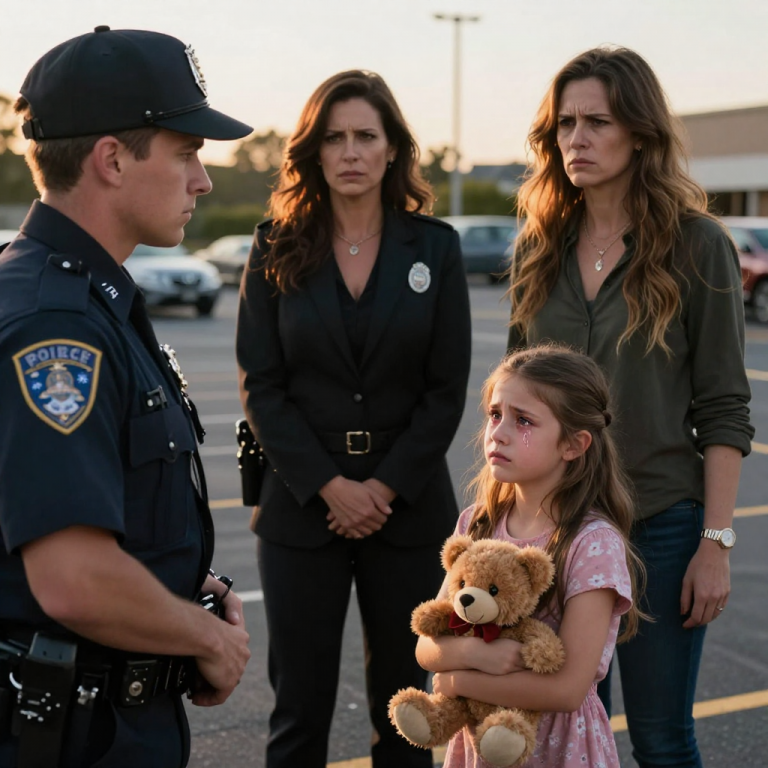
The kitchen tiles were cold against Emma’s bare knees. She knelt between her aunt and the wooden playpen where her baby brother, Tommy, screamed. His face was red and tear-streaked, his tiny fists clutching the wooden bars so tightly his knuckles were white.
Emma’s hands were raised, palms out, her whole body trembling. Above them both, Aunt Diane’s hand hung in the air, frozen mid-strike.
“Please,” Emma whispered, her voice breaking. “Please don’t hit him. He’s just hungry. I’ll make him stop. I promise I’ll make him stop.”
The words tumbled out, breathless and desperate, while her heart hammered so hard she thought it might break through her chest. The air in the kitchen tasted like stale formula and fear. Outside, the Seattle rain lashed against the panoramic windows, a relentless gray drumbeat that usually drowned out everything else.
But not this.
In that terrible, suspended moment—when the hand might fall or might not fall—the metallic click of the front door lock shattered the silence.
The heavy oak door swung open. A gust of wet wind blew into the hallway.
“Hello? I made an earlier flight!”
The voice was deep, familiar, and cheerful.
Michael Chen had come home a full day early.
Michael had built his fortune in commercial real estate, transforming abandoned warehouses into thriving mixed-use developments across three states. His name was synonymous with urban renewal and smart investment. He worked 18-hour days, traveled constantly, and made deals worth millions before breakfast. But none of it—none of the success, recognition, or wealth—meant anything compared to his children.
His wife, Sarah, had died three years ago. It was a cancer that came sudden and brutal, stealing her away in six months that felt like six minutes. In his grief, he had leaned heavily on Sarah’s sister, Diane. He was grateful beyond words when she offered to move in and care for Emma and baby Tommy. Diane had seemed like an angel then, stepping into the chaos of their shattered family, taking charge of the household while he stumbled through his days half-blind with sorrow. He had trusted her completely. Entirely. Without question.
Now, standing in the kitchen doorway with his leather briefcase still in hand, his trench coat damp from the rain, Michael felt the world tilt sideways.
He processed the scene before him in slow motion. Emma on the floor, her thin arms wrapped protectively around the leg of the playpen. Her face was pale, terrified in a way that made something cold and sharp pierce through his chest.
Tommy was screaming. Not the normal, fussy cry of a tired baby, but something raw and desperate. His little body shook with the force of it.
And Diane. The woman he had trusted with his children’s lives. She was standing over them with her hand raised high, her face twisted into an expression of such rage and contempt that, for a moment, he did not recognize her at all.
“What is happening here?”
Michael’s voice came out low, dangerous. Each word was deliberate and controlled, though his hands were shaking.
The transformation in Diane was instantaneous. It was like watching a light switch flip. Her face smoothed into concern and exhaustion. Her raised hand dropped to her hip as she let out a weary sigh.
“Michael! Thank God you’re home early,” she said, breathless. “I’ve been at my wit’s end. Tommy has been screaming for hours—I think it’s colic—and Emma keeps interfering when I try to calm him down. I was just trying to get her to move aside so I could pick him up properly.”
She moved toward the playpen, reaching for the baby.
But Emma flinched.
She actually flinched, pressing herself harder against the wooden bars, closing her eyes as if expecting a blow.
And Michael saw it.
That reflexive fear in his daughter’s body. The way she made herself smaller.
“Emma, sweetheart,” he said softly, setting down his briefcase and taking a step forward. “Come here. Come to Daddy.”
But Emma didn’t move. She stayed frozen in place, her eyes darting frantically between him and Diane.
Chapter 2: The Hunger
There was something in that hesitation—that terror of moving—that sent alarm bells ringing through Michael’s mind. He had been gone for five days on this trip, a critical negotiation in Seattle that had required his physical presence. He had called every night for video chats, but those calls had been brief. Emma always said she was fine. Tommy appeared briefly on screen, looking sleepy. Everything seemed normal.
But nothing about this moment felt normal.
Nothing about the terror in his daughter’s eyes, or the shocking thinness of her arms, or the way Tommy’s cries had an edge of genuine distress rather than simple baby fussiness.
“Diane, could you give us a moment? Please,” Michael said. He didn’t phrase it as a question.
“Of course. You must be exhausted from your flight. I’ll go start some coffee.”
Diane’s voice was honey-sweet now, solicitous and warm. She touched his arm as she passed, giving him a sympathetic smile. “The children have just been difficult today. You know how it is. They’re still adjusting to Sarah being gone. They act out sometimes.”
She left the kitchen, and Michael heard her footsteps heading down the hall toward her room.
Only then did Emma move.
She scrambled up from the floor and ran to him, her thin body colliding with his legs. She buried her face against his stomach. He knelt down, gathering her into his arms, shocked at how light she felt. He could feel her ribs through her shirt.
Tommy’s cries had subsided to hiccuping sobs now that Diane was gone. The baby’s huge eyes fixed on Michael with an expression that seemed far too knowing for a 15-month-old.
“Emma, baby, what’s wrong? You can tell Daddy. I promise you’re safe.”
Michael held her at arm’s length, studying her face. He noticed for the first time the dark shadows under her eyes, the chapped lips, the way her hair looked dull and uncombed.
“Nothing’s wrong, Daddy. Everything’s fine,” she said quickly. “Aunt Diane takes good care of us.”
The words came out in a rush—rehearsed, automatic. But Emma’s voice shook, and her eyes filled with tears that she blinked back furiously.
“Sweetheart, I saw you on the floor. I saw Aunt Diane’s hand raised. Were you protecting Tommy? Was she going to hit him?”
Michael kept his voice gentle but firm. He needed her to understand that he would believe her. That she could trust him.
Emma’s whole body went rigid. Her eyes widened with panic, and she shook her head violently. “No! No, Daddy, you saw wrong. Aunt Diane would never. She’s nice. She’s so nice. She makes us dinner and reads us stories. And she loves us so much.”
The words tumbled out faster and faster, desperate and terrified.
And Michael recognized it now. It was the speech of a child who had been coached. Threatened. Made to understand that telling the truth would bring consequences worse than staying silent.
He pulled her close again, feeling her trembling against him. Over her head, he looked at Tommy in the playpen.
Michael noticed things he should have seen before. Things he should have noticed on the video calls if he had been paying attention instead of just checking boxes. Tommy’s cheeks looked hollow. His onesie hung loose on his small frame. There was a redness around his wrists like he had been gripping the playpen bars for a very long time.
When Michael lifted him out, Tommy clung to him with desperate strength, making small whimpering sounds. His diaper sagged heavily, wet and cold against Michael’s arm. It had clearly been unchanged for hours.
“When did Tommy last eat?” Michael asked Emma, still holding Tommy against his chest. He felt the baby’s rapid heartbeat against his own.
Emma bit her lip, her eyes darting toward the empty kitchen doorway. “This morning? Aunt Diane gave him a bottle this morning.”
It was past 6:00 in the evening now. Nearly ten hours since morning. Far too long for a baby Tommy’s age to go without food.
Michael’s jaw tightened until his teeth ached. He moved to the refrigerator, opening it to find it well-stocked with food—fresh vegetables, meats, everything needed to feed a family. No shortage of resources. No shortage of supplies.
He found the formula tin and prepared a bottle with shaking hands. When he gave it to Tommy, the baby attacked it with a desperate hunger, sucking so hard and fast that Michael had to pull it away briefly to keep him from choking.
“Emma, have you eaten today?”
He watched his daughter’s face carefully as he asked.
“Yes, Daddy. I had breakfast and lunch.” But she wouldn’t meet his eyes, and her hand moved unconsciously to her stomach.
Michael went to the pantry where he kept the granola bars. He handed her one. He watched as she tore into it with barely controlled desperation, crumbs falling to the floor as she tried to eat slowly but couldn’t quite manage it. Hunger was overriding caution.
He let her eat. He let Tommy finish his bottle. His mind raced through the past months, re-examining every phone call and visit through this new lens of suspicion. The times Emma had seemed subdued on video, which he had attributed to grief. The excuses about why he couldn’t visit the office anymore with Michael—Diane saying it disrupted his routine.
He had trusted her. He believed every word because she was Sarah’s sister. Because she had stepped up when he was drowning.
“Emma,” he said quietly. “I need you to be brave. I promise—I absolutely promise—that nothing bad will happen to you if you tell me. Has Aunt Diane been hurting you?”
Emma’s face crumpled. She backed away from him. “No, Daddy. No. Everything’s good. We’re happy. Aunt Diane is nice. Please don’t be mad at her. Please don’t send her away. We need her.”
The panic in her voice was palpable and real. But Michael understood now that it wasn’t panic at the thought of losing Diane. It was panic at the thought of what Diane might do if Emma betrayed her.
“Okay, baby. Okay, it’s all right.”
Michael pulled her close again. His mind was made up about one thing: whatever was happening in this house, whether his fears were justified or paranoid, he was not leaving his children alone with Diane again. Not for a single moment until he understood what was really going on.
“I’m going to take you upstairs for a bath,” Michael said. “Just us.”
He bathed both children himself.
And that was when his heart truly broke.
As the warm water washed over Emma, he saw the bruises. Finger-shaped marks on her upper arms. A yellowing bruise on her ribs that made his stomach turn. A fresh welt on her thigh.
When he asked about them, Emma went silent. Absolutely silent, staring at the bathroom tiles with empty eyes.
Tommy had bruises too, on his chubby thighs—marks that looked like they came from being gripped too hard. And when Michael changed his diaper, he found angry, red patches of rash that spoke of being left wet for too long, too often.
He put them to bed in fresh pajamas. He sat in the hallway chair outside their door, listening to their breathing, a baseball bat he’d retrieved from the garage leaning against his leg.
Diane was in her room down the hall. He had told her he wanted “family time” and to leave them alone.
But Michael couldn’t sleep. He needed answers. He needed proof.
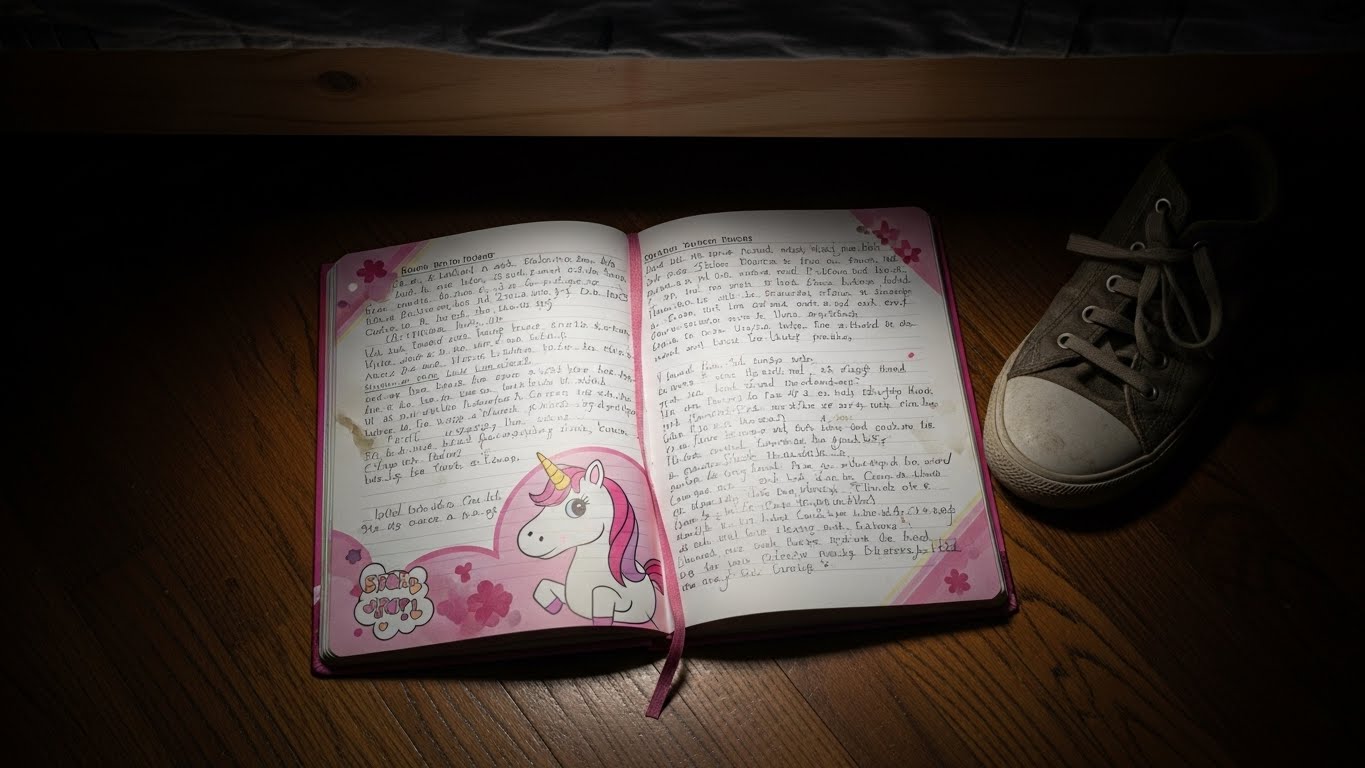
He waited until 2:00 AM, when the house was silent. He crept into Emma’s room, careful not to wake her. He remembered she used to keep a diary—a little pink book with a unicorn on it that Sarah had given her.
He looked on her desk. It wasn’t there.
He looked on her bookshelf. Not there.
He dropped to his knees and looked under her bed.
Shoved deep into the corner, inside the pocket of an old school backpack, he found it.
He sat on the floor, opened the cover, and began to read. And with every page he turned, the air in the room seemed to get colder and colder.
Chapter 3: The Unicorn Diary
The beam of my flashlight cut through the darkness of Emma’s room, illuminating the pages of the small notebook. It had a rainbow unicorn on the cover, the kind of thing you’d expect to be filled with doodles of flowers or lists of favorite colors.
Instead, the entries were written in Emma’s careful second-grade handwriting. Some words were misspelled, but the meaning was devastatingly clear.
October 12th Aunt Diane said I can’t have dinner because I spilled juice. I told Tommy a story about Mommy so he wouldn’t cry from being hungry. My stomach hurts.
October 15th She locked me in the closet for 3 hours because I asked if Daddy was coming home soon. It was dark and I was scared. But I didn’t cry because crying makes her more angry. Tommy has been crying all day. His diaper is so full and smells bad. But Aunt Diane won’t change him. She says he needs to learn not to be such a demanding brat.
I had to stop reading. My vision blurred. A physical wave of nausea rolled over me. I pressed my fist against my mouth to stifle a sob that wanted to rip its way out of my throat.
My daughter. My brave, seven-year-old daughter had been keeping a record of her suffering. She was documenting her own abuse with the heartbreaking diligence of a child who still believed the world was supposed to be fair. That someone would eventually care. That the truth mattered.
I forced myself to keep reading. Page after page of cruelty. Food withheld. Isolation imposed. Casual violence delivered with a smile.
November 2nd I tried to change Tommy myself but I don’t know how to do it right. I got poop on the rug. She hit my hands with the wooden spoon. It turned purple. I told Mrs. Patterson at school I fell down.
November 20th Daddy calls tonight. Aunt Diane practiced with me what to say. I have to smile and tell him everything is wonderful. Or she says she’ll take away Mommy’s necklace. It’s the only thing I have left of Mommy and I can’t lose it. I can’t. So I’ll lie and smile and pretend we’re happy.
The entry from two days ago broke me completely.
Daddy is so busy and important. He doesn’t have time to worry about us. Aunt Diane says he would send us away if we were too much trouble. She says he only keeps us because he has to. That we’re burdens he got stuck with when Mommy died.
I closed the notebook. I sat on the floor in the dark, tears streaming down my face, rocking back and forth.
She thought I didn’t want her. She thought she was a burden. She had been lying to protect me from worry, while enduring a living hell.
I had failed her so completely. I had been so wrapped up in my grief and my empire-building that I had handed my children over to a monster and never looked back.
But I was looking now.
I stood up. The grief in my chest hardened into something cold and sharp. It was a weapon now.
I photographed every page of the diary with my phone, uploading the images to a secure cloud account immediately. Then, carefully, I put the notebook back exactly where I found it. It was evidence, but it was also hers. I wouldn’t take it from her yet.
I left her room silently and went to my home office. I locked the door.
It was 3:00 AM. For the next three hours, I stopped being a grieving father and became the ruthless businessman who had crushed competitors for a living. I needed to know the full scope of the damage.
I logged into the household accounts I had set up for Diane’s use. I expected to find expenses for groceries, utilities, and kids’ clothes.
What I found made my hands curl into fists.
Thousands of dollars charged to high-end restaurants in the city—places you don’t take a toddler. Charges at luxury boutiques: Gucci, Prada, Nordstrom. Spa treatments. Weekend hotel stays.
I dug deeper. I ran a credit check on myself.
There it was. A credit card opened in my name six months ago. The balance was nearly $50,000. The statements showed travel to Cabo and Miami on weekends when she claimed she was home with the children.
My mouth went dry. Who had been watching my children when she was in Cabo?
I realized with a jolt of horror that I had no idea. They could have been left alone. They could have been with strangers. Anything could have happened.
I moved to my email server. I had given Diane administrative access so she could help manage household scheduling. I searched the trash folder and the blocked sender list.
There were dozens of emails from Emma’s school.
Subject: Concern regarding Emma’s lunch money Subject: Emma sleeping in class Subject: Request for meeting regarding visible bruising
Diane had intercepted them all. She had replied to them, posing as me or herself, weaving a web of lies about “grief counseling” and “behavioral issues at home.” She had painted Emma as a troubled, lying child to discredit her before she could ever speak up.
I sat back in my leather chair as the sun began to paint the sky gray.
This wasn’t just abuse. This was a systematic dismantling of my family. She was torturing my children, stealing my fortune, and slandering my daughter.
And she was sleeping down the hall.
I wanted to storm into her room and drag her out by her hair. I wanted to scream until the windows shattered.
But I knew I couldn’t. Not yet.
If I confronted her now, she would deny it. She would gaslight Emma. She might destroy evidence. Or worse, she might have an accomplice I didn’t know about.
I needed an airtight case. I needed her in handcuffs, not just out of my house.
By the time the sun rose, I had a plan.
Chapter 4: The Breakfast Test
I was in the kitchen at 6:30 AM.
I didn’t make the healthy oatmeal Diane claimed they liked. I made pancakes. Bacon. Scrambled eggs with cheese. I cut up fresh strawberries and melons. The smell of frying bacon and brewing coffee filled the house, a scent of normalcy that felt like a lie.
I heard small footsteps on the stairs.
Emma appeared in the doorway, holding Tommy’s hand. They both froze when they saw me.
“Daddy?” Emma whispered. She looked at the food, then at the stairs, terrified. “Aunt Diane isn’t up yet. We… we shouldn’t make noise.”
“It’s okay,” I said, my voice steady. “I’m making breakfast. Come sit down.”
I lifted Tommy into his high chair. He stared at the bacon on the plate, his little nose twitching. He reached for it, then pulled his hand back, looking at Emma.
“Eat, buddy,” I said. “It’s all for you.”
He grabbed a piece of bacon and shoved it into his mouth. Grease coated his chin. He moaned with pleasure, a sound that hurt my heart.
Emma sat down gingerly. I placed a stack of pancakes in front of her.
“Can I really have this?” she asked softly.
“You can have whatever you want, Emma. Always.”
She took a bite. Then another. Then she began to shovel the food in, hunger overriding her fear.
“Good morning!”
The voice came from the doorway.
Diane stood there. She was dressed immaculately in a silk blouse and tailored trousers—clothes I now recognized were bought with my stolen money. Her hair was perfect. Her makeup was flawless.
She stopped when she saw the table. Surprise flickered across her face, followed by a tight, fast calculation.
“My goodness, Michael,” she laughed, the sound tinkling and fake. “You didn’t have to go to all this trouble. I usually just give them cereal. It’s simpler.”
“I wanted to,” I said, flipping a pancake. I didn’t look at her. If I looked at her, I might kill her. “I missed them.”
She walked into the room, pouring herself a cup of coffee. She walked behind Emma’s chair and placed a hand on my daughter’s shoulder.
Emma stopped chewing instantly. She went rigid.
“Emma, darling,” Diane purred. “Remember what we talked about? Eating too fast gives you a tummy ache. We don’t want you getting sick in front of Daddy, do we?”
The threat was subtle, but I heard it loud and clear. Stop eating, or you’ll pay for it later.
Emma slowly put her fork down. She looked at her plate, the joy draining out of her face.
“She’s fine,” I said. I turned around, spatula in hand, and looked Diane dead in the eye. “Let her eat.”
The air in the kitchen turned electric.
Diane’s smile faltered. For a second, the mask slipped, and I saw the predator underneath—the woman who had stood over the playpen with a raised hand. Her eyes narrowed.
“I’m just looking out for her health, Michael. You’ve been away. You don’t know her routines.”
“I’m learning,” I said coldly. “I’ve decided to take the day off. In fact, I’m taking a few weeks off. I’m going to take Emma to school myself this morning.”
Diane stiffened. “Oh, there’s no need for that. I can do it. You must have emails to catch up on.”
“No,” I said. “I’m taking them. Both of them. We’re leaving in ten minutes.”
“But Tommy—”
“Is coming with me.”
Panic flared in her eyes. She knew. She had to suspect that I knew something. If I took them out of the house, out of her control, her narrative would crumble.
“Michael, really,” she said, her voice rising in pitch. “It’s disruptive. Tommy needs his morning nap. Emma has been… emotional lately. She acts out in the car. It’s better if I handle it.”
She moved to pick up Tommy.
“Don’t touch him.”
The command came out louder than I intended.
Emma gasped.
Diane froze, her hand inches from Tommy’s arm. She looked at me, shocking incredulity on her face. “Excuse me?”
“I said, don’t touch him.” I stepped between her and my son. “Go finish your coffee, Diane. I’ll handle my children.”
We stared at each other for five long seconds. A silent war was declared right there over the remains of the pancakes. She saw the darkness in my eyes, and she realized, perhaps for the first time, that the dynamic had shifted. She was no longer the indispensable savior. She was a suspect.
“Fine,” she snapped, turning on her heel. “If you want to deal with their tantrums, be my guest. Don’t come crying to me when you can’t handle it.”
She stormed out.
I waited until I heard her bedroom door slam upstairs.
“Okay,” I whispered to the kids, my hands shaking as I wiped Tommy’s face. “Let’s go. Right now.”
I didn’t bother with backpacks or coats. I grabbed my keys. I picked up Tommy in one arm and grabbed Emma’s hand with the other.
“Are we coming back?” Emma asked, her voice trembling as we walked to the garage.
“Not until it’s safe,” I said.
We got into the car. I locked the doors. As the garage door opened and we reversed out into the gray morning light, I looked up at the house.
Diane was watching us from the second-floor window. She was on her phone, pacing frantically.
I didn’t know who she was calling, but I knew I had to move fast.
As soon as we turned the corner, out of sight of the house, Emma started crying. Not the silent tears from before, but deep, heaving sobs.
I pulled the car over two blocks away. I unbuckled and turned around.
“I’m sorry, Daddy,” she wailed. “I’m so sorry. I tried to be good. I tried so hard.”
“Oh, baby, no.” I reached back and squeezed her hand. “You were good. You were perfect. None of this is your fault. Listen to me—we are not going to school.”
She sniffled, looking up with wide, wet eyes. “We aren’t?”
“No,” I said, starting the engine again. “We’re going to see a doctor. And then we’re going to talk to the police.”
Emma’s face went white. “She said… she said if I told the police, they would put you in jail. She said it would be my fault.”
“She lied,” I said fiercely. “She lied about everything. We are going to stop her, Emma. Today. But I need you to be the bravest girl in the world for just a little bit longer. Can you do that?”
Emma looked at Tommy, who was babbling in his car seat, oblivious to the danger we had just escaped. She took a deep breath, her small chin trembling.
“Yes,” she whispered. “I can do it.”
I drove toward the hospital, checking my rearview mirror every few seconds, half-expecting to see Diane’s car following us. I didn’t know then that Diane wasn’t chasing us.
She was doing something far worse. She was clearing out the bank accounts and calling the one person I didn’t know existed—her partner in crime.
Chapter 5: The Paper Trail of Pain
The emergency room at St. Jude’s smelled of antiseptic and floor wax, a scent that usually made me feel safe—a place of healing. Today, it smelled like judgment.
I held Tommy in my arms while Emma sat on the crinkly paper of the exam table. Her legs dangled, too thin, swinging nervously.
When the triage nurse had asked, “What brings you in?” I hadn’t known how to say it. I just lifted Emma’s shirt and showed her the yellow-green bruise on her ribs. The nurse’s eyes had snapped to mine, cold and suspicious. She thought I did it. I saw her hand hover over the silent alarm button under the desk.
“I’m her father,” I said, my voice cracking. “I just got home from a trip. I found these. I need you to document everything.”
Now, Dr. Aris, a pediatric specialist with kind eyes and a grim set to his mouth, was finishing his examination. He moved with slow, deliberate gentleness, narrating everything he did so Emma wouldn’t be scared.
“Okay, Emma. I’m just going to listen to your heart. Cold stethoscope warning.”
He listened. He looked at her skin. He checked her throat. He weighed her.
Then he turned to Tommy.
The silence in the room while he examined my son was deafening. He made notes on his iPad, his stylus tapping against the glass—tap, tap, tap—like a countdown.
Finally, he lowered the iPad and looked at me.
“Mr. Chen,” he began, choosing his words carefully. “Emma has multiple contusions in various stages of healing. The one on her ribs is about two weeks old. The marks on her arms are consistent with being grabbed forcefully by an adult hand. She is in the 10th percentile for weight, which is a significant drop from her records last year.”
He paused, looking at Tommy.
“Your son is severely dehydrated. The diaper rash is… extensive. It’s essentially a chemical burn from prolonged exposure to ammonia. He also shows signs of muscle atrophy in his legs. It looks like he hasn’t been let out of a confined space—a crib or a playpen—very often.”
I closed my eyes. Hearing a medical professional say it made it real in a way that my own eyes hadn’t. Muscle atrophy. Atrophy. My son’s legs were weak because he had been living in a cage.
“This is abuse, Mr. Chen,” Dr. Aris said softly. “And neglect. By law, I have to report this to Child Protective Services immediately.”
“Good,” I said, opening my eyes. “Do it. I want it on record. I want the police involved.”
“They’re already on their way,” he said. “The nurse called them ten minutes ago.”
While we waited for the officers, I made another stop. I couldn’t sit still. I left the kids in the room with a hospital social worker—a kind woman named Janet who immediately produced coloring books—and stepped into the hallway to make a call. Not to my lawyer. To Emma’s school.
“This is Michael Chen,” I told the receptionist. “I need to speak to Principal Rodriguez. Now.”
“Mr. Chen, she’s in a meeting—”
“Tell her I’m holding the medical report detailing my daughter’s starvation. Tell her I’m coming there next.”
I hung up.
By the time the police arrived at the hospital to take my initial statement, I was vibrating with adrenaline. I gave them the basics—the photos of the diary, the doctor’s findings—but I told them the investigation had to start at the school. I needed the timeline.
I drove to Pinegrove Elementary with the police following me. It was a surreal procession.
Mrs. Patterson, Emma’s teacher, was waiting in the principal’s office. She was a middle-aged woman with kind eyes that looked red-rimmed, like she had been crying.
When I walked in, the air was thick with tension. Principal Rodriguez sat behind her desk, a thick file folder in front of her.
“Mr. Chen,” Rodriguez said, her voice tight. “We were surprised to get your call. We were under the impression you had withdrawn Emma to homeschool her starting next week.”
I stopped dead. “What?”
“We received the email from your account on Tuesday,” she said. “Stating that due to family travel, you were pulling her out.”
“I never sent that,” I said. “Show me the file.”
They opened the folder. It was an encyclopedia of negligence.
There were incident reports dating back six months. October: Emma stole a classmate’s sandwich. Ate it in the bathroom. November: Emma fell asleep during a math test. Could not be roused for ten minutes. December: Emma flinched when the gym teacher blew a whistle. Urinated on herself from fear.
“We tried to tell you,” Mrs. Patterson said, her voice shaking. “I called. I emailed. I sent notes home in her backpack.”
“I never got them,” I said, flipping through the pages. My hands were trembling. “She deleted the emails. She intercepted the calls.”
Mrs. Patterson looked at me, searching my face for the truth. “Mr. Chen… last month, when I called about the bruise on her cheek, a woman answered. She said she was Emma’s aunt. She said… she said you were furious that the school was interfering. She said you hit Emma because she was lying about her grades, and that if we called CPS, you would pull your donation to the new library wing.”
The room spun.
Diane hadn’t just abused my children. She had used my reputation, my money, and my name to build a fortress of silence around them. She had painted me as the abuser to the outside world so that no one would question her.
“I didn’t know,” I whispered. It wasn’t an excuse. It was a confession of failure. “I swear to God, I didn’t know.”
Principal Rodriguez pushed a piece of paper across the desk. “This came yesterday. It’s a request for Emma’s transcripts to be sent to a school in Mexico City.”
My head snapped up. “Mexico?”
“Yes. The email said the family was relocating permanently.”
The pieces slammed together in my mind. The drained bank accounts. The credit card debt. The lies about homeschooling. The transcripts.
She wasn’t just living off me. She was planning to leave. And she was planning to take my children with her.
Chapter 6: The Exit Strategy
I was sitting in an interview room at the 4th Precinct, the fluorescent lights humming overhead like a headache that wouldn’t go away. Across from me sat Detective Sarah Williams. She was sharp, no-nonsense, with eyes that had seen too much darkness to be surprised by anything.
“Let me get this straight,” Williams said, looking at the timeline I had sketched out on a notepad. “She has access to your primary checking, the household account, and she opened a credit card in your name.”
“Yes. And she’s moving money. Fast.”
I had received three notifications on my phone in the last hour. A transfer of $10,000. Another for $15,000. A declined transaction for $50,000 at a jewelry broker online.
“We have a BOLO (Be On the Lookout) out for her car,” Williams said. “But if she’s smart, she’s already ditched it. We need to know where she’s going.”
“The school said Mexico,” I said. “Why Mexico?”
Williams typed something into her terminal. “Does she have connections there?”
“No. We’re from Seattle. She’s never even been to Mexico as far as I know.”
“Let’s look at who she does know.” Williams pulled up a background check on Diane Foster.
I watched the screen, expecting to see a clean record. Diane was a suburban aunt. She baked cookies. She volunteered at the library.
“Hello,” Williams murmured, leaning in. “This is interesting.”
“What?”
“Your sister-in-law has a clean record. But her phone records… we pulled them based on the emergency order you filed.” She pointed to a number that appeared dozens of times a day for the last three months. “She talks to this number constantly. mostly late at night.”
“Who is it?”
“A burner phone registered to a PO Box. But…” Williams tapped a few keys, cross-referencing the location data. “The phone pings from an apartment in Renton. The lease is under the name Marcus Webb.”
“I don’t know a Marcus Webb.”
“You wouldn’t want to,” Williams said grimly. “Marcus Webb is a career grifter. Two counts of fraud, one count of extortion, and a domestic assault charge from 2018. He served three years. He got out eight months ago.”
Eight months ago. exactly when Diane’s behavior had started to change. Exactly when the “expenses” had started to rise.
“They’re together,” I realized. “He’s the boyfriend.”
“He’s more than a boyfriend, Mr. Chen. He’s a partner.” Williams spun the monitor so I could see. “We just got a hit on Webb’s credit card. He bought three one-way tickets to Guadalajara yesterday. Departing tonight at 11:00 PM from SeaTac.”
“Three tickets,” I repeated. My blood ran cold. “Diane. Marcus. And who else?”
“Not who else,” Williams said softly. “The tickets are for two adults and one infant. But the infant ticket… it’s not under a name. It’s a ‘lap child’.”
“They were going to take Tommy,” I said. The realization hit me like a physical blow. “They were going to take my son.”
“Or,” Williams said, her voice dark, “they were going to use him.”
“Use him?”
“Kidnapping for ransom, Mr. Chen. It’s a classic play. They take the baby—easier to transport, easier to hide than a seven-year-old girl who can talk to airport security. They disappear into Mexico. Then they call you. They demand millions for his return. You pay, because you have the money and it’s your son.”
“And Emma?” I asked, my voice barely a whisper. “What about Emma?”
Williams didn’t answer immediately. She looked down at the file, then back at me. “The transcripts were a decoy. Or a Plan B. But if they only bought three tickets… and one is for a lap child…”
She didn’t have to finish the sentence.
They were going to leave Emma behind. Or worse. They were going to dispose of her because she was old enough to be a witness. Old enough to testify.
The diary. The bruises. The starvation. It wasn’t just cruelty. It was a slow process of erasure. They were breaking her spirit, weakening her, making her unreliable, so that when she inevitably disappeared or was left behind, no one would believe her story.
“We need to go to the house,” I said, standing up. “Now.”
“Units are already there,” Williams said. “They just pulled up.”
Her radio crackled on her shoulder.
“Dispatch to Williams. We have entry at the Chen residence. The house is clear. Suspect is gone. But… you’re going to want to see this. The safe is open.”
I had a wall safe in the master bedroom. It contained Sarah’s jewelry, our passports, and about $20,000 in emergency cash.
“She cleaned it out,” I said.
“Affirmative,” the officer on the radio said. “But she left something. There’s a… it looks like a shrine in the living room. Pictures of the wife. And a note.”
“Read it,” Williams commanded into the radio.
There was a pause. The static hissed.
“It says: ‘You never deserved them. I’m taking what’s owed. Don’t follow us, or the baby gets it.'”
I slammed my fist onto the metal table, the pain radiating up my arm. “She doesn’t have him! She doesn’t know I took him!”
“She thinks she has the upper hand,” Williams said, her eyes narrowing. “She thinks you’re at work. She thinks the kids are at home with the housekeeper or alone. She doesn’t know you intercepted them this morning. She’s running on a script that just got rewritten.”
“Wait,” I said. “If she thinks I’m at work… and she thinks the kids are at the house…”
“Then she’s going back to get them,” Williams finished. “She didn’t flee the house, Mr. Chen. She went out to meet Webb. To get the supplies. To get the car ready. She’s coming back to your house to execute the abduction.”
I looked at the clock on the wall. It was 1:00 PM.
“She’s walking into a trap,” I said.
“No,” Williams said, grabbing her keys. “She’s walking into a crime scene. But if she sees the police cars, she’ll run. And if she runs with Marcus Webb, we might never find them.”
She grabbed her radio. “Dispatch, pull all marked units back from the Chen residence immediately. Set up a perimeter two blocks out. Unmarked cars only. I want the house to look empty.”
She turned to me.
“Mr. Chen, I need you to do the hardest thing you’ve ever done.”
“Anything.”
“I need you to go back to that house. I need you to put your car in the garage. And I need you to wait for her. We’ll be inside with you. But we need her to come through that door. We need to catch her in the act of trying to take the children. That’s the only way we get her for conspiracy to kidnap. That’s how we put her away for life.”
“I’ll do it,” I said.
“And the children?”
“They stay here. With the officers. Safe.”
“Good. Let’s go catch a monster.”
Here is Part 4, the final part of the story.
—————-FULL STORY (CONTINUED)—————-
Chapter 7: The Trap
The house was silent. A tomb of gray walls and expensive furniture that I had worked my whole life to buy, but never taken the time to enjoy. Now, crouched in the shadows of the living room, listening to the rain drum against the roof, I hated every inch of it.
It was 1:45 PM.
The police were everywhere, yet nowhere. Detective Williams was positioned in the laundry room off the kitchen. Two SWAT officers were crouched behind the wet bar in the den. Another team was in the garage.
I sat in the armchair facing the front door. My hands were gripping the armrests so hard the leather creaked. I forced myself to breathe. In, out.
They are safe, I told myself. Emma is safe. Tommy is safe.
But the image of that empty crib, the phantom sound of Tommy’s hungry cries, wouldn’t leave my head.
At 2:13 PM, a car engine cut out in the driveway.
My heart slammed against my ribs.
I heard car doors shut. Quietly. Careful not to slam.
Then, footsteps on the porch. Not the click of Diane’s heels—she was wearing sneakers today. Getting ready to run.
The front door lock tumbled. She still had her key.
The door swung open, and a draft of cold, wet air swept into the room.
“Hurry up,” a man’s voice hissed. It was rough, agitated. Marcus Webb. “Grab the kids. I’ll get the safe. We have to be on the I-5 in twenty minutes.”
“Stop rushing me,” Diane snapped back. Her voice was unrecognizable—gone was the sweet, suffering aunt. This was the voice of a general commanding a siege. “The brat is probably hiding. She always hides when she knows I’m angry.”
They stepped into the foyer.
Diane was wearing a dark hoodie and jeans. Marcus was a big man, broad-shouldered, wearing a mechanic’s jacket. He was carrying a large, black duffel bag. I knew what was inside: duct tape, sedatives, zip ties. The tools of a kidnapper.
They walked right past the living room entrance, heading for the stairs.
“You check the nursery,” Diane ordered. “I’ll drag Emma out of the closet. If she screams, you know what to do.”
“I’ll keep her quiet,” Marcus grunted.
That was it. The line that snapped the last thread of my control.
“She’s not in the closet,” I said.
My voice was calm. Eerily calm. It cut through the silence like a gunshot.
Diane and Marcus froze on the bottom step. They turned slowly, peering into the gloom of the living room.
I stood up from the armchair.
“Michael?” Diane breathed. Her face went slack with shock. For a second, her brain tried to reboot, tried to find the lie that would save her. “Michael! Oh my God, you scared us! Marcus is… he’s a security consultant. I brought him here because I was worried about… about intruders.”
She was still trying. Even now, caught red-handed with a go-bag and a criminal, she thought she could manipulate me.
“Stop,” I said. “Just stop.”
“What are you talking about?” She took a step toward me, a nervous smile plastered on her face. “Where are the children? I came to check on them and—”
“I know about the credit cards,” I said, taking a step forward. “I know about the apartment in Renton. I know about the tickets to Guadalajara.”
Diane stopped moving. The smile vanished. Her face went cold and hard, like stone.
“And,” I continued, my voice rising, “I know about the diary.”
At the word diary, Diane flinched. She knew exactly what I was talking about. She had probably spent months terrorizing Emma to keep that book hidden.
“You shouldn’t have come back early, Michael,” she said quietly. The mask was gone completely now. Her eyes were dead. “You really shouldn’t have done that.”
“Marcus,” she said sharply. “Plan B.”
Marcus Webb didn’t hesitate. He dropped the duffel bag and reached into his jacket. He pulled out a snub-nosed revolver.
“Sit down, rich boy,” Marcus growled, pointing the gun at my chest. “Where are the kids?”
“They’re gone,” I said, staring down the barrel of the gun. I wasn’t afraid. I felt a strange, icy clarity. “You’ll never see them again.”
“Tell me where they are!” Diane screamed, her composure shattering. “We need them! We need the leverage!”
“You’re not getting leverage,” I said. “You’re getting life.”
“Shut him up, Marcus!” Diane shrieked.
Marcus cocked the hammer. “Last chance. Where are the—”
CRASH.
The laundry room door flew open.
“POLICE! DROP THE WEAPON!”
Detective Williams burst into the hallway, her service weapon drawn and leveled at Marcus’s head. At the same moment, the wet bar behind them exploded as the SWAT officers vaulted over it.
“FEDERAL AGENTS! GET DOWN! GET ON THE GROUND!”
The noise was deafening.
Marcus spun around, wild-eyed. For a split second, he aimed the gun at Williams.
“Don’t do it!” Williams yelled.
Marcus hesitated. He looked at the three barrels pointed at him. He looked at Diane. Then, slowly, he dropped the gun. It clattered loudly on the hardwood floor.
“Hands! Show me your hands!”
Officers swarmed them. Marcus was slammed face-first into the floor, cuffed before he could take a breath.
Diane didn’t go quietly. As an officer grabbed her arm, she lunged—not at the police, but at me. She was screaming, a feral, high-pitched sound of pure hatred.
“You ruined everything! You selfish bastard! You owed me! You owed me for taking care of your burden!”
She was spitting, clawing the air, her face twisted into a demonic grimace.
“Get her out of here,” I said, turning my back on her.
“I’ll kill you!” she screamed as they dragged her out the front door. “I’ll tell everyone! I’ll tell them you did it! No one will believe that brat over me!”
The door slammed shut, cutting off her voice.
Silence rushed back into the house.
Detective Williams holstered her gun. She walked over to me. I was shaking now, the adrenaline crash hitting me like a freight train.
“You did good, Mr. Chen,” she said, putting a hand on my shoulder. “We got them. Conspiracy to kidnap. Attempted extortion. Assault with a deadly weapon. Plus the abuse charges.”
“Is it over?” I asked, leaning against the wall for support.
“The danger is over,” she said. “Now comes the justice.”
Chapter 8: The Healing
The trial began six months later.
It was a media circus. Wealthy Developer’s Children Saved from Kidnapping Plot by Secret Diary. The headlines were everywhere. I shielded Emma and Tommy from it as best I could. We had moved out of the big house. I couldn’t live there anymore—too many ghosts in the hallways. We bought a smaller place near the water, somewhere with no closets that locked from the outside.
I sold my company. I liquidated my assets. I put the money into trusts for the kids and started a foundation for victims of child abuse. I wasn’t the shark businessman anymore. I was just a dad. A full-time, present, terrifyingly protective dad.
The courtroom was packed every day.
The evidence was overwhelming. The financial records, the burner phone data, the flight tickets. But the linchpin was the diary.
The judge ruled that Emma was competent to testify, but he allowed her to do it via closed-circuit TV from a private room, so she didn’t have to look at Diane.
I sat in the courtroom and watched my daughter on the monitor. She wore a blue dress. She held a stuffed bear I had bought her.
“Emma,” the prosecutor asked gently. “Why did you write in the notebook?”
“Because,” Emma’s small voice filled the silent courtroom. “I wanted to remember. Aunt Diane told me that nobody would believe me. She said I was a liar. I wrote it down so I wouldn’t forget the truth. And so… if I went away… Daddy would know I loved him.”
Half the jury was crying.
Diane sat at the defense table. She didn’t cry. She stared at the screen with cold, dead eyes. She never showed remorse. Not once. Even when the photos of Tommy’s injuries were shown, she looked bored.
The jury deliberated for less than three hours.
Guilty on all counts.
Diane Foster was sentenced to 25 years in prison. Marcus Webb got 30.
When the gavel came down, I didn’t feel triumph. I felt exhaustion. But mostly, I felt the heavy weight on my chest finally, finally lift.
Three Years Later
“Dad! Watch this!”
I looked up from my book. The spring sun was warm on my face.
We were at the park. Emma, now ten years old, was hanging upside down from the monkey bars. Her hair, shiny and healthy, brushed the wood chips.
“I see you, Em! That’s amazing core strength!”
She giggled and flipped down, landing on her feet.
Tommy, now a boisterous four-year-old, ran past me chasing a butterfly. He was fast. Strong. The muscle atrophy was a distant memory, corrected by physical therapy and a lot of running around in the backyard.
“Daddy, juice!” he yelled, looping back to me.
“Say please.”
“Pwease!”
I handed him a juice box. He chugged it, then leaned against my leg. “Love you, Dad.”
“Love you too, buddy.”
He ran off again.
Emma walked over and sat on the bench beside me. She was growing up so fast. She still had nightmares sometimes. She still didn’t like loud voices. But she smiled now. A real smile that reached her eyes.
“You okay?” I asked, wrapping an arm around her.
She leaned her head on my shoulder. “Yeah. I was just thinking.”
“About what?”
“About the unicorn diary.”
I stiffened slightly. We didn’t talk about it often.
“What about it?”
“I’m glad you found it,” she said softly. “But I’m glad we don’t need it anymore.”
I kissed the top of her head. “Me too, sweetheart. Me too.”
We don’t keep secrets in our house anymore. We talk. If something hurts, we say it. If we’re scared, we say it.
I learned the hard way that providing for your family isn’t about the size of the house or the balance in the bank account. It’s about being there. It’s about seeing—truly seeing—the people you love.
I almost lost everything because I was looking at the wrong things. But I got a second chance.
And I’m never, ever going to waste it.
[END OF STORY]