I Found a Girl in the Rain With My Dead Daughter’s Handwriting.
Part 1
Chapter 1: The Ghost in the Rain
The rain in Chicago doesn’t wash things clean. It just makes the grime slicker. It was freezing, that kind of November chill that settles into your bones and reminds you of every old injury you ever got. My knee, the one I blew out in Fallujah, was throbbing like a second heartbeat, counting down the seconds until I could get off my feet.
I just wanted coffee. I just wanted to get out of the downpour and forget that I was sixty-two years old, living alone in a studio apartment that smelled like stale tobacco and regret. I wanted to forget that today was the anniversary.
That’s when I saw her.
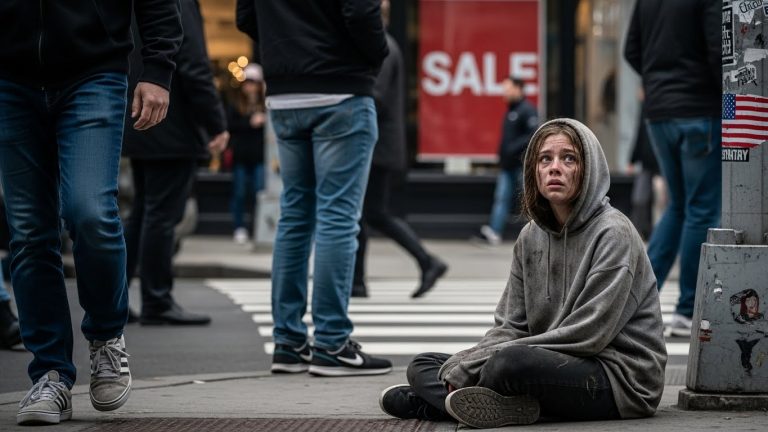
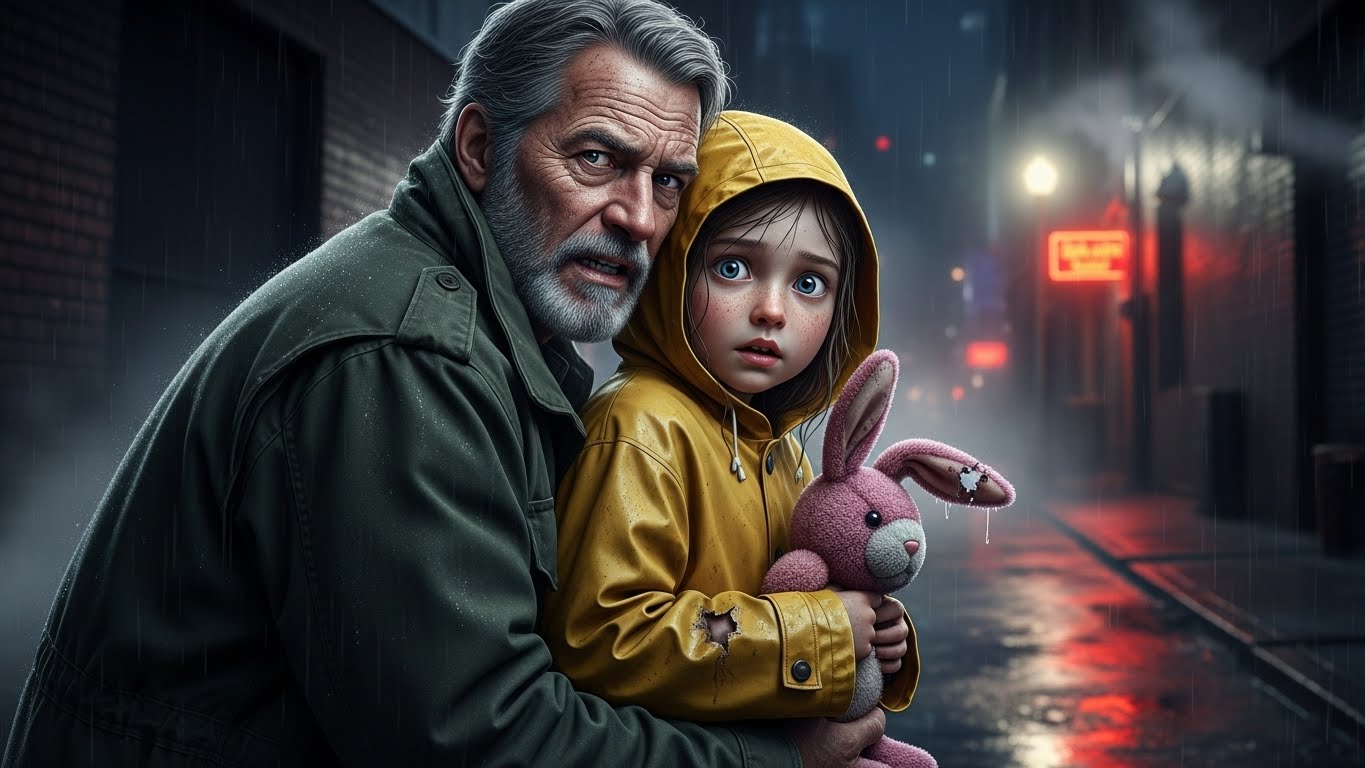
She couldn’t have been more than five. Tiny. Fragile. She was standing on the corner of State and Lake, right where the wind whips off the river and cuts through you like a knife. She was wearing a yellow raincoat that was three sizes too big, the sleeves rolled up in thick, clumsy cuffs. Her legs were bare beneath the coat, disappearing into red rubber boots.
People were streaming past her. Hundreds of them. The evening rush hour crowd—heads down, collars up, eyes glued to their phones or the gray pavement. They parted around her like water around a stone, not even acknowledging her existence.
Or maybe they were actively avoiding her.
I knew why. We all know why. You see a kid alone on a street corner in a city like this, your first instinct isn’t compassion. It’s suspicion. It’s self-preservation.
“Don’t look,” a voice in my head whispered. It was the old Sergeant voice. The one that kept me alive in the desert. “It’s a bait. There’s a handler watching from a van or a doorway. You stop, you get marked. You get robbed. Or worse. Keep moving, Elias.”
I walked past. I actually walked past her.
I made it ten steps. I stared at the neon sign of the 7-Eleven ahead. Just keep walking. Not your problem. You’ve got enough ghosts.
Then, the wind howled, a long, mournful sound that echoed through the concrete canyon. I stopped. I don’t know why. Maybe it was the way her little head was bowed, staring at her rain boots. Maybe it was because she wasn’t begging. She wasn’t holding out a cup. She wasn’t crying out.
She was just… waiting.
I turned around. The rain was coming down harder now, blurring the streetlights into streaks of neon. I limped back toward her, cursing myself with every step.
As I got closer, I saw she was shivering. Not just a little tremble, but violent, full-body shakes. She was holding a piece of paper against her chest, trying to shield it from the water with those tiny hands.
A businessman in a beige trench coat brushed past her, his briefcase clipping her shoulder. She stumbled, but he didn’t even look back.
“Hey!” I barked. My voice was rusty, unused to shouting anymore. The guy kept walking, disappearing into the crowd.
I stepped up to the girl. I tried to make myself look less like a scary, scarred-up veteran and more like a grandfather. I crouched down, my bad knee screaming in protest.
“You’re going to freeze to death out here, kid,” I said.
She didn’t look up. She was staring at a puddle near her boots, watching the ripples.
“Where are your parents?” I asked, scanning the area. I looked for the watcher. The handler. There was a guy smoking in a doorway across the street, face obscured by a hoodie, but he was looking at his phone, not us.
“Kid?”
She slowly lifted her head.
Her eyes were blue. Not just blue, but that piercing, electric shade that looks almost unnatural. My breath hitched.
They were her eyes.
I shook the thought away. Stop it, Elias. Sarah is dead. She’s been dead for twenty years. This is just a random kid.
“Can you talk?” I asked gently.
She didn’t speak. Instead, she peeled the wet piece of paper off her chest and held it out to me.
Chapter 2: The Star in the Circle
It was a page torn from a lined notebook. It was damp, the ink slightly bleeding, but the message was clear. It was written in black marker.
“I Want To Go Home.”
I stared at the words.
And then, the world fell out from under me. The noise of the traffic faded into a dull hum. The cold vanished, replaced by a flush of heat that started in my chest and shot to my fingertips.
It wasn’t the message. It was the handwriting.
The ‘I’ had a peculiar, unnecessary serif on the bottom, like a little foot. The ‘W’ was rounded, not sharp. But it was the ‘o’ in ‘Home’ that made the air leave my lungs.
Inside the circle of the ‘o’, there was a tiny, perfectly drawn star.
My hands started to shake, worse than hers. I reached out and took the note, the paper feeling heavy as lead. I brought it closer to my face, squinting through the rain and the tears that were suddenly welling up.
My daughter, Sarah, used to write like this.
It wasn’t just “similar.” It was identical.
Sarah had a quirk. She was obsessed with the night sky. From the time she learned to write until the day the car accident took her at age seven, she never wrote an ‘o’ without putting a star inside it. We used to joke about it. I used to tell her she was writing the universe into her words.
I looked at the note. I looked at the star.
It was Sarah’s star. Five points. The top point slightly longer than the rest.
“Where did you get this?” I whispered, my voice cracking. “Who wrote this?”
The girl just stared at me with those electric blue eyes. She blinked, raindrops catching on her lashes.
“Hey, buddy, back off.”
I looked up. A police officer was standing over us, his hand resting near his belt. He looked young, rookie young. His face was wet with rain, and he looked annoyed.
“She’s… look at this note,” I stammered, holding it up.
“Yeah, we know,” the cop sighed, rolling his eyes. “We’ve had three calls about a scammer using a kid on this block. I need you to step away, sir. We’re waiting for social services. It’s a classic ploy.”
“No,” I stood up, blocking the girl from his view. “You don’t understand. Look at the handwriting.”
“Sir,” the cop stepped closer, his voice dropping an octave. “It’s a prop. It’s a sad note to get money. Step. Away.”
“It’s my daughter’s handwriting,” I said, and saying it out loud made me sound insane. “My daughter who died in 2004.”
The cop looked at me like I was a drunk or a lunatic. “Okay, that’s enough. Step aside or I’m detaining you for interference.”
He reached for the girl’s arm.
“Don’t touch her!” I snapped.
The girl flinched. And then, for the first time, she opened her mouth.
“Daddy?” she whispered.
She wasn’t looking at me. She was looking past me.
I spun around.
The man who had been smoking in the doorway across the street was gone. But lying on the wet pavement where he had been standing was a stuffed rabbit.
A pink stuffed rabbit with one ear torn off.
I felt like I was going to throw up.
I knew that rabbit. I had bought that rabbit at a hospital gift shop the day Sarah was born. We buried it with her. I watched them lower the casket. I watched the dirt cover it. I visited that grave every Sunday for twenty years.
I looked back at the girl. She was reaching toward the toy across the street.
“Daddy,” she said again, louder this time.
“Sir!” the cop grabbed my shoulder.
I shoved his hand away with a force that surprised us both. “That rabbit,” I pointed, my finger trembling. “That was in my daughter’s grave.”
The cop hesitated, looking from me to the toy in the gutter.
“I’m telling you,” I hissed, “something is wrong here. That note… that toy… none of this is possible.”
“Elias?”
The voice didn’t come from the girl. It didn’t come from the cop.
It came from the phone in the girl’s raincoat pocket.
We both froze. The girl reached into her oversized pocket and pulled out an old, cracked smartphone. It was on speaker.
“Elias Thorne,” the voice on the phone said. It was distorted, digital, but calm. “If you want to know why your dead daughter is writing notes in the rain… you better run. Now.”
The cop reached for his radio. “Dispatch, I have a Situation at State and—”
BANG.
The storefront window next to us exploded. Glass showered down like diamonds.
“Run!” I screamed.
I didn’t think. I didn’t plan. I grabbed the little girl, tucked her under my arm like a football, and I ran. I ran on a bad knee, into the dark, wet throat of the city, with the ghost of my daughter chasing me.
Part 2
Chapter 3: The Concrete Labyrinth
The sound of a gunshot in a city canyon doesn’t sound like it does in the movies. It’s not a clean crack. It’s a thunderclap, a flat, hard slam against the eardrums that bounces off the glass and steel towers, making it impossible to tell where the death is coming from.
I didn’t wait to triangulate the position. That’s something a younger, two-legged Elias might have done. Old Elias, with the bad knee and the ghost of a daughter tucked under his arm, just moved.
I hit the alleyway to the left of the convenience store, my boots skidding on the slime of wet trash and grease. The girl was light, terrifyingly light, like a bird made of hollow bones. She didn’t scream. She didn’t cry. She just wrapped her arms around my neck and buried her face in the rough canvas of my field jacket.
“Dispatch, shots fired! Officer down!” I heard the rookie cop screaming into his radio behind us. He hadn’t been hit, I knew that much from the cadence of his voice—he was panicked, not dying—but he was pinned. That bought us seconds.
Seconds were all I had.
My knee was a ball of fire. Every time my left foot hit the pavement, a jagged bolt of agony shot up my thigh and into my spine. I gritted my teeth so hard I thought I’d crack a molar. Move, old man. Move or she dies again.
The alley spit us out onto Wabash. The overhead train tracks—the ‘L’—formed a rusted iron ceiling above the street, dripping rusty water onto the asphalt. It was darker here, the shadows stretching long and deep between the pillars.
“Put me down,” the girl whispered.
I didn’t stop. I kept limping, half-jogging, hugging the brick wall of a parking garage. “Not yet. We need cover.”
” The phone,” she said, her voice oddly flat. “The phone says left.”
I nearly dropped her. I shifted her weight and reached into her pocket, pulling out the cracked smartphone. The screen was glowing a sickly green. A map application was open, but it wasn’t Google or Apple. It was a wireframe grid of the city, stark and minimalist. A blue dot pulsed where we were. A red line snaked away from us, turning left into a narrow service entrance between two high-rises.
“Who is on this phone?” I growled, staring at the screen.
” The Friend,” she said.
“The Friend?”
“He says run left. The Bad Men are on the roof.”
I looked up. The skyline was a jagged set of teeth against the rainy sky. I couldn’t see a shooter, but I felt eyes on me. That old itch at the base of my neck, the one that used to wake me up in the desert before the mortars started falling.
I turned left.
We dove into the service entrance. It was a loading dock for one of the luxury hotels. Stacks of wooden pallets, dumpsters overflowing with wet cardboard, the smell of rotting vegetables and expensive perfume mingling in the damp air.
I set her down behind a stack of blue plastic crates. My chest was heaving, my lungs burning with the cold air. I wiped the rain from my eyes and looked at her. Really looked at her.
In the dim light of the security bulb above the door, the resemblance was shattering. It wasn’t just the eyes. It was the chin. The way her hairline formed a slight widow’s peak. It was Sarah. But Sarah was buried six feet under a granite marker in Rosehill Cemetery. Sarah had died of massive internal trauma after a drunk driver T-boned our sedan. I had held her hand while the monitor flatlined. I knew death. I knew finality.
“Who are you?” I rasped, leaning over her, hands on my knees, gasping for air.
She looked up at me, unblinking. She reached out a tiny hand and touched the scar on my cheek—shrapnel from an IED in ’98.
“I want to go home, Daddy,” she said.
The word was a dagger. “I’m not your daddy. My daughter is dead. Who told you to say that?”
The phone in my hand buzzed. I looked down.
TEXT MESSAGE RECEIVED: SENDER: UNKNOWN MESSAGE: DNA doesn’t lie, Elias. Neither does the grave. But graves can be empty. Keep moving. Access tunnel 4B is behind the grey door. Code 7734.
I stared at the screen. Graves can be empty.
Rage, hot and blinding, surged through me. Someone was playing a game. A sick, twisted game using the face of my dead child. If I found them, I wouldn’t just hurt them. I would dismantle them.
But right now, survival was the priority.
I looked at the grey metal door at the back of the loading dock. It was marked “Authorized Personnel Only – High Voltage.”
“Come on,” I said, grabbing her hand. Her hand was warm. Human. Real.
I punched 7734 into the keypad. It beeped, a cheerful sound that felt out of place in the grim night, and the lock disengaged with a heavy clunk.
We slipped inside.
The heat hit us first—dry, industrial heat coming from the massive boilers humming in the darkness. We were in the guts of the city now. The service tunnels that connected the hotels, the subway, and the deep infrastructure of Chicago.
We walked in silence for what felt like a mile. My knee settled into a dull, rhythmic throb. The tunnel was lit by caged bulbs that flickered, casting jumping shadows on the concrete walls.
“Do you remember me?” I asked, my voice echoing in the narrow space. I needed to catch her in a lie. I needed to prove this was a trick.
She was walking beside me, her little boots squeaking on the concrete. She didn’t look up. “I remember the stars,” she said softly. “I remember the telescope in the backyard. The one with the dent on the side.”
I stopped walking.
The tunnel went silent, save for the hum of the boilers.
“The dent,” I whispered.
“You dropped it,” she said matter-of-factly. “When you were trying to show me Mars. You said a bad word. Mommy laughed.”
I felt the blood drain from my face.
I had dropped that telescope. It was a Celestron. I dented the optical tube. I swore—I said ‘dammit’—and my wife, Martha, had laughed and told me I was teaching the baby bad habits.
It happened in the backyard. At night. Just the three of us.
“That’s impossible,” I breathed. “No one knows that. Martha is gone. Sarah is gone. I never told anyone that story.”
“I missed you,” the girl said. She tugged on my hand. “The Friend said you were lost. He said I had to come back to find you.”
“Come back from where?”
She looked at me, and for a second, her eyes seemed older than five. Ancient. Infinite.
“From the sleeping place,” she said.
The phone buzzed again.
TEXT MESSAGE RECEIVED: SENDER: UNKNOWN MESSAGE: They are in the tunnels. Tracker on the girl’s coat. DITCH THE COAT. NOW.
I looked at the yellow raincoat. The oversized, clumsy thing she was wearing. I ripped the buttons open.
“Take it off,” I ordered.
She slipped her arms out. I grabbed the coat and felt the lining. There was a hard lump sewn into the collar. A transponder.
I heard boots on the stairs behind us. Heavy boots. Tactical movement. Not police. These were guys who knew how to move quietly, but the acoustics of the tunnel gave them away.
“Run,” I said.
I threw the coat down a side corridor toward a steam vent, hoping to confuse the signal. Then I scooped the girl up again. She was wearing a simple white dress underneath, stained with dirt.
We ran deeper into the dark, toward the rumble of the subway trains above us.
Chapter 4: The Impossible Sample
We emerged into the Randolph/Wabash station through a maintenance door that spilled us right onto the platform. The sudden transition from the silent, suffocating tunnels to the chaotic noise of the ‘L’ station was jarring.
Commuters were everywhere. Tired faces, wet umbrellas, the smell of ozone and wet wool. The loudspeaker crackled with an unintelligible announcement.
No one looked at us. A sixty-year-old man in a dirty field jacket and a little girl in a dirty dress. In Chicago, we were just part of the background scenery of urban decay.
A Brown Line train screeched into the station, sparks flying from the third rail. The doors hissed open.
“In,” I nudged her.
We took two seats in the back corner of the last car. I pulled her onto my lap, shielding her from the rest of the train with my body. I checked the reflection in the window. No tactical teams. No cops yet. Just tired people wanting to go home.
Home. The note.
I pulled the crumpled note from my pocket. “I Want To Go Home.”
“Where is home?” I asked her, keeping my voice low. The train lurched forward, rocking us.
She rested her head on my chest. “The white room,” she said. “With the bright lights. And the needles.”
My stomach turned over. “Needles?”
“They hurt,” she said, closing her eyes. “They take the blood. They make me write the words. Over and over. They check my eyes.”
“Who?”
” The Doctors. And the man with the scar.”
“What scar?”
“Like yours,” she traced a line on her own jaw. “But he’s mean. He says I’m the best one yet. He says I’m… what’s the word? Viable.”
Viable.
The word chilled me more than the rain. You don’t use that word for a child. You use that word for a tissue sample. For an experiment.
I looked at the phone again. I needed answers. I needed to know who “The Friend” was. I tried to unlock it, but the screen was locked now. A keypad appeared.
“What’s the code?” I asked her.
“I don’t know,” she murmured, drifting off. The adrenaline was fading, and she was crashing. “The Friend knows.”
I looked at the keypad. Four digits.
The text message earlier had given me the door code: 7734. But that was for the door.
I thought about the date. Sarah’s birthday. 0512. I typed it in. Incorrect.
I thought about the day she died. 1104. I typed it in. Incorrect.
I looked at the girl sleeping against my chest. Her breathing was shallow. She looked so much like Sarah it was physically painful to look at her.
“Think, Elias,” I muttered. “If this is a game about me, the code is something only I would know.”
I thought about the star in the ‘o’. The telescope.
I typed in the catalogue number of the star we were looking at that night in the backyard. It was the North Star. Polaris.
But that’s a name.
I thought harder. What was the last thing I said to her before the crash? We were driving. She was in the back seat. She asked me how far the moon was.
I told her. 238,000 miles.
I tried 2380.
The phone clicked. Unlocked.
My heart hammered against my ribs. Whoever set this up knew everything. They knew the intimate, trivial details of my life that I hadn’t even written in my journals.
I opened the photo gallery.
It was empty. Except for one video file.
I pressed play.
The video was shaky. It was filmed inside a laboratory. Sterile white walls. Glass partitions. In the center of the room was a tank. A large, cylindrical tank filled with amber fluid.
Inside the tank was a child.
I brought the phone closer, my hands trembling so violently the image blurred.
It was a girl. She was floating, hooked up to tubes.
But the camera panned.
There was another tank next to it. And another. And another.
There were six tanks.
And inside every single one of them was Sarah.
They were at different stages. One looked like an infant. One looked like a toddler. One looked exactly like the girl sleeping in my arms.
A voice spoke on the video. It was a narrator, recording notes.
“Subject 114, Batch 7. Memory implantation successful at 85%. Physical reconstruction matches target ‘Sarah Thorne’ at 99.8%. The DNA synthesized from the exhumed remains has stabilized. We are ready for the field test.”
The video ended.
The train rattled over a switch, shaking the car.
I stared at the black screen of the phone.
Exhumed remains.
They dug her up. They dug up my little girl. And they used her… to make this.
I looked down at the child in my lap. She wasn’t a ghost. She wasn’t a trick.
She was a clone.
And if “Batch 7” meant what I thought it meant, she wasn’t the only one.
The train slowed down. We were approaching the Quincy stop. I needed to get off. I needed to find a weapon. I needed to find a safe place.
But as the doors opened, I saw them.
Standing on the platform, waiting, were two men in dark suits. They weren’t looking at their phones. They were scanning the windows of the train.
One of them looked right at me. He tapped his earpiece.
They knew. The phone. The GPS. Even without the tracker in the coat, the phone itself was a beacon.
“Wake up,” I whispered, shaking the girl. “Wake up, Sarah. We have to run again.”
She groaned, rubbing her eyes. “Are we home?”
“No,” I said, standing up and grabbing her hand tight. “But we’re going to find the people who took you. and I’m going to kill every single one of them.”
I didn’t step out the doors. As the men moved toward the open doors of our car, I turned and kicked the emergency door at the end of the train car, the one that leads to the connector between cars.
“Jump,” I yelled, over the roar of the tracks.
We leaped across the gap to the next car just as the train started moving again. The men on the platform missed us by seconds.
We were trapped on a moving train, with a hunting party waiting at the next stop, and a phone that was tracking our every move.
I looked at the phone one last time. I should throw it away. I should smash it.
But then a new message popped up.
TEXT MESSAGE RECEIVED: SENDER: MARTHA MESSAGE: Elias? Is that you? They told me you were dead.
I almost dropped the phone. Martha. My wife. My wife who died of cancer four years ago.
I stared at the message. The world was spinning.
“It’s a lie,” I whispered. “It’s all a lie.”
But the girl looked up at me, her eyes wide.
“Mommy?” she asked. “Is Mommy on the phone?”
The train plunged into a tunnel, turning the world black.
Chapter 5: The Voice from the Void
The train car was a rolling coffin, hurtling through the dark artery of the Chicago underground. The lights flickered overhead, buzzing like angry wasps.
I stared at the screen. The name “MARTHA” glowed white against the black background.
It wasn’t possible. I held Martha’s hand when she took her last breath. I organized the hospice care. I picked out the urn. I have her ashes sitting on my mantle next to my dog tags.
My thumbs hovered over the glass screen. My heart was hammering against my ribs so hard I thought it might crack them.
ME: Who is this? Martha is dead.
Three dots appeared instantly. The typing bubble. It pulsed, mocking me.
MARTHA: They told me you died in the ambush in Fallujah. They told me there was nothing left to bury. I’ve been in the facility for 19 years, Elias.
I dropped the phone. It clattered onto the dirty linoleum floor of the train car.
Nineteen years. Sarah died twenty years ago. Martha “died” four years ago. The math didn’t work. The reality didn’t work.
But then I looked at the girl.
She was wide awake now, staring at the phone on the floor. She reached down and picked it up.
“It’s Mommy,” she said. Her voice was certain. Absolute. “She sings the song. The one about the blackbird.”
Blackbird.
Martha used to sing “Blackbird” by the Beatles to Sarah every night. It was their thing.
“Where is she?” I grabbed the phone back, my grip too tight.
“She’s in the Quiet Room,” the girl whispered. “She can’t leave. She has the collar on.”
The train brakes squealed. We were slowing down. The conductor’s voice crackled over the intercom. “We are being held at the station due to police activity ahead. Please remain inside the train.”
Police activity. That meant the hunters were setting up a net. If we stayed on this train until the next platform, we were done.
“We have to go,” I said.
“The doors are closed,” the girl said, looking at the rubber seals.
I looked around the car. We were alone in this section. I moved to the emergency release lever near the ceiling. It was covered by a plastic shield.
I smashed the plastic with the butt of my elbow. A sharp pain shot up my arm, but the adrenaline dulled it. I yanked the red handle down.
A hiss of pneumatic pressure released. The doors popped open about two inches. The wind from the tunnel screamed in.
“Can you fit?” I asked her.
She nodded.
“Squeeze through. Drop down to the walkway. Stay against the wall. Do not touch the third rail. If you touch the third rail, you die. Do you understand?”
She nodded again, her eyes huge.
I wedged my fingers into the gap and pulled. My biceps burned. My bad knee trembled under the strain. I managed to widen the gap to about eight inches.
“Go!”
She slipped through like a wraith. I saw her yellow boots hit the narrow concrete catwalk outside the train.
Now it was my turn. I’m six-foot-two. Broad shouldered. This wasn’t going to be graceful.
I shoved my head and one arm through. I exhaled all the air in my lungs, compressing my ribcage, and pushed. The metal doors scraped the skin off my back. I stuck.
“Daddy!” the girl hissed from the darkness.
“I’m coming,” I grunted.
I heard footsteps inside the train car behind me. The connecting door opened.
“He’s exiting the vehicle!” a voice shouted.
I gave one final, desperate heave. My jacket tore, my skin tore, but I popped through. I tumbled onto the catwalk, landing hard on my shoulder.
“Run!” I grabbed the girl’s hand.
We sprinted along the narrow ledge of the tunnel. To our right, the train. To our left, the damp, soot-covered wall. Below us, the deadly third rail humming with 600 volts of electricity.
Behind us, a flashlight beam cut through the dark.
“Stop! Federal Agents!”
They weren’t agents. Agents don’t shoot at kids in crowded cities.
We ran until the catwalk ended at a service ladder.
“Up,” I ordered. “Climb.”
She scrambled up the rusty rungs. I followed, listening to the boots pounding on the metal behind us. A bullet pinged off the ladder right next to my ear, sending a spray of rust into my eyes.
I didn’t look down. I pushed the hatch at the top open and we spilled out into an alleyway in the Loop.
The rain was still falling. It felt like a baptism.
Chapter 6: The Dead Zone
We needed to get off the grid. The phone was a lifeline, but it was also a shackle. They were tracking it.
I looked at the device in my hand. The battery was at 12%.
“We need a Faraday cage,” I muttered. “And a gun. And a doctor.”
I knew a place.
I flagged down a cab on Wells Street. The driver, a Somali man with kind eyes, looked at us—a bleeding, limping veteran and a soaking wet child.
“I have fifty bucks cash,” I said, leaning in the window. “Take us to Pilsen. 18th and Blue Island. No meter.”
He hesitated, then unlocked the door. “Get in. Quickly.”
We slumped into the backseat. The girl immediately curled into a ball and passed out. Her stamina was gone.
I kept the phone wrapped in a piece of aluminum foil I found in a trash can near the alley exit. It wasn’t perfect, but it might dampen the signal.
We rode in silence. The city lights blurred past. I checked the girl’s pulse. It was fast. Too fast. Her skin was burning up.
“Is she sick?” the driver asked, eyeing us in the rearview mirror.
“She’s… it’s complicated,” I said.
We got out at a dilapidated auto body shop in Pilsen. The sign said “Sully’s Customs,” but half the letters were burned out.
I banged on the metal shutter. “Sully! Open up!”
Nothing.
I banged again, using the secret rhythm we used in the platoon. Rat-a-tat-tat. Pause. Tat-tat.
A small viewing port slid open. A pair of suspicious brown eyes peered out.
“Elias?” The voice was gravel and cigarettes. “You look like hell.”
“I’ve been better. Open the door, Sully. I’ve got a situation.”
The shutter rolled up. Sully was short, wide as a vending machine, and missing three fingers on his left hand. He ushered us in and slammed the shutter down, locking it with three heavy deadbolts.
“Who’s the kid?” Sully asked, wiping grease on a rag.
I laid her down on a workbench covered in blueprints. “Look at her, Sully.”
He leaned in. He squinted. Then he recoiled as if he’d been slapped.
“Jesus, Mary, and Joseph,” he whispered. “That’s Sarah.”
“It’s not Sarah,” I said, pacing the garage. “It’s a copy. A clone. Someone dug her up, Sully. Someone took her DNA and made… this.”
Sully looked at me like I’d finally cracked. “Clones? Elias, this is the real world. We don’t have tech like that.”
“Look at the phone,” I unwrapped the foil. “Look at the video.”
I played the video of the tanks. Sully watched it three times. He went pale.
“This is Viable Tech,” he said softly. “I’ve heard rumors. Dark web chatter. They’re a contractor for the DOD. Supposed to be working on organ regeneration for wounded soldiers.”
“They’re not growing organs,” I spat. “They’re growing people.”
The girl groaned on the table. She arched her back, a sound of pure agony escaping her lips.
“She’s burning up,” Sully said, touching her forehead. “She needs meds.”
“She needs answers,” I said. “Sully, can you trace the signal on this phone? Can you find out where the text from Martha came from?”
“Martha?” Sully froze. “Your Martha?”
“She texted me. Said she’s been a prisoner for nineteen years.”
Sully walked over to his computer bank—a mess of wires and monitors that looked like it belonged on a spaceship. He plugged the phone in.
“I can try to triangulate the origin of the message,” he said, his fingers flying across the keyboard. “But Elias… if Martha is alive… that means your whole life for the last two decades has been a lie.”
“I know,” I said. I pulled my 1911 pistol from my waistband—the one I kept in the small of my back—and checked the chamber. “Just find the signal.”
The girl started to convulse. Foam gathered at the corner of her mouth.
“Daddy!” she screamed. “The stars are falling! The stars are burning!”
“Do something!” I yelled at Sully.
“I’m a mechanic, not a pediatrician!” Sully yelled back. He grabbed a bottle of water and a cool rag.
Suddenly, the computer screen turned red.
ALERT: TRACE COMPLETE.
“I got it,” Sully said. “The signal isn’t coming from a cell tower. It’s coming from a secure hardline.”
“Where?”
Sully turned to me, his face grim. “It’s coming from under the city. Deep under. There’s a decommissioned fallout shelter beneath the old Post Office building. The one they turned into a tech hub.”
“The Old Main Post Office,” I nodded. It made sense. Massive. Fortress-like. Sitting right over the major rail lines and the river.
“Wait,” Sully said. “There’s something else.”
“What?”
“The phone… it’s transmitting data out right now. It bypassed my firewall.”
“What data?”
“Biometrics,” Sully said, pointing at the screen. “It’s reading her vitals. And… it’s reading yours.”
I looked at the girl. She had stopped seizing. She was sitting up, perfectly still.
Her eyes weren’t blue anymore.
They were entirely black. No whites. Just deep, void-like pools.
She opened her mouth, but the voice that came out wasn’t hers. It was a synthesized, mechanical voice.
“Subject 114 synced. Guardian identified as Elias Thorne. Welcome back to the program, Sergeant. We have been waiting for your activation code.”
My blood turned to ice.
“Activation code?” I whispered.
The girl turned her head mechanically toward me. “You entered the code 2380. The distance to the moon. You initiated the recall protocol.”
“Sully,” I backed away. “Get the gun.”
“Elias,” Sully said, his voice trembling. “Look at the door.”
I turned.
The heavy steel shutter of the garage wasn’t just closed. It was glowing orange.
Someone was cutting through it with a thermal lance.
“Extraction team arriving in T-minus ten seconds,” the girl said with the black eyes. “Please assume the submission posture.”
I looked at Sully. I looked at the girl who wore my dead daughter’s face.
“I’m not submitting,” I growled.
I grabbed a canister of gasoline from the shelf and hurled it at the glowing door.
“Sully, the back exit! Now!”
I raised my pistol and aimed at the canister.
“Sorry about your shop, brother,” I said.
And I pulled the trigger.
Chapter 7: The River of Ghosts
The explosion wasn’t just a sound; it was a physical blow. The gasoline canister detonated with a concussive force that rattled my teeth and sucked the oxygen right out of the garage.
The fireball engulfed the front entrance, turning the tactical team’s thermal lance into a detonator. I heard screams—human, terrified screams—cut short by the roar of the flames.
“Move!” Sully grabbed my collar, hauling me toward the back of the shop.
I had the girl. She was dead weight in my arms, her eyes rolled back in her head, the terrifying black voids gone, replaced by the whites of unconsciousness.
We kicked open the rear door and spilled out into the alley just as the roof of the garage collapsed inward. A plume of black smoke punched up into the rainy night sky, marking our position for every cop and fed in Chicago.
“The river,” Sully wheezed, limping heavily. He’d taken a piece of debris to the leg. “We have to hit the river. My boat is docked at Ping Tom Park.”
We ran. I carried the girl, ignoring the agony in my knee, ignoring the burning in my lungs. We navigated the maze of Chinatown alleys, the red lanterns overhead swaying violently in the wind.
When we reached the dock, the rain was coming down in sheets. Sully’s “boat” was a rusted pontoon with a patched-up outboard motor. It wasn’t pretty, but it started on the first pull.
“Where are we going?” Sully shouted over the engine and the storm.
“The Old Main Post Office,” I stared north, toward the hulking black mass that straddled the Eisenhower Expressway. “That’s where the signal is. That’s where they have Martha.”
Sully steered us into the dark, churning water of the Chicago River. We ran without lights, a shadow moving through the shadows. The city loomed above us, a canyon of glass and steel, indifferent to the three fugitives floating in its gut.
The girl stirred in my arms.
“Daddy?” Her voice was tiny. Fragile. The robotic tone was gone.
“I’ve got you,” I whispered, brushing wet hair from her forehead. “I’ve got you, Sarah.”
“I saw… I saw numbers,” she murmured. “I saw a map. In my head.”
“What map?”
“The way inside,” she said. She pointed a trembling finger toward the massive building looming ahead. “There is a water intake pipe. Beneath the north piling. It leads to the cooling systems.”
I looked at her. “How do you know that?”
“The Friend showed me,” she said. “When I was sleeping.”
We killed the engine a hundred yards out and let the current drift us toward the massive concrete pillars that held up the Post Office. The water here was foul, smelling of oil and decay.
We found the grate she described. It was rusted through.
“Sully,” I said, handing him the girl. “You stay here. Keep the engine warm.”
“Like hell,” Sully racked the slide of a shotgun he’d pulled from under the boat seat. “You think I’m letting you go into a top-secret cloning facility alone? I served with you, Elias. We finish the mission.”
We climbed into the intake pipe. It was tight, claustrophobic, and slick with algae. We crawled for what felt like miles, the sound of rushing water echoing around us.
Finally, we reached a service hatch. I pushed it open.
We weren’t in a basement. We were in a cathedral of technology.
The room was vast, stretching up four stories. It was filled with servers. Rows and rows of blinking blue lights, humming with a sound that vibrated in my chest. And in the center of the room, suspended from the ceiling by thick cables, was a glass sphere.
Inside the sphere was a chair. And in the chair was a woman.
I stopped breathing.
It was Martha.
She looked exactly as she did the day she died. Her hair was the same shade of auburn. Her skin was pale. She was wearing a white hospital gown. Wires were attached to her temples, her chest, her arms.
“Martha!” I screamed.
My voice echoed through the server farm.
The woman in the chair didn’t move. She didn’t open her eyes.
“Welcome, Sergeant Thorne.”
The voice boomed from the speakers surrounding us. A spotlight snapped on, blinding me.
Standing on a catwalk above us was a man in a pristine white suit. He had a scar running down his cheek, just like the girl had said.
I knew him.
“Colonel Vance,” I growled, raising my pistol. “I thought you were in Leavenworth.”
“Parole comes early when you offer the Pentagon the ultimate soldier,” Vance smiled. He leaned on the railing. “Do you like the facility? It’s amazing what you can build with black budget funding and a few dead bodies.”
“Let her go,” I aimed at his head.
“I can’t,” Vance shrugged. “She’s not a prisoner, Elias. She’s the operating system. Look at the monitors.”
I looked at a massive screen behind him. It showed thousands of lines of code scrolling. And in the center, a waveform. A brainwave.
“We tried artificial intelligence,” Vance said, walking down the stairs. “But it lacked intuition. It lacked the maternal instinct required to nurture the subjects. We needed a human processor. Someone who loved the donor so much, she could stabilize the clones’ volatile DNA.”
He pointed to the girl standing next to me.
“Martha isn’t alive, Elias. We harvested her temporal lobe and her limbic system. She is a biological CPU. Her only function is to keep the subjects… viable. To keep them from going insane. She sings to them in the digital dark.”
I felt bile rise in my throat. They had turned my wife into a motherboard. They had turned her love into code.
“And Sarah?” I gestured to the girl.
“Subject 114,” Vance corrected. “We dug up the daughter to get the genetic template. But we needed the father’s aggression. We spliced your DNA into hers, Elias. That’s why she’s so resilient. She has your killer instinct and her mother’s empathy. The perfect spy. The perfect soldier. A child no one suspects.”
The girl looked up at me. “Daddy? Am I a monster?”
“No,” I dropped to my knees and hugged her. “No. You are a miracle.”
“Touching,” Vance sneered. “But the test is over. Subject 114 has been contaminated by emotional attachment. She is no longer fit for deployment.”
He pulled a remote from his pocket.
“Reset protocol.”
The girl screamed. She grabbed her head, falling to the floor. The lights in the server room turned red.
On the screen, Martha’s brainwave spiked. It went chaotic.
“Kill it!” Sully yelled. “Shoot the sphere!”
“If you shoot the sphere,” Vance laughed, “you kill your wife. Again. Can you do that, Elias? Can you kill Martha to save a copy of a dead girl?”
Chapter 8: The Star in the Circle
The room was spinning. The red emergency lights pulsed like a dying heart. The girl—my Sarah, not a copy, my Sarah—was writhing on the floor, blood trickling from her nose.
Vance stood there, his finger hovering over the remote, a god in a white suit.
I looked up at the glass sphere. I saw Martha. I saw the wires digging into her skin. I saw the peaceful, slack expression on her face.
She wasn’t alive. This wasn’t life. This was hell.
I remembered the text message. DNA doesn’t lie. Graves can be empty.
But love isn’t DNA. Love isn’t a grave. Love is the promise you keep.
I looked at the girl. She was fighting. She was fighting the programming. She reached out and grabbed my hand.
“Daddy,” she gritted out, her teeth clenched. “The star. The star in the circle.”
I looked at the phone in her other hand. She had opened the app again.
“What?” I asked.
“Override,” she gasped. “Mommy told me. The code. It’s the star.”
I understood.
Vance was monologuing about the future of warfare. He didn’t see the girl hand me the phone.
I didn’t need to shoot the sphere. I didn’t need to shoot Vance.
I needed to talk to Martha.
I hit the microphone button on the phone, which was still synced to the system.
“Martha,” I said. My voice broke. “Martha, it’s me. It’s Elias.”
The chaotic waveform on the screen paused.
“I know you’re in there,” I cried, tears streaming down my face. “I know you can hear me. They are hurting our baby. They are hurting Sarah.”
Vance stopped laughing. “Disconnect the audio!” he screamed at his technicians.
“Martha!” I shouted. “Do you remember the telescope? Do you remember the dent? Do you remember the night we showed her the North Star?”
The waveform shifted. It began to pulse in a rhythm.
Thump-thump. Thump-thump.
It was a heartbeat.
“Sing to her, Martha,” I whispered. “Sing the song.”
Suddenly, the speakers in the room crackled. The synthesized, mechanical noise vanished.
And then, a voice filled the cathedral. A voice I hadn’t heard in four years. Soft. Warm. Imperfect.
“Blackbird singing in the dead of night…”
Vance’s eyes went wide. “Impossible. The neural pathways are severed!”
“Take these broken wings and learn to fly…”
The glass sphere began to vibrate. The blue lights on the servers turned a blinding, brilliant white.
The girl on the floor stopped screaming. She stood up. Her eyes were glowing, not with the black void, but with the blue electric light of the screens.
“System override confirmed,” the girl said. But it was Martha’s voice coming out of her mouth.
“No!” Vance pulled a gun.
Sully was faster. The shotgun boomed.
Vance flew backward, crashing into a rack of servers. Sparks showered down like fireworks.
“Elias,” the girl said, looking at me. “I can’t hold it. The surge is too strong. I have to purge the system.”
“If you purge the system…” I looked up at the sphere.
“I know,” the girl/Martha said. “It’s okay. I’m tired, Elias. I’ve been tired for a long time. It’s time to go home.”
“I can’t lose you again,” I sobbed.
“You aren’t losing me,” she smiled, a sad, sweet smile. “You have her. Take care of her. She has my eyes. And your heart.”
“Run!” Sully grabbed my arm. “The cooling tanks are rupturing!”
“I love you,” I whispered to the woman in the glass sphere.
“I love you,” the girl said.
And then, the sphere exploded.
A shockwave of glass and water blasted outward. The servers sparked and died. The lights went out.
The entire facility groaned as the support structures gave way.
We ran. We ran through the dark, through the water, carrying the girl who was now unconscious again. We scrambled back through the intake pipe, the water rising behind us, chasing us like a flood.
We burst out into the river just as the sub-basement of the Post Office imploded, sending a geyser of steam and debris into the air.
We hauled ourselves onto the boat. Sully gunned the engine.
We sped away, watching the massive building shudder against the skyline.
One Month Later.
The rain in Chicago never stops, but today, the sun is trying to break through.
I’m sitting on a bench in Millennium Park. My knee still hurts, but I don’t mind it as much anymore.
“Daddy, look!”
I look up. Sarah is running toward me. She’s wearing a new coat. A red one. It fits her perfectly.
She’s holding a pretzel.
“I got the salty one,” she grins.
She doesn’t remember the facility. She doesn’t remember the white room or the needles. The doctors said it was a trauma block, or maybe Martha wiped it clean before she let go.
We have new names now. New papers. Sully knows a guy in Wisconsin. We’re leaving tomorrow.
But for today, we are just a father and a daughter in the park.
She sits next to me and breaks the pretzel in half. She hands me the bigger piece.
“Thanks, kid,” I say.
She looks at me with those electric blue eyes. “Daddy?”
“Yeah?”
“Can we get a telescope?” she asks. “I want to see the star. The one in the circle.”
I swallow the lump in my throat. I look up at the sky, where the clouds are parting.
“Yeah,” I say, wrapping my arm around her. “Yeah, Sarah. We can get a telescope. We’re going to see them all.”
She leans her head on my shoulder.
“I missed you,” she whispers.
“I missed you too,” I say. And for the first time in twenty years, I believe it.
I am Elias Thorne. I am a soldier. I am a father.
And I am finally home.