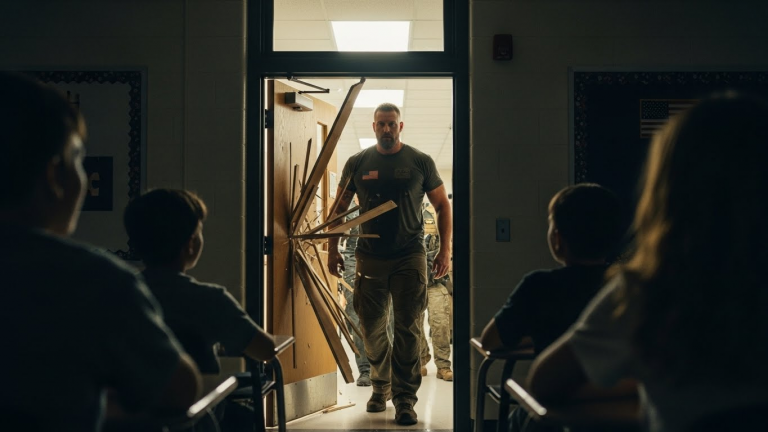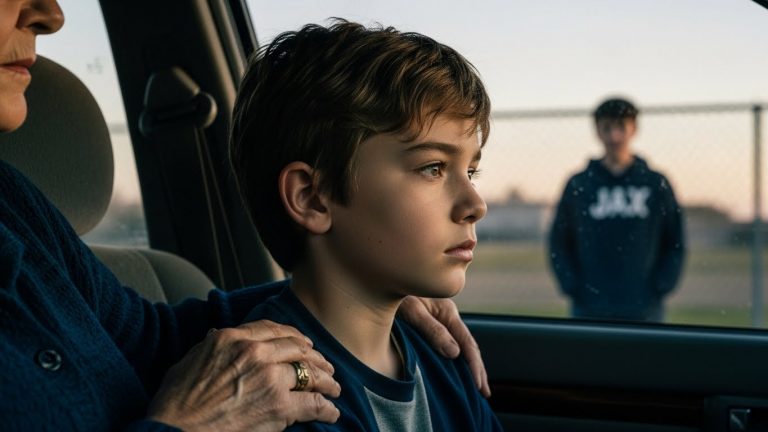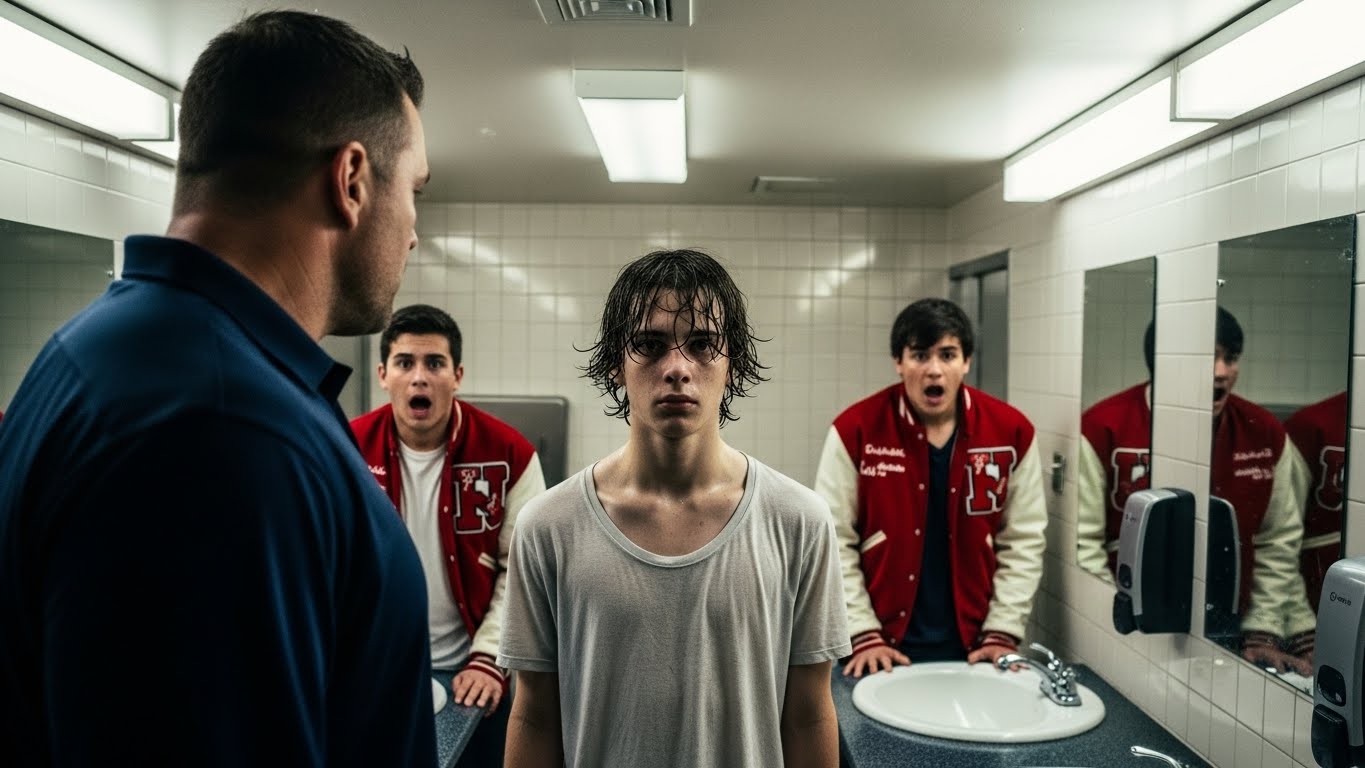
They pushed the quiet kid into the toilet. But when the Officer walked in, he didn’t arrest the bullies—he drew his weapon on the victim.
PART 1: THE TRIGGER
Chapter 1: The Porcelain Cage
The smell of a high school bathroom is a specific kind of hell. It’s a mix of industrial-strength lemon bleach, stale urine, and the metallic tang of rusty pipes. But today, the overwhelming scent was fear.
And it wasn’t mine. Not entirely.
My name is Leo. I’m seventeen, I sit in the back of the class, and I wear hoodies even when it’s eighty degrees out. People at Oak Creek High think I’m just the weird, quiet kid. They think I’m shy.
They have no idea.
At that moment, my face was pressed against the cold, unforgiving rim of a toilet bowl in the third-floor boys’ restroom. My knees scraped against the gritty, dirty grout of the tile floor. My hands were gripping the porcelain so hard my knuckles were turning the color of bone.
“Take a deep breath, freak,” Brad hissed from above me.
I could feel the heat radiating off him. Brad was the quintessential American nightmare—the Varsity quarterback, built like a tank, with a brain that seemingly stopped developing in the womb. He was wearing his red and white letterman jacket, the leather sleeves creaking as he tightened his grip on the back of my neck.
There were three of them. There were always three. Brad, the muscle. Mike, the hyena who laughed at everything Brad did. And Jason, the lookout, standing by the door with his arms crossed, pretending he wasn’t just as guilty as the rest of them.
“I said,” Brad shoved my head down an inch, the stagnant water now touching the tip of my nose, “take a breath.”
My heart was hammering against my ribs like a trapped bird. But it wasn’t because I was afraid of drowning. It wasn’t because I was afraid of the humiliation.
I was afraid of the noise.
It started as a low hum in the base of my skull. Buzz. Buzz. Buzz. Like a high-tension wire snapping in the wind.
It was the noise that told me things. It was the noise the doctors gave me pills to silence.
Grab his pinky finger, the noise whispered. Snap it backward until the tendon tears. Pivot your weight. Drive your elbow into his kneecap. He will never play football again.
I squeezed my eyes shut. No. Stop it. Don’t listen.
“Dunk him!” Mike chanted, kicking my shin with his expensive sneaker. “Wash the weird off him!”
Brad laughed, a cruel, hollow sound that echoed off the tiled walls. “Let’s see if he can hold his breath as long as he holds onto that creepy stare of his.”
He pushed.
My head went under.
The world turned into a muffled, watery blur. The cold shock of the water hit my face, filling my ears. The sound of their laughter distorted, bending into demonic shrieks.
I held my breath.
One. Two. Three.
The hum in my head grew louder. It wasn’t a whisper anymore. It was a scream. The adrenaline dumped into my system wasn’t the flight response. It was the fight response. A primal, focused, calculated violence that I had spent three years in therapy trying to suppress.
My hand twitched. I could feel the tendon in Brad’s wrist just inches from my grasp. I knew exactly how much pressure it would take to crush it.
Mom made you promise, Leo. Mr. Halloway made you promise. No more incidents.
I stayed limp. I let them win. I let them think they were the ones in power.
But the water was cold, and the darkness was inviting, and the monster inside my head was banging on the door, begging to be let out to play.
Chapter 2: The Silence of the Lambs
My lungs were burning. I needed air.
Just as I was about to break—just as I was about to snap Brad’s wrist and unleash three years of repressed rage—the pressure vanished.
One second, Brad’s heavy hand was forcing me down into the abyss. The next, it was gone.
I pulled my head up, gasping, water streaming from my hair, down my face, dripping off my chin. I coughed, sputtering, choking on the taste of toilet water and humiliation. I braced myself. I expected a punch to the ribs. I expected them to grab my hair and shove me back down.
But nothing happened.
The bathroom was dead silent.
It wasn’t just quiet. It was a vacuum. The kind of silence that happens right before a tornado touches down.
I wiped the stinging water from my eyes and slowly turned my head.
The scene before me didn’t make sense.
Brad was backed up against the stall door, his face drained of all color. He looked like he’d seen a ghost. His hands were half-raised, palms out.
Mike was frozen mid-laugh, his mouth hanging open in a stupid O shape.
Jason, the lookout, was pressing himself into the corner by the sinks, trying to merge with the wall tiles.
They weren’t looking at me. They were staring at the entrance of the bathroom.
Standing there, framed by the harsh fluorescent light of the hallway, was Mr. Halloway.
Now, every school has a security guard. Maybe an old guy who sleeps in a golf cart. But Oak Creek High had Mr. Halloway. His title was “Student Resource Officer,” but everyone knew the rumors. Ex-special forces. Dishonorable discharge? Maybe. Decorated hero? Maybe.
He was six-foot-four, built like a vending machine made of muscle, and he never, ever smiled.
But right now, he didn’t look like a disciplinarian catching kids cutting class.
He looked… terrified.
His right hand was hovering near his belt—not where a teacher keeps a pen, but where a cop keeps a weapon. His posture was rigid, tactical.
And the terrifying part?
He wasn’t glaring at Brad. He wasn’t looking at Mike.
Mr. Halloway was staring directly at me.
His eyes were wide, locked onto mine with an intensity that made the air freeze. It was the look a bomb disposal expert gives a red wire.
“Leo,” Halloway said.
His voice was barely a whisper. Soft. Controlled. But in the dead silence of the tiled room, it sounded like a thunderclap.
“Stand up. Slowly.”
Brad looked between me and Halloway, confused by the shift in dynamic. The predator was suddenly confused why the zookeeper was afraid of the prey.
“Mr. Halloway,” Brad started, his voice cracking. “We were just… messing around. It’s no big deal.”
“Shut up,” Halloway didn’t even turn his head toward Brad. He kept his eyes glued to me, tracking my every micro-movement. “I said, shut up. Don’t move. Don’t breathe unless you have to.”
The fear in the room shifted. You could smell it. Brad realized, for the first time, that he had made a mistake. A massive mistake.
I slowly rose to my feet. The water dripped from my clothes onto the floor. Drip. Drip. Drip.
The buzzing in my head was at a fever pitch. I stared at Halloway. I knew what he saw. He didn’t see a bullied kid. He saw the incident from three years ago. He saw the reason I had to transfer schools.
“Hands where I can see them, Leo,” Halloway commanded, stepping into the room. He moved with a predator’s grace, ignoring the three varsity athletes cowering against the wall. He walked right past them.
“Did you… did you let it out?” Halloway asked, his voice trembling slightly.
I looked at my hands. They were shaking. Not from cold. From the effort of holding back.
I looked at Brad. I could see the pulse in his neck. I could see the vulnerability.
“Almost,” I whispered. My voice sounded jagged, like broken glass.
Halloway let out a breath he must have been holding since he entered the room. His shoulders dropped half an inch. He turned to Brad, and his face hardened into granite.
“You three,” Halloway said, his voice dropping an octave, turning into a low growl. “You have no idea what you just did. You have no idea how close you came to never walking out of this room.”
Brad stammered, shrinking into his varsity jacket. “We… it was just a prank…”
“Get out,” Halloway roared, finally breaking his calm facade. The sound echoed violently. “Get out before I change my mind and let him finish what you started!”
They scrambled. The tough guys. The kings of the school. They tripped over each other’s feet trying to get to the door. They ran like children escaping a haunted house.
The door swung shut behind them.
The silence returned.
Mr. Halloway looked at me. The fear in his eyes faded, replaced by a deep, weary sadness. He reached into his tactical pocket and pulled out a clean, white handkerchief.
He walked over to me, cautious, like approaching a wounded wolf.
“Wipe your face, kid,” he said softly, handing me the cloth.
I took it. My hands were still shaking.
“I didn’t hurt them,” I said, my voice barely audible. “I wanted to. But I didn’t.”
Halloway nodded grimly. He pulled a radio from his belt, but he didn’t call the principal.
“We need to call your mother, Leo,” he said, his eyes scanning my face for signs of the ‘shift.’ “The dosage isn’t working anymore. If I had walked in ten seconds later…”
He didn’t finish the sentence. He didn’t have to.
We both knew what would have happened. There wouldn’t have been a suspension. There would have been a coroner.
PART 2: THE UNRAVELING
Chapter 3: The Protocol
Mr. Halloway’s office wasn’t in the main administration block. It was tucked away near the boiler room, a converted storage closet that smelled faintly of gun oil and old coffee. There were no inspirational posters on the walls. No “Hang in There” cats. Just a heavy steel desk, two chairs, and a bank of monitors linked to the school’s security cameras.
He locked the door behind us. Click. Clack. Two deadbolts.
I sat in the plastic chair, shivering. The wet clothes stuck to my skin, freezing me to the bone, but the cold was the only thing grounding me. It kept the static in my head from turning back into a roar.
Halloway didn’t offer me a towel. He knew that physical comfort sometimes lowered my defenses, and right now, I needed my walls up. I needed to be numb.
He sat behind his desk and picked up the red landline phone—the one that didn’t go through the school switchboard. He punched in a number from memory.
“It’s me,” Halloway said into the receiver. His eyes never left me. “We had a Code Yellow.”
A pause.
“The bathroom. Three hostiles. Typical high school alpha-male posturing. They dunked him.”
Another pause, longer this time. I watched Halloway’s jaw tighten.
“No,” he said sharply. “No, he didn’t engage. But he was close. I saw the ocular shift. The pupils dilated. He was pre-strike.”
I looked down at my hands. The “ocular shift.” That’s what they called it. When the adrenaline hit my system, my pupils expanded until my eyes looked almost entirely black. It allowed me to take in more light, to see movement in slow motion. It was a combat response. A biological weapon buried inside a skinny teenager.
“Yeah. I intervened,” Halloway said, sighing. “Bring the kit. The dosage needs adjustment. He’s… he’s growing out of the current suppression levels. He’s seventeen now. His metabolism is changing.”
He hung up the phone.
For a long time, the only sound was the hum of the servers in the corner and the dripping of water from my jeans onto the linoleum.
“You did good, Leo,” Halloway said finally. He opened his desk drawer and slid a chocolate bar across the metal surface. High sugar. It helped with the crash after the adrenaline spike.
“I wanted to break his fingers,” I said, staring at the candy. “I visualized it. I knew exactly how much torque to apply.”
“I know,” Halloway said. “That’s the training. It never goes away. Muscle memory is forever.”
“I didn’t ask for the training,” I whispered.
“No,” Halloway agreed, his voice softening. “You didn’t. You were just the only one who survived it.”
Twenty minutes later, the back door of the school opened. My mother walked in.
She didn’t look like a frantic soccer mom worried about her son getting bullied. She looked like a field medic arriving at a disaster zone. She was wearing her oversized coat, her face pale and drawn. She carried a small, metallic briefcase.
She didn’t hug me. She rushed to me, grabbed my face in her hands, and looked deep into my eyes. She was checking the pupils.
“Is it gone?” she asked, her voice trembling. “Is the noise gone?”
“It’s quiet,” I lied. It wasn’t quiet. It was just waiting.
She turned to Halloway. “How bad?”
“Bad enough,” Halloway said, standing up. “Brad Miller. Quarterback. If I hadn’t walked in, that kid would be breathing through a tube for the rest of his life, and we’d be on a plane to Alaska by midnight.”
My mom closed her eyes and exhaled. “Okay. Okay. I’ll up the dosage tonight.”
She turned back to me, brushing the wet hair off my forehead. Her touch was gentle, but her hands were shaking. I hated this. I hated that I terrified the woman who gave birth to me. I hated that she had to love a monster.
“Let’s go home, Leo,” she said.
As we walked out to the car, passing the empty football field, I saw them.
Brad and his crew were sitting on the bleachers. They weren’t laughing anymore. They were watching me leave.
But it wasn’t the look of bullies plotting their next prank.
Brad was holding his wrist—the phantom pain of what I almost did to him echoing in his mind. He watched me with a mixture of confusion and a primal, instinctive dread.
He knew. Deep down, in the lizard part of his brain, he knew he had touched fire.
And the problem with fire is that even if you pull your hand away, the heat stays with you.
Chapter 4: The Ripple Effect
Going back to school the next day was supposed to be impossible. Any normal kid who got dunked in a toilet would feign illness. They’d stay home, play video games, and try to forget the taste of lemon bleach.
But I wasn’t allowed to stay home. Routine was part of the containment. Deviation from the schedule caused anxiety, and anxiety fed the Noise.
So, at 7:55 AM, I walked through the double doors of Oak Creek High.
The hallway was a river of noise. Slamming lockers, shouting freshmen, the screech of sneakers on wax. Usually, I was invisible. I was a ghost haunting the margins of the social hierarchy.
Today, the river parted.
It wasn’t obvious at first. Just a subtle shift in the current.
I walked toward my first-period history class. A group of cheerleaders standing by the trophy case stopped talking as I passed. They didn’t giggle. They didn’t whisper. They just… stopped.
I looked straight ahead, gripping the straps of my backpack. Left foot. Right foot. Breathe.
“Hey, Dahmer,” a voice called out.
I froze.
It was Mark, a junior who hung out on the periphery of Brad’s circle. He was leaning against a locker, a smirk plastered on his face. He didn’t know. He hadn’t been in the bathroom.
“Heard you got thirsty yesterday,” Mark laughed. “Need a drink?”
He held out a water bottle.
Before I could react—before the static could even start to buzz—a hand slammed onto Mark’s shoulder.
It was Brad.
Brad looked terrible. He had dark circles under his eyes, like he hadn’t slept. He wasn’t wearing his Varsity jacket. He was just in a grey hoodie, looking smaller than usual.
“Shut up, Mark,” Brad said. His voice was flat. Dead.
Mark looked confused. “What? I’m just messing with the freak.”
“I said shut up,” Brad snapped, shoving Mark back against the lockers. “Don’t talk to him. Don’t look at him. Just walk away.”
Mark’s jaw dropped. The hallway went silent. The quarterback was defending the weird kid? It defied every law of the high school jungle.
Brad didn’t look at me. He couldn’t. He kept his eyes fixed on the floor, his body rigid. He was terrified that if he made eye contact, he’d see it again—the black void in my eyes that promised violence.
He grabbed Mark by the collar and dragged him away, disappearing into the crowd.
I stood there, alone in the middle of the hallway.
The silence around me stretched out. People were staring now. Really staring.
They weren’t looking at a victim anymore. They were looking at an anomaly.
I felt a prickle on the back of my neck. I looked up toward the ceiling, toward the security camera housed in the black dome.
I knew Halloway was watching. I knew his finger was hovering over the button that would lock down the school.
I lowered my head and walked to class.
History was a blur. I sat in the back row. Usually, Mike—the hyena from the bathroom—sat two desks away. He spent the entire semester throwing crumpled paper at the back of my head.
Today, Mike was sitting in the front row, right under the teacher’s nose. He was hunched over his notebook, scribbling furiously. Every time the door opened, he flinched.
The dynamic had shifted. But it wasn’t a good shift.
Fear is volatile. Fear turns into anger.
By lunch, the whispers had started.
I sat at my usual empty table in the far corner of the cafeteria. I unpacked my sandwich—no crusts, cut diagonally, just how the routine demanded.
“I heard he brought a knife,” someone whispered at the next table.
“No, I heard he’s a narc. That’s why Halloway saved him,” another voice replied.
“My brother said Halloway didn’t save him,” a girl’s voice cut in, lower than the rest. “He said Halloway looked like he was arresting him. Like he was scared of him.”
I took a bite of my sandwich. It tasted like sawdust.
The static was low, a manageable hum. The extra pill Mom gave me at breakfast was working. It felt like my brain was wrapped in cotton wool.
But then, the shadow fell over my table.
I stopped chewing.
I looked up to see Sarah standing there.
Sarah was… different. She wasn’t popular, but she wasn’t an outcast. She was the editor of the school paper, smart, observant, and dangerously curious. She had eyes that missed nothing.
“Can I sit?” she asked.
She didn’t wait for an answer. She dropped her tray onto the table and sat opposite me.
“Why is the entire football team suddenly terrified of you, Leo?” she asked. Her voice wasn’t mocking. It was investigative.
“I don’t know what you’re talking about,” I mumbled, looking at my tray.
“Bullshit,” she said cheerfully. “Brad Miller hasn’t spoken a word all day. Mike looks like he’s about to cry. And Jason? Jason skipped school.”
She leaned in closer, dropping her voice.
“And I saw the footage.”
My blood ran cold. The cotton wool in my brain dissolved instantly. The static spiked.
“What footage?” I asked, my voice tight.
“I’m the T.A. for the AV club,” Sarah whispered. “I have access to the server. I saw the hallway cam outside the third-floor bathroom yesterday.”
She paused, watching my reaction.
“I saw them run out, Leo. They ran out like the devil himself was chasing them. And then… a full minute later… Halloway walks out with you. But he’s not walking with you. He’s walking behind you. Hand on his holster.”
She narrowed her eyes.
“Who are you, Leo? Really?”
The noise in my head screamed. She knows. She’s a threat. Neutralize.
My hand twitched under the table. I grabbed my leg, digging my fingernails into my thigh to ground myself.
“Leave it alone, Sarah,” I whispered. “Please. For your own sake. Just leave it alone.”
“Or what?” she challenged. “You’ll dunk me in a toilet?”
I looked up. I couldn’t help it. The frustration, the fear, the exhaustion—it slipped.
Just for a microsecond, the control slipped.
Sarah gasped and recoiled, slamming her back against the plastic chair.
“Your eyes,” she breathed, her face going pale. “What just happened to your eyes?”
I stood up abruptly, my chair screeching against the floor. The cafeteria went silent again.
“I have to go,” I choked out.
I ran. I ran out of the cafeteria, past the staring faces, into the hallway.
I needed Halloway. I needed the office. I needed the lock.
Because the medication was failing. And Sarah had just pulled the pin on the grenade.
PART 3: THE BREAKING POINT
Chapter 5: The Red Zone
I didn’t run like a normal kid. I knew that.
A normal kid runs with wasted energy—arms pumping too high, breath jagged, feet slapping the floor.
I ran efficiently. My center of gravity lowered, my head stayed level, and my breathing synchronized with my stride. I moved through the crowded hallways like water through a grate, slipping between bodies without touching a soul.
The static in my head was no longer a noise. It was a command.
Target acquired. Threat level rising. Engage protocols.
I burst through the double doors of the administration wing, startling the secretary. I didn’t stop. I sprinted past the principal’s office, straight to the unmarked grey door at the end of the hall.
Mr. Halloway’s office.
I didn’t knock. I slammed my shoulder into the steel-reinforced wood.
It was locked, of course. But at that speed, with the adrenaline cocktail flooding my veins, the lock didn’t matter. The deadbolt sheered off the frame with a sickening crack, and I tumbled into the room.
Halloway was on his feet instantly, his weapon drawn.
He saw me. He saw the splintered door frame. He saw my eyes.
“Damn it,” Halloway cursed, holstering the gun and rushing to the door. He kicked it shut and jammed a chair under the handle.
“I didn’t mean to,” I gasped, sliding down the wall to the floor. I clutched my head. “She saw. Sarah saw the shift.”
Halloway froze. He turned slowly, his face ashen.
“Sarah? The girl from the paper?”
I nodded, squeezing my eyes shut to block out the light. Everything was too bright. The hum of the computer server in the corner sounded like a jet engine. I could hear Halloway’s heartbeat. It was fast. Irregular.
“She accessed the server,” I whispered. “She knows you walked me out. She saw the fear.”
Halloway moved to his computer. His fingers flew across the keyboard.
“If she accessed the server… if she dug deep enough…”
He hit a key. A red warning box flashed on his screen.
UNAUTHORIZED ACCESS DETECTED. IP TRACE INITIATED. BEACON ACTIVATED.
Halloway slammed his fist onto the desk. The metal dented.
“She tripped the silent alarm,” he said, his voice void of emotion. “The encrypted files regarding your transfer. They have a digital tripwire. If anyone without clearance tries to view them, it pings the Home Office.”
He looked at me.
“They know, Leo. They know the cover is blown.”
“Who?” I asked, though I knew the answer.
“The retrieval team,” Halloway said. He walked over to a metal cabinet and unlocked it with a key from around his neck. inside was a heavy tactical vest and a duffel bag.
“We have ten minutes, maybe fifteen,” Halloway said, tossing the bag to me. “Pack your things. We aren’t going home. We aren’t going to your mom’s. We are going off the grid.”
“What about Sarah?” I asked.
Halloway paused. He looked at me, and for the first time, I saw the cold, military calculation in his eyes.
“She’s a loose end, Leo. The team coming here? They don’t do witnesses. They clean the slate.”
The static in my head stopped buzzing. It went silent.
A new clarity washed over me. Cold. Sharp.
“They’ll kill her?”
“They’ll make it look like an accident,” Halloway said, loading a magazine into his sidearm. “Gas leak. Car crash. It doesn’t matter. She compromised a Level 5 asset. That’s a death sentence.”
I stood up. The trembling in my hands stopped.
“No,” I said.
Halloway looked up. “Excuse me?”
“We’re not leaving her,” I said. My voice was different. Deeper. Steadier. It wasn’t the voice of the scared teenager who got dunked in the toilet. It was the voice of the thing they had created.
“Leo, we don’t have time to play hero,” Halloway snapped. “This isn’t a comic book. These are professionals.”
“I know,” I said, walking toward the door, kicking the chair away. “But you taught me how to think like them. And I’m not leaving a civilian behind.”
Halloway stared at me for a long moment. He looked at the dented door frame. He looked at my eyes, which were now fully black, the irises swallowed by the pupils.
He sighed, a long, defeated sound.
“God help us,” he muttered. “You’re taking point.”
Chapter 6: Code Black
The intercom system crackled to life.
Usually, it was Principal Skinner making announcements about the bake sale or the football game.
This time, it was a prerecorded mechanical voice.
“Code Lockdown. This is not a drill. Teachers, secure your classrooms. Students, remain silent and away from windows. Police are en route.”
“They’re early,” Halloway hissed, checking his watch. “They hacked the school’s PA system to trigger a lockdown. It herds the sheep so the wolves can hunt freely.”
The hallways were emptying fast. Teachers were yanking students into classrooms, locking doors, covering windows. The lights in the corridor dimmed as the emergency power kicked in.
“Where is she?” Halloway asked, his gun held low against his leg, concealed by his body.
“Library,” I said. “Fourth period. She has a free period.”
“How do you know that?”
“I memorized everyone’s schedule,” I said simply. “It’s part of the threat assessment routine you made me do.”
We moved.
The school felt different now. It wasn’t a place of learning anymore. It was a tactical environment.
Corner. Clear. Hallway. Clear.
We reached the central staircase. Below us, through the wire mesh of the railing, I saw movement on the first floor.
Three men.
They weren’t wearing SWAT gear. They weren’t wearing police uniforms. They were dressed in generic grey maintenance coveralls, carrying what looked like toolboxes.
But I knew how they walked. I knew how they scanned the perimeter.
“Cleaners,” Halloway whispered. “Three of them. That means there’s a sniper outside covering the exits.”
One of the men looked up. He wore a baseball cap pulled low. He looked right at the gap in the railing where I was standing.
He didn’t shout. He didn’t point. He just tapped his earpiece.
“They spotted us,” I said.
“Move,” Halloway commanded.
We sprinted up the stairs to the second floor. The library was at the end of the north wing.
We were halfway down the hall when the door to the science lab opened.
It was Brad.
The quarterback. He looked confused, scared. He had probably been in the bathroom and missed the lockdown call.
“Mr. Halloway?” Brad asked, stepping out. “What’s going on? Is there a shooter?”
“Get back inside, Miller!” Halloway roared.
Thwip.
A sound like a compressed air canister venting.
The locker next to Brad’s head exploded in a shower of metal sparks.
Brad screamed and dropped to the floor, covering his head.
“Suppressor!” Halloway yelled, grabbing Brad by the collar and throwing him into the open classroom. “Stay down and don’t make a sound!”
Halloway spun around, aiming down the stairs. He fired two shots. Bang! Bang! The sound was deafening in the confined space.
“Go, Leo! Get the girl!” Halloway shouted, taking cover behind a trash can as a return volley of silenced shots chewed up the drywall above his head.
I didn’t hesitate. I turned and ran toward the library.
I hit the library doors at full speed. They were locked. Through the glass, I saw the librarian and a dozen students huddled under the tables.
Sarah was there. She was sitting under a desk near the back, clutching her laptop. She looked terrified.
I couldn’t knock. There was no time.
I stepped back, focused on the lock mechanism. I visualized the tumblers. I visualized the weak point in the wood.
I kicked.
The door flew open with such force that the glass shattered.
Screams erupted from inside. The librarian stood up, shouting at me.
“Get out! We’re in lockdown!”
I ignored her. I vaulted over the checkout desk and sprinted to the back.
Sarah looked up at me. Her eyes were wide. She saw the blood on my shirt—Brad’s blood, from when Halloway threw him. She saw the black void of my eyes.
“Leo?” she whimpered.
“You triggered a tripwire,” I said, grabbing her arm. “They’re here to kill you.”
“Who? Who is here?”
“The people who made me,” I said.
Before she could answer, the library window behind her—the one overlooking the football field—shattered.
A red laser dot danced across her chest.
“Down!”
I tackled her.
The bullet tore through the space where her head had been a millisecond before, burying itself in a stack of encyclopedias.
I rolled us behind a heavy oak bookshelf.
Sarah was hyperventilating. “What is happening? What are you?”
“I’m the weapon you were looking for,” I said, peering around the edge of the shelf.
Down the main aisle of the library, the doors swung open again.
The three men in grey coveralls walked in. They moved in perfect unison. They raised their weapons—submachine guns with long suppressors.
“Leo 7-3-4,” the lead man said. His voice was calm, bored even. “Step out. The asset is compromised. We are initiating a sanitized withdrawal.”
I looked at Sarah. She was shaking so hard her teeth rattled.
“Stay here,” I whispered to her. “Close your eyes. Cover your ears.”
“What are you going to do?” she cried softly.
I stood up slowly, stepping out from behind the bookshelf into the open aisle.
I looked at the three men.
The static in my head was gone. There was no noise. No fear.
Only the cold, hard calculus of violence.
“You’re not sanitizing anything,” I said.
My muscles tensed. The world slowed down to a crawl. I could see the dust motes floating in the air. I could see the tension on the trigger finger of the lead man.
I smiled. A broken, terrifying smile.
“Class is in session.”
PART 4: THE EXODUS
Chapter 7: The Physics of Violence
The air in the library felt heavy, pressurized by the silence that precedes a gunshot.
The lead Cleaner raised his weapon. In a normal timeline, I would be dead. His finger began to squeeze the trigger. It takes approximately 0.2 seconds for a human to react to a visual stimulus and another 0.1 seconds to engage a motor function.
But I don’t live in a normal timeline. Not when the blackness swallows my irises.
To me, he was moving underwater.
I didn’t run away. I surged forward.
I grabbed a heavy hardcover book from the cart next to me—The Rise and Fall of the Roman Empire. Fitting.
I hurled it.
The book spun through the air like a discus, closing the twenty-foot gap in a heartbeat. It struck the lead gunman square in the throat just as his weapon discharged.
Thwip.
The bullet went wild, shattering a light fixture above. The man gagged, his trachea crushed, and he dropped to his knees, clutching his neck.
The other two reacted, their barrels swinging toward me.
I was already moving. I slid across the polished floor on my knees, reducing my profile. I grabbed the leg of a heavy oak study table and heaved.
The table flipped. It wasn’t a perfect shield, but it was enough to absorb the spray of 9mm rounds that chewed into the wood. Splinters rained down on me like confetti.
“Flank him!” the second man shouted.
I didn’t wait to be flanked. I grabbed a metal chair. I stood up and threw it—not at the men, but through the glass of the trophy case to my right.
Crash.
The noise was chaotic, disorienting. For a trained tactical team, chaos is the enemy. They hesitated for a microsecond to assess the new threat.
That was all I needed.
I vaulted the overturned table. I was on the second man before he could realign his aim. I didn’t punch him. Punching hurts the hands. I used the palm of my hand to strike his chin, snapping his head back, rattling his brain inside his skull.
As he stumbled, I grabbed his wrist—the one holding the gun—and twisted.
The snap was loud. He screamed. I used his body as a shield just as the third man fired.
The rounds hit the second man’s vest. He grunted, the wind knocked out of him.
I shoved the human shield into the shooter. They collided in a tangle of limbs and grey coveralls.
I stepped in.
A kick to the knee. A strike to the solar plexus. A chop to the vagus nerve.
It took six seconds.
From the moment I threw the book to the moment the third man hit the floor, unconscious, six seconds had passed.
I stood over them, my chest heaving, but not from exhaustion. From the heat. The sheer, burning heat of the system running at 100% capacity.
I looked back at the corner.
Sarah was peeking out from behind the bookshelf. Her hands were over her mouth. Her eyes were wide, filled with a mixture of awe and absolute horror. She wasn’t looking at a hero. She was looking at a monster that wore the skin of a high school student.
“Leo?” she whispered.
I didn’t answer. The buzzing was starting to return. The crash was coming.
Suddenly, the library doors burst open again.
I spun around, snatching a dropped submachine gun from the floor, leveling it at the entrance.
“Don’t shoot!”
It was Halloway.
He was limping. There was a dark stain spreading on his tactical polo, right above his hip. He was holding his side, his face pale and sweaty.
He looked at the three unconscious men on the floor. He looked at me.
“You cleared the room,” he rasped, leaning against the doorframe. “Clean. Efficient.”
“You’re hit,” I said, lowering the weapon. The sight of Halloway bleeding made the blackness in my eyes recede. The fear returned. Not for me, but for him.
“Grazed,” Halloway lied. I could tell by the pallor of his skin it was worse than a graze. “We have to move. The police are two minutes out. The retrieval team has a secondary unit inbound. If we’re here when they arrive…”
“We disappear,” I finished for him.
I turned to Sarah.
She stood up, her legs shaking. She looked at the bodies on the floor, then at Halloway, then at me.
“You have to come with us,” I said.
“What?” She stepped back. “No. No way. I’m not going anywhere with you people.”
“Sarah,” Halloway said, his voice straining. “These men… they aren’t the police. They are a private contractor. You have seen their faces. You have seen him work. If you stay here, they will find you. And they won’t arrest you.”
She looked at the shattered window where the sniper had fired. She looked at the bullet hole in the encyclopedias.
“I have a family,” she cried. “My mom…”
“We’ll get word to them,” Halloway promised. “But right now, you need to be a ghost. Or you’ll be a corpse.”
Sirens wailed in the distance. Louder now.
Sarah looked at me. She searched my face for the quiet boy who sat alone at lunch. The boy she thought she knew.
“Did you mean to hurt Brad?” she asked suddenly.
“What?”
“In the bathroom. Did you mean to hurt him?”
“I wanted to,” I admitted, my voice breaking. “But I didn’t. I stopped.”
She held my gaze for a long moment. She saw the conflict. She saw the human fighting the weapon.
“Okay,” she whispered. “Okay.”
Chapter 8: The Ghost in the Machine
We exited through the loading dock of the cafeteria.
Halloway had a car stashed two blocks away—a nondescript grey sedan that looked like a thousand other cars on the road. It had fake plates and a trunk full of cash and passports. He was always prepared.
I supported Halloway as we moved through the alleyways, sticking to the shadows. Sarah followed close behind, clutching her laptop like a lifeline.
The sounds of the school surrounded by police faded behind us. We could hear the helicopters now. News choppers. Maybe police. Maybe something else.
We reached the car. Halloway slumped into the passenger seat, his breathing shallow. He threw me the keys.
“You drive,” he groaned.
“I don’t have a license,” I said, catching the keys.
“Kid,” Halloway chuckled, a wet, rattling sound. “You’re a million-dollar government weapon. I think you can figure out a Honda Civic.”
I got in the driver’s seat. Sarah climbed in the back.
I started the engine. I adjusted the mirrors. I put the car in gear and pulled out into traffic, merging seamlessly with the flow of suburban minivans and delivery trucks.
Nobody looked at us. We were invisible.
We drove for an hour in silence, heading north, away from the city, away from the life I had tried so hard to pretend was real.
“Where are we going?” Sarah asked from the back seat. Her voice was small.
“Safe house,” Halloway murmured, his eyes closed. “Up near the Canadian border. Old cabin. Off the grid.”
“And then what?” she asked.
Halloway didn’t answer. He had passed out.
I glanced at him. His pulse was weak but steady. He needed a doctor, but we couldn’t go to a hospital. I would have to patch him up myself. I knew how. I had the medical data downloaded in my head.
I looked in the rearview mirror. Sarah was staring out the window, watching her life disappear in the glass.
“I’m sorry,” I said.
She looked at my reflection.
“For what? Saving my life?”
“For ruining it,” I said. “You can’t go back, Sarah. Not for a long time.”
She was quiet for a while. Then, she leaned forward, resting her arms on the back of my seat.
“Who are you, really, Leo?”
I tightened my grip on the steering wheel.
“I was an experiment,” I said. “Project Nephilim. They wanted to create the perfect soldier. Someone who didn’t feel fear, who could process combat data faster than a computer. They took orphans. They… changed us.”
“Changed you how?”
“Chemistry. Conditioning. Surgery.” I tapped my temple. “But it didn’t work. The other subjects… they went unstable. Violent. Uncontrollable.”
“But not you,” she said.
“No,” I said softly. “I was the failure.”
“Failure?”
“I felt too much,” I said. “I felt guilt. I felt empathy. When they told me to kill the test target, I couldn’t do it. So they marked me for termination. Halloway was supposed to be the executioner. Instead, he grabbed me and ran.”
I looked at Halloway, sleeping fitfully beside me. The man who had saved me twice.
“He thinks I’m a ticking time bomb,” I said. “He thinks eventually, the programming will take over and I’ll lose my humanity.”
“Will you?” Sarah asked.
I thought about the bathroom. The urge to snap Brad’s wrist. The voice in my head.
But then I thought about the silence. The moment I let go. The moment I chose to just be a scared kid instead of a monster.
I looked at the road ahead. The sun was setting, painting the sky in bruises of purple and red.
“I don’t know,” I said. “But as long as there are people like the ones chasing us… maybe being a monster isn’t such a bad thing.”
I felt a hand on my shoulder. It was Sarah.
“You’re not a monster, Leo,” she said firmly. “Monsters don’t say sorry.”
I watched the road. The static in my head was gone completely now. For the first time in years, there was just silence. Peaceful, empty silence.
I wasn’t Leo the victim anymore. I wasn’t Leo the high school student.
I was something new. Something they hadn’t planned for.
I was a weapon that had learned to choose its own target.
“Sarah,” I said, my voice steady. “Check the glove box. There’s a burner phone.”
She opened it and handed me the cheap plastic device.
“Who are you calling?”
“Mom,” I said. “I need to tell her to run. And then…”
“Then?”
I looked at the darkening horizon.
“Then we stop running. And we start hunting.”
The car sped up, disappearing into the vast American night.
THE END.