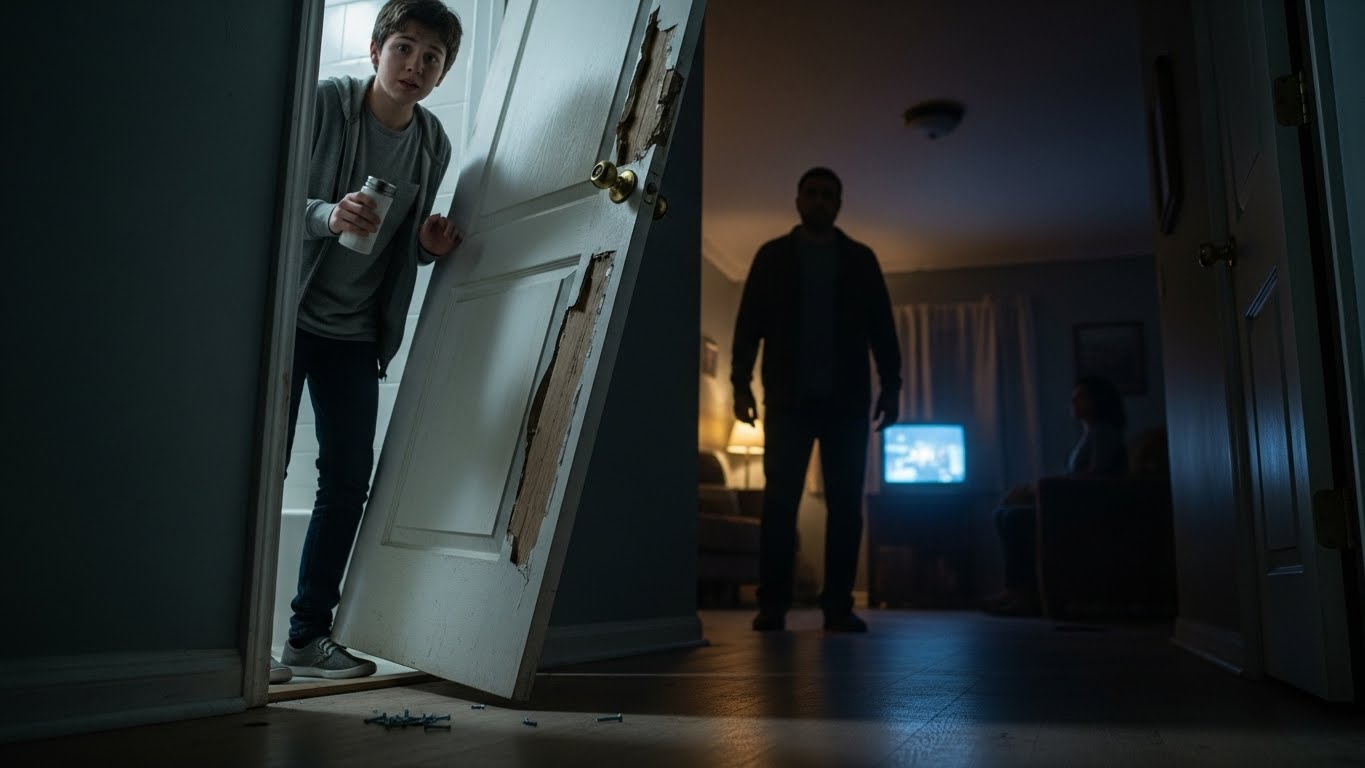
I Broke A $1 Salt Shaker. Now My Stepdad Is Taking The Bathroom Door Off Its Hinges, And My Mom Just Turned Up The TV Volume To Drown Out My Screams.
Chapter 1: The Sound of Gravel
I didn’t break the law. I didn’t hurt anyone. I was seven years old, and my only crime was existing in a house where the air felt like it was made of gasoline, waiting for a single spark to blow it all to hell.
It started with a sound. That specific, distinct crunch of gravel in the driveway. Most kids hear their dad’s car and run to the door, tails wagging like excited puppies. I heard that sound—the heavy rolling tires of that rusted Ford F-150—and I felt my stomach dissolve into acid.
It was 4:13 PM on a Tuesday in rural Ohio. I know the time because I was staring at the microwave clock, praying for it to freeze.
My stepfather, Ray, was home early.
I was in the living room, kneeling on the shag carpet. The house smelled like dust and lemon pledge because I had been cleaning for two hours straight. In my hands, I held the pieces of a ceramic eagle. It was a cheap thing, something he’d won at a county fair or bought at a garage sale for a dollar. It had painted feathers that were chipping off and a beak that looked more like a parrot’s than a predator’s. But in that house, Ray’s possessions were sacred artifacts.
I had been dusting. Mom told me to dust. I was trying to be good. I was trying to be invisible. But my elbow had clipped the side table, and gravity did the rest.
The front door groaned open. The hinges needed oiling, but nobody dared to tell Ray that.
The atmosphere in the house shifted instantly. The pressure dropped. My ears popped. It was like being in a submarine that had just sprung a leak.
“Sarah?” His voice wasn’t loud. That was the scary part. Ray was never loud at first. He was a simmering pot, the kind that burns you before you see the bubbles.
My mom was in the kitchen. I could see her silhouette through the doorway. She froze over the sink, a dish rag in her hand. She didn’t answer right away. She was calibrating, just like me. Checking the tone. Assessing the threat level.
“I’m here, Ray,” she finally said. Her voice was thin, like paper.
I couldn’t move. I was staring at the shattered ceramic wings in my hands. I wanted to glue them back together with my mind. I wanted to disappear into the floorboards. I wanted to be anyone else, anywhere else.
Ray walked in. I heard his boots. Heavy. Steel-toed. Thud. Thud. Thud.
He stopped at the entryway of the living room. I didn’t look up. I couldn’t. I was fixated on his shadow, which stretched across the carpet and covered me completely. It felt cold, physically cold, like a cloud blocking out the sun.
“What’s that?” he asked.
The silence that followed was heavy enough to crush a lung.
“I… I was cleaning,” I whispered. My voice sounded like it belonged to a stranger. A scared little stranger.
He took a step closer. The smell hit me then. Stale beer, sawdust, and Old Spice. It was the scent of my nightmares.
“I asked you,” he said, the volume rising just a fraction, “what is that on my floor?”
“It’s… the eagle,” I choked out, tears already hot in my eyes. “I’m sorry. Ray, I’m sorry. I’ll fix it.”
He laughed. It was a dry, sharp sound. “You’ll fix it? You think you can fix things, boy?”
I risked a glance at the kitchen. Mom was facing the window now. She was scrubbing a plate. She was scrubbing it hard. She wasn’t turning around.
Please, I screamed inside my head. Please, Mom. Just look at me. Just tell him it was an accident. Just step between us once. Just once.
But she kept scrubbing. She turned the faucet on higher. The water rushed, creating a wall of white noise. She was drowning me out. She was washing her hands of me.
Chapter 2: The Lesson
Ray unbuckled his belt. The sound of leather sliding through loops is a sound I will never, ever forget. It sounds like a snake hissing before it strikes.
“Stand up,” he said.
I stood up. My knees were shaking so bad they knocked together. I was wearing shorts. I hated wearing shorts when Ray was home, but it was July, and the house had no AC.
“Turn around.”
I didn’t understand. I never understood. In school, Mrs. Miller gave us gold stars when we did good, and a timeout when we were bad. A timeout meant sitting in a chair for five minutes and thinking about what you did. It didn’t mean this. It didn’t mean pain.
“Ray, please,” I sobbed. “I didn’t mean to.”
“That’s the problem with you,” he said, wrapping the leather strap around his hand, testing the tension. “You never mean to. You’re careless. You’re ungrateful. And you need to learn respect. A man respects his property.”
The first lash hit the back of my thighs.
It felt like fire. It felt like a hot wire slicing through my skin. The shock of it took my breath away before the pain even registered.
I screamed. I couldn’t help it. It was a primal, animal sound.
“Shut up!” he roared.
He hit me again. And again.
I looked toward the kitchen one last time. Through the blur of tears, I saw my mother’s shoulders hunched up to her ears. She was still scrubbing that same plate. She hadn’t moved. She hadn’t turned.
She knew. She heard the snap of the leather. She heard my scream. And she did nothing.
That hurt more than the belt. The belt bruised my skin, but her silence broke something inside my chest that never really healed. It taught me that I wasn’t worth saving. It taught me that love was conditional, and apparently, I didn’t meet the conditions.
I collapsed onto the carpet, curling into a ball to protect my stomach. I just laid there, taking it, wondering what secret code other kids had cracked. Why did their parents hug them when they cried? Why did their mistakes get forgiven with a smile?
What was wrong with me? Was I born broken? Was I unlovable?
After what felt like an hour, but was probably only two minutes, he stopped. He was panting slightly.
“Clean that mess up,” he spat, gesturing to the broken ceramic shards scattered around me. “And stop crying. You sound like a girl.”
He walked into the kitchen. I heard him open the fridge. The pop of a beer can. That crisp hiss-crack sound.
“Dinner ready?” he asked my mom, his voice casual, normal, as if he hadn’t just beaten a seven-year-old boy on the floor of the next room.
“Almost,” Mom said. Her voice was steady. “Meatloaf.”
I lay on the floor, the stinging spreading across my back and legs like a wildfire. I pulled my knees to my chest. I looked at the broken eagle.
It was just things. Broken things.
I realized then that I was just like that eagle. I was just something in Ray’s house. Something to be moved, dusted, and occasionally smashed when he needed to vent his anger.
I crawled toward the stairs, dragging my numb legs. I needed to get to my room. I needed to hide.
But deep down, a terrifying thought took root in my mind, a question that would haunt me for the next ten years of my life.
If the people who are supposed to love you the most can hurt you like this… what is the rest of the world going to do to me?
And the scariest part?
I was starting to think I deserved it.
I made it to my room and closed the door. It didn’t lock. Ray didn’t allow locks in his house. “Secrets are for liars,” he used to say. So I pushed my toy chest against the door. It wouldn’t stop him, but it would give me a two-second warning.
I climbed into my closet. It was my sanctuary. I had a blanket in there, and a flashlight. I curled up among the shoes and the winter coats that smelled like mothballs.
I lifted my shirt and twisted my neck to try and see the damage in the dim light. Red welts were already rising. They looked like angry roadmaps.
I sat there in the dark, listening to the clink of silverware downstairs. They were eating. They were sitting at the table, eating meatloaf, while I was up here bleeding.
Why?
The question looped in my brain. Why?
Was I bad? I did my homework. I brushed my teeth. I said “yes sir” and “no sir.”
Maybe I was just bad inside. Maybe there was a black spot on my soul that Ray could see, but I couldn’t. Maybe he was trying to beat the badness out of me.
I hugged my knees and rocked back and forth. I closed my eyes and imagined a different life. A life where a dad came home and picked me up and swung me around. A life where a mom dropped a plate and said, “Oops,” and laughed.
But that was just a story. That was make-believe.
The reality was the stinging on my legs and the smell of mothballs. The reality was that I was alone.
And I knew, with a chilling certainty, that this wasn’t the end. It was only Tuesday.
Chapter 3: The Art of Invisibility
The next morning, the sun came up like it always did. That was the most insulting part about my childhood. The world kept turning. The birds kept chirping. The school bus rumbled down the street at 7:15 AM, stopping at the end of my driveway with a screech of brakes that sounded like a scream cut short.
I woke up stiff. The welts on the back of my legs had turned into angry, purple ridges. Every movement was a reminder. Sitting up was a negotiation with pain. putting on my jeans was torture. The denim fabric rubbed against the raw skin, sending sharp jolts up my spine.
I learned to walk differently that day. I developed a shuffle, a way of moving that minimized the friction between my skin and my clothes.
Downstairs, the kitchen was empty. Ray had already left for work at the plant. Mom was still in bed, or maybe she was pretending to be asleep so she didn’t have to look at me. There was a note on the counter: “Toast in the toaster. Be good.”
Be good.
Two words that meant everything and nothing. I was good yesterday. I was cleaning. Look where that got me.
I ate the cold toast dry. I didn’t want to risk dropping crumbs. I drank water from the tap, cupping my hands so I wouldn’t dirty a glass.
School was usually my sanctuary, but today it felt like a minefield.
The bus ride was a blur of noise. Kids shouting, throwing paper balls, laughing about cartoons. I sat three rows from the back, pressing my forehead against the cool glass of the window, watching the cornfields blur by.
I was terrified of Gym class.
It was Wednesday. Wednesday was volleyball. That meant shorts.
I spent the first three periods in a haze of anxiety. I couldn’t focus on math. I couldn’t care about spelling. My mind was racing, calculating scenarios, trying to figure out how to hide the evidence of my “discipline.”
When the bell rang for Gym, I felt like I was walking to the gallows. The locker room smelled of unwashed socks and Axe body spray. Boys were loud, shoving each other, snapping towels.
I took the corner locker, the one in the shadows. I waited until everyone else was halfway changed before I started. I kept my back to the wall. I pulled my jeans down and yanked my gym shorts up in one fluid, practiced motion, faster than a magician’s sleight of hand.
“Whoa, look at the freak, he’s shy!” someone yelled. A couple of kids laughed.
I didn’t care if they called me a freak. Being a freak was safe. Being noticed was dangerous.
I managed to get changed without anyone seeing the back of my legs. But the real test was the game.
“Teams!” Mr. Henderson barked. He was a squat man with a whistle that lived permanently around his neck.
I tried to stand in the back row. I tried not to move too much. But then the ball came right at me. A high arc, spinning.
“Get it, kid!”
I lunged. My shorts rode up.
For a split second, I felt the air hit the bruises on my upper thighs.
I hit the ball. It went over the net. But as I landed, I saw Mr. Henderson’s eyes narrow. He was looking right at my legs.
My heart stopped.
He blew the whistle. “Timeout. rotate.”
He walked over to me. He wasn’t looking at my face. He was looking at my legs.
“You okay there, son?” he asked, his voice low.
The gym went quiet. Or maybe it just went quiet in my head. This was it. The moment. I could say it. I could say, “No. I’m not okay. My stepdad hurts me and my mom watches.”
I looked at Mr. Henderson. I saw concern, yes. But I also saw something else. I saw a man who had a mortgage. A man who wanted to coach football, not deal with a crying kid and social services.
And I heard Ray’s voice in my head: “Secrets are for liars. You tell anyone, and I’ll really give you something to cry about.”
Fear is a powerful silencer.
“I fell,” I said. My voice was steady. Too steady for a seven-year-old. “I was climbing a tree. I fell on a branch.”
Mr. Henderson looked at me for a long beat. He looked at the bruises. They didn’t look like tree bruises. They looked like belt bruises.
He sighed. He looked away.
“Be more careful,” he said. And he blew his whistle again. “Play ball!”
The game resumed. The world kept turning.
I learned a valuable lesson that Wednesday: People don’t want to know. They might ask, but they don’t really want the answer. The truth is messy. The truth is uncomfortable. It’s easier to believe the lie about the tree than to accept that a monster lives in the house down the street.
Chapter 4: The Betrayal of Hope
Saturday came, and with it, a cruel trick of fate: Ray went hunting.
He packed his gear, his rifles, and his cooler full of beer into the truck at 4:00 AM. I heard the engine rumble away, and for the first time in four days, my shoulders dropped two inches.
The house felt different when he was gone. It felt lighter. The air was breathable.
I walked into the kitchen around 8:00 AM. Mom was making pancakes. Not just toast. Pancakes. With chocolate chips.
She was humming. She was wearing a yellow sundress, not the grey sweatpants she usually wore when he was around. She looked… pretty. She looked like the mom I remembered from before Ray. Before the darkness.
“Good morning, sleepyhead,” she said, flipping a pancake.
I stood in the doorway, wary. Was this a trap?
“Hi, Mom,” I said softly.
“Hungry?”
I nodded. I sat at the table. She put a stack of pancakes in front of me. She poured syrup. She sat down across from me with a cup of coffee.
For a few hours, we were a family. Just the two of us. We ate. We laughed about a squirrel running across the deck railing. We watched cartoons on the big TV in the living room, sitting on the couch together.
She stroked my hair. Her hand was soft. It felt so good I wanted to cry.
This was the confusing part. This was the part that kept me trapped. If it was bad 100% of the time, I think I would have run away. I would have walked into the woods and never looked back.
But it wasn’t bad 100% of the time. There were these pockets of sunlight. These moments where she loved me. These moments gave me hope.
And hope is a dangerous thing.
Around noon, I was feeling brave. The safety of the morning had made me reckless.
“Mom?” I asked. We were folding laundry on the couch.
“Yeah, baby?”
“Why is Ray so mean?”
The air in the room froze. The cartoons on the TV seemed to get louder.
She stopped folding a towel. Her hands went still. The smile vanished from her face, replaced by that familiar, guarded mask.
“He’s not mean,” she said, her voice robotic. “He’s just… strict. He had a hard life. He wants you to be tough. He wants you to be a man.”
“But he hurts me,” I whispered. “And you don’t stop him.”
She stood up abruptly. She walked to the window.
“He provides for us,” she said, talking to the glass. “He pays for this house. He buys the food. We don’t have anywhere else to go, okay? You need to understand that. Life isn’t a fairy tale.”
“I don’t want a fairy tale,” I said, my voice trembling. “I just don’t want to be hit with a belt.”
She turned around. Her eyes were wet, but her jaw was set tight.
“Then stop provoking him,” she snapped. “Stop being so clumsy. Stop making messes. If you were better, he wouldn’t get so angry.”
It felt like she had slapped me.
If you were better.
So it was my fault. Ray was right. Mom agreed with him. I was the problem. I was the reason the house was full of gasoline. If I could just be perfect—if I could just be absolutely, flawlessly perfect—then maybe they would love me.
Before I could answer, we heard it.
The crunch of gravel.
It was only 1:00 PM. He wasn’t supposed to be back until Sunday.
Mom’s face went pale. The color drained out of her skin so fast it was scary.
“Clean this up,” she hissed, pointing at the laundry. “Fast. He hates it when the living room is messy.”
The panic in her voice was contagious. I started grabbing clothes, shoving them into the basket. My heart was hammering against my ribs like a trapped bird.
The door opened.
Ray walked in. He wasn’t wearing his hunting gear. He was covered in mud. His face was thunder.
“Truck broke down,” he growled. “Piece of junk. Had to walk three miles to get a signal to call a tow.”
He looked at me. Then he looked at the TV.
“Why is the TV on?” he asked. “I told you, no TV during the day. Wastes electricity.”
“We… we were just turning it off,” Mom said, rushing to grab the remote. Her hands were shaking.
Ray looked at the laundry basket. He looked at the half-eaten plate of pancakes still on the coffee table that I hadn’t cleared yet.
“Eating in the living room?” Ray said softly.
He looked at Mom. “You letting him run wild just because I’m gone for five hours?”
“No, Ray, I—”
“Shut up,” he said.
He looked at me.
“Get to your room,” he said. “And stay there. I don’t want to see your face for the rest of the weekend.”
I ran. I ran up the stairs, my eyes burning.
I realized then that the morning hadn’t been real. The pancakes, the cartoons, the hair stroking—it was all a lie. A temporary truce.
The real world was Ray. The real world was fear. And my mother wasn’t my protector. She was his hostage, and she was willing to sacrifice me to keep him happy.
Chapter 5: The Basement
Two weeks later, the stakes got higher.
I brought home my report card.
I was a smart kid. I liked to read. Books were escape hatches. But the stress at home was eating my brain. I had trouble focusing in class because I was too busy worrying about what mood Ray would be in when I got home.
I got three A’s. And one B.
The B was in Math. I got an 88%. Two points away from an A.
I sat at the dinner table, the report card sitting next to the salt shaker like a bomb. Ray was eating steak. I was eating mac and cheese.
He picked up the paper. He wiped his greasy fingers on a napkin before unfolding it.
He scanned the list. He stopped.
“Math,” he said. “Eighty-eight.”
“It’s a B-plus,” I said quickly. “It’s almost an A.”
“Almost only counts in horseshoes and hand grenades,” he recited. He looked at me. “Are you stupid?”
“No, sir.”
“Then why didn’t you get an A? The neighbor’s kid, the Miller boy, he got straight A’s. I saw his dad bragging about it at the hardware store. You trying to embarrass me?”
“No, sir. I tried. The fractions are hard.”
“Hard?” He slammed his fist on the table. The silverware jumped. “Life is hard! You think I like working at the plant? You think that’s easy? I do it so you can sit here and eat. And you can’t even get the numbers right.”
He stood up.
“Go get the belt,” Mom whispered, staring at her plate. She was trying to get it over with. She knew the routine.
“No,” Ray said. “The belt isn’t working. He’s getting used to it. He needs time to think.”
He walked over to the basement door. He opened it.
The basement was unfinished. It was just concrete walls, a furnace, and darkness. It smelled like mold and wet earth. There were no windows. When the light was off, it was pitch black—the kind of black that has weight.
“Get down there,” Ray said.
I looked at Mom. “Mom?”
She took a bite of her steak. She chewed slowly. She didn’t look up.
“Go,” Ray said.
I walked to the door. I looked down into the abyss of the stairs.
“How long?” I asked, my voice barely a squeak.
“Until you learn how to do math,” he said.
He shoved me. Not hard enough to make me fall down the stairs, but hard enough to get me moving.
I stumbled down the wooden steps.
Click.
The light at the top of the stairs went out.
Slam.
The door closed. I heard the lock turn.
I was alone in the dark.
Panic is a cold thing. It starts in your toes and fills you up like ice water. I couldn’t see my hand in front of my face. I could hear the furnace humming, like a sleeping dragon. I could hear the scuttle of things in the corners—spiders, mice, monsters.
I sat on the bottom step. I pulled my knees to my chest.
I didn’t cry. I was past crying. Crying was for kids who had hope that someone would hear them.
I sat there and listened to the muffled sounds of the house above me. I heard the TV turn on. I heard Ray laugh at a sitcom. I heard the water running.
They were living their lives. They were warm. They were in the light.
And I was down here in the dark, discarded like a broken toy.
I started to count. One, two, three…
I counted to keep my mind from snapping. I counted to prove to myself that I could do math.
…one thousand four hundred and two…
Time warped. Was it an hour? Five hours? A whole night?
In the darkness, your mind starts to eat itself. I started seeing shapes that weren’t there. I started whispering to myself just to hear a friendly voice.
I realized something in that basement. Something that changed me from a scared boy into a survivor.
I realized that Ray didn’t hate me because I was bad at math. He didn’t hate me because I broke the eagle.
He hated me because he could. He hated me because it made him feel powerful.
And Mom? She didn’t love me enough to stop him.
I was on my own.
If I was going to survive this childhood, if I was going to make it out of this house alive, I couldn’t rely on them. I couldn’t rely on teachers. I couldn’t rely on anyone.
I had to become iron. I had to become something he couldn’t break.
I sat in the dark, shivering, and I made a promise to the cold concrete floor.
One day, I will walk out of that door, and I will never, ever come back.
But first, I had to survive the night.
Chapter 6: The Ghost in the House
The door opened at 6:00 AM.
Light flooded the basement stairs, burning my retinas like acid. I hadn’t slept. I had spent the entire night sitting on the bottom step, shivering, listening to the house settle and groan.
“Get up,” Ray’s voice drifted down. “Time for school. Don’t be late.”
I walked up the stairs. My legs were stiff. My clothes were damp from the humidity of the underground.
When I stepped into the kitchen, the world looked the same, but I was different. Something in me had been cauterized in that dark room. The part of me that desperately craved their approval, the part that wanted to cry and beg for forgiveness, was gone. It had died of exposure.
Mom was at the stove. She didn’t look at me. She slid a plate of eggs onto the table.
“Eat,” she said softly.
I looked at her. Really looked at her. For years, I had seen her as a victim, just like me. I thought we were teammates in a war zone. But as I looked at her refusing to meet my eyes, I realized the truth.
She wasn’t a hostage. She was a collaborator.
She chose this. Every single day, she woke up and chose Ray over me. She chose her security, her house, her “man,” over the safety of her own son.
I ate the eggs. They tasted like ash.
“Did you learn your lesson?” Ray asked, leaning against the counter with a mug of coffee. He was watching me closely, looking for the fear. He wanted to see the tremble.
I looked him dead in the eye. I didn’t shake. I didn’t cry.
“Yes, sir,” I said. My voice was flat. monotone. Dead.
Ray frowned. He didn’t like that. He wanted the tears. He wanted the satisfaction of breaking me. But I had built a wall overnight.
“Good,” he grunted, but he looked disappointed.
That became my strategy. The “Grey Rock.” I didn’t know the term back then, but I mastered the art. I became boring. I became unreactive. If he yelled, I said, “Yes, sir.” If he hit me, I grit my teeth and refused to scream.
I became a ghost in my own house. I stopped dusting the eagles. I stopped trying to tell Mom about my day. I stopped existing in their world any more than I absolutely had to.
I spent my time at the library. I joined the track team, not because I liked running, but because practice kept me out of the house until 5:30 PM.
I started saving. Every quarter I found on the sidewalk, every dollar from mowing neighbors’ lawns when Ray wasn’t looking—it all went into a hollowed-out biology textbook in my closet.
I wasn’t living anymore. I was waiting. I was serving a sentence, counting down the days until I turned eighteen.
Chapter 7: The Stash
Five years passed. I was twelve now. Taller. Faster. But the house was still the same sinking ship.
Ray had gotten worse. The plant had cut his hours, and he spent more time at home, nursing a grudge against the world and a bottle of Jack Daniels.
The violence had changed. He hit me less often because I was bigger now, and bruises were harder to explain to the middle school coaches. Instead, he switched to psychological warfare. He would “accidentally” break my things. He would throw away my homework. He would tell me I was going to end up in prison, just like my “real dad” (a man I had never met).
One Tuesday in November, I came home from track practice. The house was quiet. Too quiet.
I walked up to my room.
My door was open.
My stomach dropped. I ran inside.
My room had been tossed. The mattress was overturned. My drawers were pulled out, clothes scattered everywhere.
And there, sitting on the floor, was my biology textbook. Open.
Empty.
Ray was sitting on my bed, holding a wad of crumpled bills. My escape fund. It was about $300. It had taken me three years to save that much.
He was smiling. A cruel, sloppy, drunk smile.
“Look at this,” he slurred. “The little rat has a nest egg.”
I stood in the doorway, my gym bag sliding off my shoulder. “That’s mine,” I said. My voice was deeper now, but it still shook. “I earned that.”
“You earned it?” Ray laughed. “You live under my roof. You eat my food. You use my electricity. You don’t own anything, boy. Everything you have is mine.”
He shoved the money into his shirt pocket.
“Consider this rent,” he said.
“No!”
I lunged. It was a mistake. I knew it was a mistake the moment my feet left the floor, but I couldn’t stop. That money was my freedom. It was my future.
Ray was drunk, but he was heavy. He backhanded me before I even got close. His ring caught my cheekbone. I went down hard, hitting my head on the bedframe.
Stars exploded in my vision.
“You want to fight?” Ray roared, standing up. “You think you’re a man now?”
He kicked me in the ribs. I curled up, gasping for air.
“Ray, stop!”
It was Mom. She was standing in the doorway. She held a laundry basket.
“He’s stealing my money!” I wheezed, looking at her with one eye swollen shut. “Mom, he took my money! Help me!”
She looked at Ray. She looked at the money bulging in his pocket. Then she looked at me, bleeding on the floor.
“You shouldn’t have been hiding things from him,” she said quietly. “You know he hates secrets.”
She turned and walked away.
That was the moment. That was the final shatter. The last tiny fragment of love I held for her disintegrated.
She wasn’t just weak. She was evil. Because evil isn’t just the monster who hits you. It’s the person who watches the monster hit you and tells you it’s your fault.
Ray kicked me one last time for good measure, then walked out, patting his pocket.
“I’m going to the bar,” he announced. “Don’t wait up.”
I lay on the floor of my wrecked room, tasting blood and iron. I didn’t cry. I didn’t pray.
I realized that $300 wasn’t enough. Running away wasn’t enough.
I needed to end this.
Chapter 8: The 9-1-1 Call
I waited two hours. I waited until I was sure Ray was gone and Mom was downstairs watching her soap operas, pretending the world was perfect.
I went to the bathroom. I looked in the mirror.
My face was a mess. My left eye was purple and swollen shut. My lip was split. There was a cut on my cheekbone that was still oozing.
Good.
I needed the evidence.
I walked into the hallway. The landline phone sat on a small table.
My heart was hammering so hard I thought it would crack my ribs. This was the nuclear option. Once I did this, there was no going back. I would lose my home. I would lose my school. I would lose everything familiar.
But I looked at my reflection in the hallway mirror again. I looked at the ghost of the seven-year-old boy who just wanted to be loved.
Do it for him, I thought.
I picked up the receiver. I dialed.
Nine. One. One.
“911, what is your emergency?” The dispatcher’s voice was calm, professional.
“My stepfather beat me,” I said. My voice was clear. “I’m twelve years old. I’m bleeding. He’s drunk.”
“Okay, honey. Is he still there?”
“No. He went to the bar. But he’ll be back.”
“I’m sending officers now. Stay on the line. What is your address?”
I gave her the address.
Ten minutes later, the flashing lights painted the living room walls in chaotic bursts of red and blue.
The siren was the most beautiful sound I had ever heard.
When the police knocked, Mom jumped off the couch like she’d been electrocuted. She opened the door, a confused smile plastered on her face.
“Is everything okay, officers?” she asked.
“We received a call about a domestic disturbance. A child was assaulted,” the officer said. He was a big guy, serious face.
“Oh, no,” Mom laughed nervously. “There must be a mistake. Everything is fine here. My husband isn’t even home.”
I walked down the stairs.
I stepped into the light.
The officer looked up. His eyes widened. He saw my face. He saw the blood on my shirt.
“Ma’am, step aside,” he said, his voice dropping an octave.
“He… he fell,” Mom stammered, blocking the officer’s path. She turned to look at me, her eyes pleading, desperate. “Tell them, baby. Tell them you fell off your bike. Tell them you were clumsy.”
The room went silent.
This was it. The final test.
She was asking me to lie for him again. She was asking me to protect the monster. She was asking me to stay in the hell she had helped build.
I looked at the officer. Then I looked at my mother.
I saw the fear in her eyes. Not fear for me. Fear for herself. Fear that her life was about to change. She loved her comfort more than she loved her son.
“I didn’t fall,” I said.
I pointed at her.
“She watched him do it,” I said. “Just like she always does.”
The officer gently moved my mother aside. “Son, come with us.”
Mom started screaming. “You ungrateful brat! You’re ruining everything! Ray loves you! He’s going to kill you for this!”
As the officers led me out to the cruiser, a paramedic was waiting. They put a blanket around my shoulders. It was warm.
I looked back at the house one last time. I saw my mother in the window, crying. But I felt nothing.
I sat in the back of the police car. The radio crackled. The world outside was dark, but for the first time in my life, I wasn’t afraid of the dark.
I had lost my family. I had lost my home. I had lost my $300.
But as the car pulled away, leaving the gravel driveway behind, I took a deep breath.
It didn’t smell like stale beer. It didn’t smell like lemon pledge and fear.
It smelled like freedom.
I was twelve years old. I was bruised. I was alone. But I was free.
And for the first time, I knew I was going to be okay.
(END OF STORY)