I Opened My Door to a Freezing Father and His Baby During the Worst Blizzard of the Decade, Thinking I Was Saving Them. But When I Woke Up to a Cold House and Turned on the Morning News, I Realized I Hadn’t Just Invited a Stranger into My Home—I Had Invited a Monster into My Sanctuary, and the Nightmare Was Only Just Beginning.
Chapter 1: The White Wall
The wind didn’t just howl that night; it screamed. It was a sound that didn’t feel terrestrial, a high-pitched shriek that vibrated through the floorboards of my cabin and settled deep in my bones.
I live twenty miles outside of Bozeman, Montana, tucked away in a cedar-sided A-frame that was supposed to be my escape from the noise of the world. After Mark died, the silence of the city felt too loud, too filled with memories. So I came here, to the edge of the grid, where the only company I kept was the swaying pines and the occasional elk. But on a night like this, with the temperature dropping to twenty below zero and the snow piling up in thick, suffocating walls against the glass, isolation feels less like peace and more like a trap.
I was sitting by the stone fireplace, wrapped in three layers of wool—a thermal shirt, a flannel button-down, and a thick knitted cardigan. I was trying to ignore the way the large pane windows rattled in their frames, threatening to shatter inward under the pressure of the gale. The power had flickered and died an hour ago, a casualty of a fallen line somewhere down the mountain road. I was left with nothing but the dancing, predatory shadows cast by the fire and the oppressive silence of the empty house.
I took a sip of lukewarm tea, my hands trembling slightly. It wasn’t just the cold. It was the feeling of being watched. It’s a trick the mind plays on you when you’re alone in the wilderness. You start to see shapes in the tree lines, start to hear footsteps in the settling of the foundation.
Then, I heard it.
A knock.
My breath hitched in my throat. I lowered the mug, straining my ears. Maybe it was a branch. Maybe it was a chunk of ice sliding off the roof.
Bang. Bang. Bang.
It wasn’t a branch. It was a rhythmic, desperate pounding on the heavy oak front door.
My heart hammered against my ribs like a trapped bird. No one comes up here in a storm like this. The roads were impassable. My own truck, a heavy-duty pickup with chains on the tires, was buried under three feet of drift in the driveway. Even the plows wouldn’t attempt the pass until the wind died down.
I stood up, my knees stiff. I grabbed the iron fire poker from the hearth, the metal cold and heavy in my grip.
“Who’s there?” I called out, but my voice sounded small, swallowed by the roar of the wind outside.
The knocking stopped. Then, a voice, muffled by the wind and the three inches of solid wood between us.
“Please! Help us!”
It was a man’s voice. Hoarse. Broken.
I shouldn’t have moved. Every instinct I had honed living alone—every survival show I’d ever watched, every warning my father gave me about strangers—told me to stay put. To stay silent. To let the storm take whatever was outside.
But then he said the one word that disarmed me completely.
“My baby… she’s freezing!”
I moved to the window next to the door, peeling back the heavy velvet curtain just an inch.
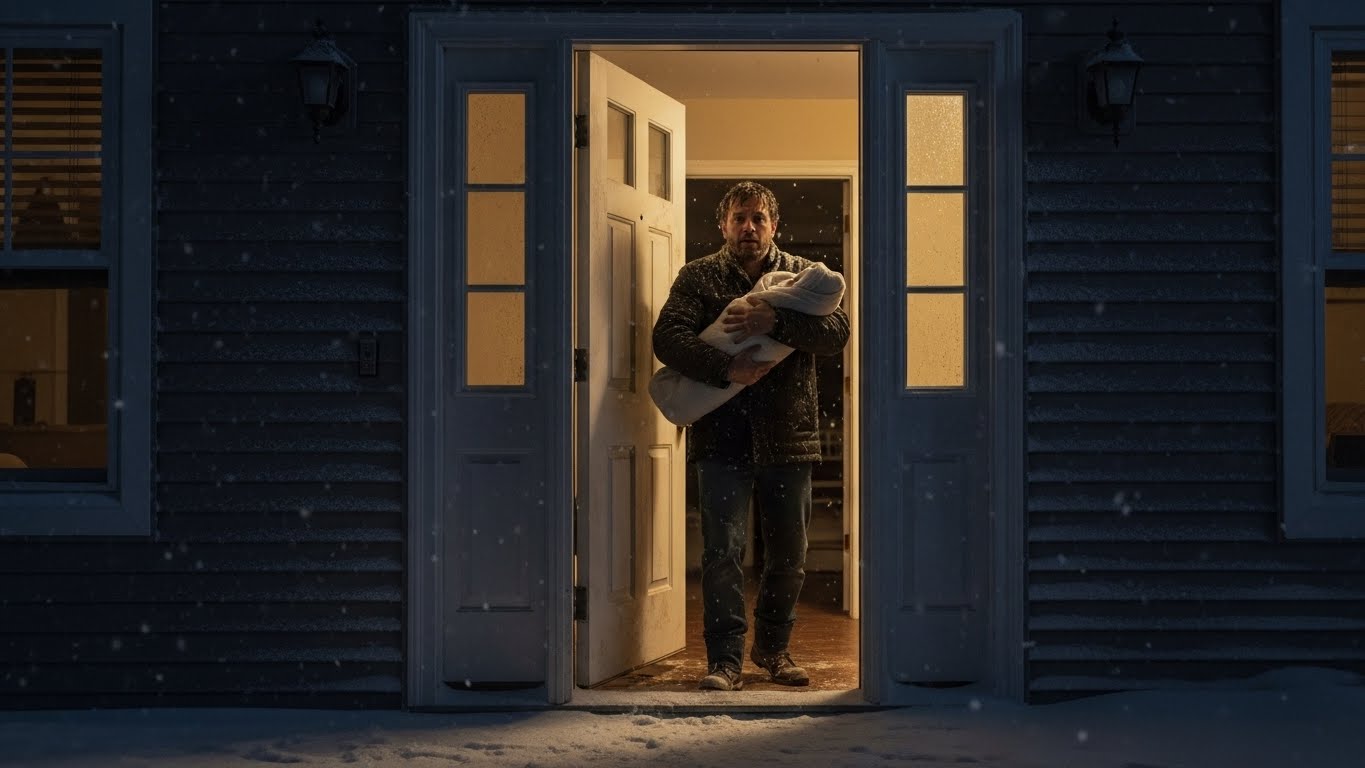
Through the swirling white chaos, illuminated by the faint glow of the snow reflecting the moonlight, I saw him. A figure huddled on my porch, barely standing upright. He wasn’t wearing heavy winter gear—no parka, no snow pants. Just a thin, soaked denim jacket that looked like paper against the elements. His hair was plastered to his skull, frozen in icicles.
But it was what he was clutching to his chest that made my stomach drop into my shoes. A bundle. A small, pink blanket, already dusted with a layer of white.
I didn’t think. I couldn’t think. The image of a child out there, in air that could freeze exposed skin in minutes, overrode every safety protocol in my brain.
I unlocked the deadbolt, my fingers fumbling with the cold metal, and threw the door open.
Chapter 2: The Guest
The wind slammed into me, a physical blow of ice and snow, threatening to extinguish the fire behind me. It sucked the heat out of the room instantly, replacing the smell of woodsmoke with the sharp, metallic scent of ozone and ice.
“Get in!” I shouted over the gale, grabbing the man’s arm.
He stumbled across the threshold, bringing a gust of arctic air with him. He was heavier than he looked, dead weight leaning into me. I struggled to push the door closed against the wind, finally managing to slam it shut and throw the lock. I leaned against the wood, gasping for breath, my heart racing.
The man collapsed to his knees on the rug. He was shaking so violently his teeth chattered audibly, a sound like dry bones clicking together. He looked to be in his forties, handsome in a rugged, weathered way, but his face was a mask of exhaustion. His lips were blue.
“Thank you,” he gasped, his voice trembling uncontrollably. “Oh God, thank you. My car… it slid off the embankment about two miles back. I didn’t know where else to go.”
“You walked two miles in this?” I asked, my voice rising in disbelief. Two miles in this weather was a death sentence.
He nodded, pulling the blanket down to reveal a sleeping infant. The baby couldn’t have been more than six months old. She was pale, too pale, her lips lacking that healthy rosy hue. She was eerily quiet.
“She’s ice cold,” he whispered, looking up at me with eyes that were wide, rimmed with red, and filled with a terror that I assumed was from the cold. “Please. I need… heat.”
“Bring her to the fire,” I commanded, my maternal instincts overriding my caution. “I’ll get blankets. I’ll heat up some milk. Don’t put her too close, just let the ambient heat warm her.”
I ran to the linen closet, grabbing the thickest down comforter I owned and a wool throw. When I came back, he was sitting right in front of the hearth on the stone floor, rocking the baby. The firelight cast long, flickering shadows against the walls, making his silhouette look distorted, almost too large for the room.
I draped the wool throw over his shoulders. He didn’t even flinch. He just kept his eyes on the fire.
“I’m going to the kitchen to light the gas stove,” I said, backing away slowly. “I have formula. Well, I have milk. Is she on solids?”
“Milk is fine,” he said. His voice was stronger now, less tremulous.
I went into the kitchen. My hands were shaking as I poured milk into a saucepan. I struck a match and lit the burner, staring at the blue flame.
Something felt… off.
It wasn’t just the storm. It was the situation. Why was he on this road? This road leads nowhere except to the trailhead and my cabin. It’s a dead end. If he slid off the embankment two miles back, he must have been coming up the mountain, not down. Who drives up a dead-end mountain road in a blizzard with a baby?
I gripped the handle of the saucepan. Stop it, Sarah, I told myself. He’s a father in trouble. Don’t be paranoid.
I walked back into the living room with the warm milk in a bottle I had kept from when my niece visited last year.
“Where is the mother?” I asked, trying to keep my voice steady, handing him the bottle. “Was she in the car? Is she still out there?”
The man stiffened. I saw the muscles in his jaw clench. He didn’t look at me. He just kept staring into the flames, rocking the child a little too fast.
“She’s not here,” he said. His voice was flat. Devoid of the panic he showed earlier. “Just me. Just us.”
“Is she hurt? Do we need to call for help? I have a CB radio in the back room, the phone lines are down but—”
He turned his head slowly. The fire reflected in his eyes, making them look hollow, almost black.
“No,” he said softly. “She’s gone. It’s just me and Lily now.”
I nodded, not wanting to pry into grief on a night like this. “I’m sorry,” I murmured.
I watched him feed the baby. He was gentle, incredibly so. The baby drank greedily, and slowly, color began to return to her cheeks. She let out a soft coo, and the tension in the man’s shoulders dropped visibly.
“You can take the guest room,” I told him, pointing down the hallway. “It’s just there on the left. It’s cold, but there are plenty of blankets. I’ll sleep out here on the sofa near the fire.”
“You’re too kind,” he said, standing up. He loomed over me, taller than I expected, easily six-foot-two. He shifted the baby to one arm and extended a hand. “I’m David.”
I hesitated for a fraction of a second before taking his hand. It was rough, callous, and still cold. “Sarah.”
“Thank you, Sarah. You saved our lives tonight.”
He went into the room and closed the door. I heard the latch click.
I sat by the fire for hours, unable to sleep. The wind outside hadn’t let up, but the silence inside the house was heavier. I kept replaying his face in my mind. The way he looked at the front door before he closed the bedroom door. Like he was checking for an escape route.
Eventually, exhaustion won. I drifted into a restless sleep on the sofa, clutching the fire poker to my chest underneath the blanket.
When I woke up, the silence was absolute.
Chapter 3: The Silence of the Snow
When I woke up, the sun was blinding.
The storm had finally broken. The light streaming through the living room windows was brilliant and sharp, reflecting off the miles of fresh, untouched snow that blanketed the world outside. It was the kind of morning that usually made me love living here—pristine, quiet, holy.
But today, the silence felt wrong. It wasn’t peaceful; it was heavy.
I sat up on the sofa, my neck stiff from the awkward angle. The fire had burned down to gray ash, leaving the room with a lingering chill. I rubbed my face, trying to shake off the grogginess.
“David?” I called out.
My voice echoed slightly in the high-ceilinged room.
Nothing. No footsteps. No baby crying.
I checked my watch. 8:15 AM.
I threw off the blanket and stood up, my socks sliding on the hardwood floor. I walked down the short hallway to the guest room. The door was ajar, just a crack.
My heart began to beat a little faster, a rhythmic thumping in my ears. I pushed the door open.
The room was empty.
The bed was made. Not just slept in and left—it was perfectly made. The corners were tucked, the pillows fluffed, as if no one had touched it in months.
But the room was freezing. I could see my breath in the air.
I looked across the room and gasped. The window was wide open. The screen had been popped out and was lying in the snowbank outside. A drift of snow had blown onto the carpet, not melting in the frigid air of the room.
“Why would he…” I trailed off, confusion warring with a rising sense of panic.
I ran to the kitchen.
On the wooden dining table, there was the empty milk bottle I had given him, washed and dried. Next to it sat a piece of paper torn from a magazine on the coffee table.
Scrawled in charcoal from the fireplace, dirty and smudged, it read:
“Thank you for the warmth. I couldn’t stay. I can’t let them find us. Sorry I left without saying goodbye.”
I stared at the note, my hands trembling. He had left in the middle of the night. Through the window. Why not the door? Because the door was loud? Because he didn’t want to wake me?
Or because he didn’t want me to see which way he went?
I ran to the living room window that overlooked the front yard. The snow was piled high, but I could see them clearly—tracks.
Deep, dragging footprints cutting through the waist-high powder. They didn’t go down the driveway toward the main road. They headed straight into the dense pine forest behind my cabin.
He was heading North. Into the wilderness.
I felt a shiver that had nothing to do with the temperature. That direction… there was nothing that way for forty miles. Just ravines, cliffs, and the frozen expanse of the Gallatin National Forest.
“You idiot,” I whispered to the glass. “You’ll die out there.”
I turned away from the window, intending to find my landline to call the Sheriff, even though I knew the lines were likely down. As I passed the living room, my eyes caught the television.
The power must have come back on sometime in the early morning. The small red standby light was glowing. I grabbed the remote and turned it on, needing the noise, needing to know what the road conditions were like.
The screen flickered to life. The local news station was broadcasting.
A “BREAKING NEWS” banner flashed across the bottom of the screen in urgent, pulsing red.
I was about to change the channel when the anchor’s voice froze the blood in my veins.
“…police are expanding the manhunt to the tri-state area. We are looking for a man considered armed and extremely dangerous.”
A photo appeared on the screen.
I dropped the remote. It clattered onto the hardwood floor, the battery cover popping off, but I didn’t move. I couldn’t breathe.
It was him.
The man who sat by my fire. The man who drank my milk. The man I had slept twenty feet away from.
“Authorities say Elias Thorne kidnapped the six-month-old infant from a hospital in Denver two days ago after assaulting a nurse and a security guard. Thorne is the biological father but lost custody six months ago due to severe psychological instability and a history of violence.”
My knees gave out. I sank onto the sofa, my eyes glued to the screen.
“The child, Lily Thorne, was in the NICU recovering from heart surgery. She requires life-saving medication every twelve hours or she will go into cardiac arrest.”
The anchor paused, looking grave, leaning into the camera.
“The suspect is believed to be driving a stolen dark sedan. If you see this man, do not approach. Call 911 immediately. He is desperate, and he has vowed not to be taken alive.”
Chapter 4: The Ticking Clock
The silence of the house shattered.
It was replaced by the roaring of my own blood in my ears.
Every twelve hours.
I looked at the clock on the mantle. It had been… how long? He arrived around 10 PM. It was now past 8 AM.
If he had left in the middle of the night, when was the last time the baby had her medicine? Did he even have it?
I remembered his jacket. The thin denim. No pockets bulging with pill bottles or syringes. No diaper bag. No supplies. Just the baby wrapped in a blanket.
“Oh my God,” I choked out. “He doesn’t have it.”
He didn’t have the medicine. He was walking into the frozen wilderness with a baby who was essentially a ticking time bomb.
I scrambled for the landline phone on the kitchen wall. I lifted the receiver.
Nothing. No dial tone. Just the dead, static silence of a line severed by falling ice or timber.
I pulled my cell phone from my pocket. “No Service.” Of course. The cell tower was down the valley, likely powerless or damaged by the storm.
I was cut off.
I ran back to the window. The tracks. They were already beginning to soften around the edges as the wind picked up slightly.
He had a head start. Maybe four hours? Maybe five?
In deep snow, moving with a baby, he wouldn’t be fast. But the cold… the cold didn’t care about speed. It just waited.
I paced the living room, my mind racing. The police wouldn’t come. They couldn’t get up my road. My truck was buried. Even if I dug it out, the road down the mountain is a switchback nightmare of ice. I’d slide off the cliff before I made it to the first mile marker.
I was the only one who knew where he was.
I was the only one who could stop him.
I looked at the photo of the baby on the TV screen. A tiny thing with tubes in her nose, smiling weakly. Lily.
He wasn’t trying to save her. In his twisted mind, maybe he thought he was, but he was killing her.
I stopped pacing. I looked at the gun cabinet in the corner of the room.
My husband, Mark, had been a hunter. He taught me everything. How to track, how to shoot, how to survive when the mountain tries to eat you alive. Since he died, I hadn’t touched the rifles. I hated them. They were cold, hard reminders of a life that was gone.
But now? Now they were tools.
I walked over to the cabinet and unlocked it with the key hidden inside the hollow spine of a book on the shelf. I reached in and pulled out the scoped .308 hunting rifle. I checked the action. It was clean, oiled.
I went to the mudroom. I didn’t think; I just moved on autopilot.
Thermal underwear. Waterproof trekking pants. Two pairs of wool socks. My heavy-duty parka. A balaclava.
I grabbed my snowshoes from the wall. Without them, I’d sink to my waist in the drifts. With them, I could move twice as fast as him.
I packed a rucksack: a thermos of hot water, a first aid kit, flashlights, hand warmers, and the rest of the milk formula. I didn’t have heart medication, but I had heat. And I had speed.
I stood by the door, my hand on the latch.
Fear washed over me. A cold, slimy wave of nausea.
He was “armed and dangerous.” He had assaulted a guard. He was mentally unstable.
I was a thirty-four-year-old graphic designer who moved to the woods to hide from the world. I wasn’t a hero. I wasn’t a cop.
But you are the only one here, a voice inside me whispered. If you stay, that baby dies today. And you will hear her silence for the rest of your life.
I gritted my teeth, pulled the bolt of the rifle back to chamber a round, and clicked the safety on.
“Not today,” I said to the empty room.
I opened the door and stepped out into the blinding white.
Chapter 5: The Hunter
The cold hit me like a physical slap. It was sharper than last night, a biting, dry freeze that instantly stiffened the hairs in my nose.
I strapped on the snowshoes, the plastic bindings crunching loudly in the quiet air. I took a breath, adjusted the rifle sling on my shoulder, and looked at the tracks.
They were messy.
He was struggling. I could see where he had fallen, leaving body-shaped depressions in the snow. I could see where he had crawled for a few feet before standing up again.
He was desperate. And he was tiring.
I started to move.
The snowshoes kept me afloat, allowing me to glide over the powder where he had to plow through it. I set a rhythm: step, slide, step, slide.
The forest was eerily beautiful. The pine trees were bowed heavy under the weight of the snow, looking like hunched old men in white robes. The sky was a piercing, unnatural blue.
I tracked him for an hour.
The terrain began to incline. He was heading toward the ridge. Why? The ridge was exposed. It was windy. It was suicide.
Unless he thought he could cross it to get to the old logging road on the other side.
He didn’t know the logging road hadn’t been used in twenty years. It was washed out, a dead end of rock and ice. He was walking into a trap of his own making.
I pushed harder, sweat beginning to bead on my forehead despite the freezing air. My breath came in ragged clouds.
Suddenly, I stopped.
Up ahead, about fifty yards, something bright contrasted against the white snow.
I crouched low, unbuttoning the strap on my scope. I brought the rifle up, looking through the glass.
It wasn’t him.
It was the blue blanket. The one I had given him last night.
It was lying in a heap at the base of a tree.
My heart stopped.
Did he drop her? Did he leave her?
I scrambled forward, abandoning caution. I ran as best as I could in the clumsy snowshoes, my lungs burning.
I reached the blanket and fell to my knees, ripping it open.
Empty.
It was just the wool throw.
I let out a sob of relief, followed instantly by a surge of dread. Why did he drop the blanket?
Then I saw it.
Blood.
Small, dark red drops in the snow. Not a lot. But enough to be terrifying.
Was it him? Was it the baby?
I touched the blood. It was frozen hard.
I looked up at the tracks. They changed here. They became erratic. He was staggering. Dragging one foot.
He was hurt. Or he was hypothermic.
The tracks led toward a dense cluster of spruce trees near the edge of a frozen creek bed.
I stood up, gripping the rifle. The silence of the woods felt malicious now. Every creak of a tree branch sounded like a footstep.
I moved forward, slower now.
“David!” I screamed, my voice cracking. “Elias! Stop!”
My shout disturbed a crow, which took flight from a branch above me, sending a cascade of snow down onto my head.
I wiped my eyes and looked forward.
There.
Through the trees, about a hundred yards away.
A figure.
He was sitting in the snow, leaning against a large boulder. He wasn’t moving.
He wasn’t wearing the jacket anymore. He was in his shirtsleeves.
Paradoxical undressing. The final stage of hypothermia. When the body is so cold, the brain tricks you into thinking you are burning up, so you strip off your clothes right before you die.
I didn’t see the baby.
Panic, hot and searing, exploded in my chest.
“Where is she?” I screamed, running forward, the snowshoes kicking up clouds of white dust.
I closed the distance. Seventy yards. Fifty.
He didn’t move. His head was lolled back against the rock, eyes open, staring up at the blue sky.
I reached him, breathless, my rifle pointed at his chest.
“Elias!”
No response. His skin was the color of marble. Frost had formed on his eyelashes.
He was dead. Or close to it.
I dropped the rifle into the snow and fell to my knees beside him, frantically searching.
“Where is she? Where is Lily?”
His hands were empty. His lap was empty.
I grabbed the collar of his shirt and shook him violently. “What did you do with her?!”
His head lolled to the side. And then, I saw his eyes shift.
Just a fraction. A tiny movement.
His lips parted. A whisper, barely a breath.
“Warm…”
He raised a frozen, stiff hand and pointed.
Not at the woods. Not at the road.
He pointed down.
Under his own body.
He was sitting on his jacket. He had bundled the denim jacket into a nest on the snow, and he was sitting over it, curling his body around it like a dying shield.
He was using the last heat of his body to incubate her.
I shoved his heavy, lifeless weight aside. He slumped over into the snow like a statue.
Beneath him, wrapped in the thin denim jacket and his own flannel shirt, was a tiny bundle.
I peeled back the layers with trembling fingers.
There she was.
Lily.
She was blue. Her eyes were closed. She wasn’t moving.
I ripped my gloves off. I placed my hand on her chest.
Silence.
The world stopped spinning. The wind stopped blowing.
“No,” I whispered. “No, no, no.”
I put my ear to her mouth.
Nothing.
I didn’t think about the man dying in the snow next to me. I didn’t think about the gun. I didn’t think about the cold.
I ripped my parka open. I pulled up my layers of thermal and flannel until my own skin was exposed.
I grabbed the icy, tiny body and shoved her against my bare chest, zipping my parka up over both of us until only her face was visible.
“Come on,” I sobbed, rubbing her back vigorously through the coat, trying to transfer every ounce of fire in my body into hers. “Come on, Lily. Breathe.”
I rocked back and forth in the snow, tears freezing on my cheeks.
“Breathe, damn it! Breathe!”
And then…
A gasp.
A tiny, wet, rattling gasp against my skin.
Then a cough.
And then, the most beautiful sound in the world.
A thin, high-pitched wail.
She was alive.
I fell back into the snow, clutching her, laughing and crying hysterically at the sky.
But the nightmare wasn’t over.
Because as I lay there, looking at the dead man who had died trying to keep her warm, I heard a sound that didn’t belong in the wilderness.
The crunch of snow. Behind me.
I froze.
I turned my head.
Standing ten feet away, watching me, was a massive mountain lion.
Its ribs showed through its tawny fur. It was starving. The winter had been hard for everyone.
It looked at the body of Elias. Then it looked at me. And the screaming bundle in my jacket.
My rifle was ten feet away.
The cat lowered its head, ears pinning back, and let out a low, vibrating growl that shook the ground beneath me.
I was the only thing standing between the predator and the meal.
And I had nowhere left to run.
Chapter 6: The Apex
The mountain lion didn’t look like the majestic creatures you see in nature documentaries. It looked like a demon made of tawny wire and hunger. Its ribs heaved with every breath, and a thick rope of saliva hung from its jowls, steaming in the frigid air.
It was ten feet away. My rifle was ten feet away. We formed a perfect, deadly triangle.
Lily wailed against my chest, a muffled, distressed sound that acted like a dinner bell to the predator. The cat’s ears swiveled toward the sound, its yellow eyes locking onto the bulge in my parka.
“Shh,” I hissed, my hand pressing visibly over the baby’s back through the fabric. “Don’t cry. Please, don’t cry.”
The cat took a step forward. The snow crunched softly under its massive paws. It wasn’t rushing. It knew I was cornered. It knew Elias was dead. It was assessing which one of us was the easier kill.
My heart hammered so hard I thought it might bruise the baby. I calculated the distance. If I dove for the rifle, I would expose my back. If I stayed still, it would pounce.
I needed a distraction.
My eyes darted to the thermos in the side pocket of my rucksack, which lay in the snow near my knees.
The cat lowered its body, its hind legs bunching up. The muscles in its shoulders rippled. It was preparing to launch.
“Hey!” I screamed, a raw, guttural sound that tore at my throat.
The cat flinched, its concentration broken for a microsecond.
I didn’t waste it.
I grabbed the heavy metal thermos and hurled it with every ounce of hysterical strength I possessed. It sailed through the air and struck the cat square on the snout with a hollow thud.
The beast yowled, shaking its head, batting at the air.
I threw myself to the right, landing hard on my side in the snow, my arms instinctively curling around my chest to protect Lily.
My hand clawed through the powder, fingers searching blindly.
Cold metal.
I gripped the stock of the .308.
The cat recovered instantly. It let out a shriek that sounded like a woman screaming and launched itself at me.
I didn’t have time to aim. I didn’t have time to stand.
I rolled onto my back, jamming the butt of the rifle into the snow to steady it, and pulled the trigger while the barrel was still pointing skyward at an angle.
CRACK.
The sound was deafening in the silence of the woods. The recoil jarred my shoulder, but I barely felt it.
The cat twisted in mid-air, a fluid, impossible motion, and landed heavily on top of my legs.
I screamed, kicking out wildly. The weight was immense. Claws shredded the bottom of my trekking pants, searing lines of fire racing up my calf.
I worked the bolt of the rifle, ejecting the spent shell. Clack-clack.
I shoved the barrel into the fur of the animal’s flank and fired again.
BOOM.
The heavy weight on my legs convulsed once, violently, and then went limp.
Silence rushed back into the forest, ringing in my ears.
I lay there for a moment, gasping, staring up at the blue sky through the pine branches. The smell of gunpowder and wet fur filled my nose.
I scrambled out from under the carcass, dragging myself backward through the snow until my back hit a tree.
I ripped my zipper down just an inch to check Lily.
She was wide alive, eyes wide, staring up at me. She wasn’t crying anymore. She was too shocked by the noise.
“It’s okay,” I sobbed, kissing her forehead. “It’s okay. I got it. I got the monster.”
I looked over at Elias.
He hadn’t moved. He hadn’t flinched at the gunshots. The mountain lion had ignored him because he was already gone. The predator wanted warm blood.
I stood up on shaky legs, my calf bleeding, but functional. I walked over to the man who had died to save this child.
I knelt beside him. I reached out and closed his eyes.
“You didn’t leave her,” I whispered. “You didn’t leave her.”
I couldn’t carry him. The snow was too deep, the terrain too rough. I could barely carry myself.
I took his flannel shirt—the one he had wrapped Lily in—and tucked it into my pack. I took his wallet from his back pocket, needing something to prove who he was, to prove he wasn’t just a headline.
Inside, there was a picture. A photo booth strip of him and a woman, laughing. And a tiny hospital bracelet. Lily Thorne.
I put the wallet in my pocket.
“I’ll come back for you,” I promised him. “I won’t let you stay out here alone.”
I turned my back on the dead man and the dead cat, and I started to walk.
Chapter 7: The White Mile
The adrenaline crash hit me about twenty minutes later.
It felt like someone had unplugged my battery. My legs turned to lead. The cold, which I had ignored during the fight, came back with a vengeance. It gnawed at my fingers, my toes, the tip of my nose.
I checked my watch. 10:45 AM.
Lily needed her medication by roughly 10:00 AM or 11:00 AM, based on the news report saying “every twelve hours.” Assuming he took her late the night before… we were in the danger zone.
She was quiet against my chest. Too quiet.
“Stay with me, baby,” I muttered, my teeth chattering. “Don’t you dare go to sleep.”
The trek back was a nightmare. The sun was high now, reflecting off the snow with a blinding intensity. I hadn’t brought sunglasses. My eyes burned and watered, the world turning into a blurry wash of white and gray.
Every step was a battle. Lift the snowshoe. Step. Sink. Repeat.
My calf throbbed where the lion had scratched me. I could feel the blood sticking to my sock, freezing into a crust.
I started to hallucinate.
I saw movement in the trees. I saw Mark, my husband, standing by a pine tree, wearing his favorite orange hunting vest.
“Keep moving, Sarah,” he said, his voice clear as a bell.
“I can’t,” I whispered to the empty air. “I’m so tired.”
“You have the baby. Keep moving.”
I stumbled, falling to my knees. The impact knocked the wind out of me. I wanted to just lie there. The snow was soft. It looked like a bed. It would be so easy to just close my eyes for a minute. Just one minute.
Lily shifted against me. A tiny hand reached up and grabbed the fabric of my thermal shirt.
The movement was faint, weak.
She was fading.
I let out a scream of frustration and forced myself up.
“Not today!” I yelled at the snow. “You don’t get her!”
I started singing. I didn’t know why, but it was the only thing I could think of to keep a rhythm.
“Jingle bells, jingle bells, jingle all the way…”
My voice was cracked and off-key, drifting through the desolate forest.
I crested the ridge.
Below me, about a mile away, I saw it.
Smoke.
Chimney smoke. My cabin.
It looked like a toy house from this distance, but it was the most beautiful thing I had ever seen.
And then I heard it.
A sound that cut through the wind. A rhythmic thumping.
I looked up, shielding my eyes.
A helicopter.
It was red and white. Search and Rescue.
It was circling the valley, miles away from where I was. They were looking in the wrong place. They were looking near the main road where his car had crashed.
“Over here!” I screamed, waving my arms frantically.
But they were too far. They turned and banked away, heading south.
Despair crashed over me. They were leaving.
I looked down at the cabin. I had to make it. I was the only rescue party.
I slid down the ridge, half-falling, half-skiing on the snowshoes. I didn’t care about safety anymore. I cared about speed.
I hit the tree line at the bottom of the ridge and kept moving. My lungs burned like I had inhaled broken glass.
Finally, I broke through the trees into my backyard.
I stumbled up the porch steps and collapsed against the door, fumbling for the handle.
I fell inside the house. The warmth hit me like a wall.
I didn’t stop. I couldn’t stop.
I scrambled to my feet, kicked off the snowshoes, and ran to the kitchen.
I grabbed the landline. Still dead.
I grabbed my cell phone.
One bar.
Just one tiny bar of service flickering in the corner. The storm clearing must have reconnected the tower.
I dialed 911.
“Emergency, operator 42.”
“I have her,” I rasped, sliding down the kitchen cabinet to the floor. “I have Lily Thorne. She needs a heart ambulance. Now.”
Chapter 8: The Thaw
The next hour was a blur of noise and lights.
The Sheriff’s deputies arrived first, their SUVs tearing up my driveway, chains churning the snow. Then the ambulance. Then the helicopter, landing in the field next to my house.
They took Lily from me immediately.
I watched as the paramedics swarmed around the tiny bundle. I saw them hook up monitors. I saw the flat line on the screen for a terrifying second before a rhythm appeared. Beep… beep… beep.
“She’s bradycardic,” one medic shouted. “Get the epinephrine! How long has she been without meds?”
“I don’t know!” I cried from the doorway, where a deputy was holding me back. “Since last night!”
They loaded her into the helicopter. The rotors spun up, whipping snow into a frenzy.
I watched it lift off, a red star rising into the blue sky.
“Ma’am?”
I turned. A tall officer was standing there. He looked at my torn pants, the blood on my leg, the wild look in my eyes.
“We need to get you to the hospital too,” he said gently. “And… we need to know where the suspect is.”
I looked at him. I reached into my pocket and pulled out the wallet. I handed it to him.
“He’s not a suspect,” I said, my voice hollow. “He’s a father. He’s about three miles north, near the creek bed. You’ll find him under the snow.”
Two days later, the sensation in my toes had finally returned.
I was sitting in a hospital waiting room in Bozeman. My leg was stitched up and bandaged. My face was windburned red, peeling slightly.
The news was playing on the TV in the corner.
“…a miraculous survival story today. Lily Thorne is in stable condition after being rescued from the wilderness…”
They showed a picture of me. A terrible driver’s license photo.
“Sarah Miller, a local graphic designer, is being hailed a hero for tracking the kidnapper and saving the child.”
They showed a picture of Elias.
“The body of Elias Thorne was recovered yesterday. Police confirm he died of hypothermia. Forensic evidence suggests he used his own clothing to keep the infant warm in his final hours.”
The narrative had shifted. He wasn’t the monster anymore. He was the tragic figure. The desperate man who broke because he couldn’t bear to lose his daughter to the system, only to give his life to ensure she survived the storm he created.
A door opened. A doctor walked out, looking tired but smiling.
“Ms. Miller?”
I stood up.
“She’s awake. The mother… the foster mother… agreed to let you see her.”
I walked into the NICU. It was warm and quiet, filled with the soft beeping of machines.
There she was.
Lying in a plastic crib, hooked up to wires, but pink. Warm. Alive.
She looked at me. Those big eyes.
I reached out and touched her hand. Her tiny fingers curled around my index finger.
I thought about the night she came to my door. I thought about the man who stood in the blizzard, terrified, not for himself, but for her.
He had knocked on my door hoping for a miracle. And in a twisted, heartbreaking way, he got one.
I leaned down and whispered to the baby.
“I told you,” I said, tears prickling my eyes. “I told you I wouldn’t let the cold take you.”
I looked out the hospital window at the mountains in the distance. They looked beautiful. Silent.
I wasn’t afraid of the silence anymore. I had filled it with something that mattered.
I squeezed Lily’s hand one last time, feeling the strong, steady beat of her heart, and finally, for the first time in two days, I exhaled.
[THE END]