I Was Eight When I Realized My Parents Weren’t My Saviors. They Were My Captors. The Night I Fled My ‘American Dream’ Home Will Haunt You.
Part 2: The Journey West
Chapter 3: The Ghost on Highway 92
The first mile was the hardest. Every car that passed felt like a patrol car. Every shadow seemed to coalesce into the shape of my father. I kept my head down, forcing myself to focus on the rhythm of my sneakers hitting the cracked sidewalk. The neighborhood of Oak Crest eventually gave way to the commercial strip of Highway 92.
The Quick Stop sign glowed ahead, a beacon of cheap coffee and questionable freedom. It was almost 9:30 PM. The bus was scheduled to leave at 10:00 PM. I had made it, but now the real danger began: visibility.
The gas station parking lot was brightly lit, exposing me. I tucked myself into the shadowed corner of the building, near the dumpster, and watched the bus pull up—a massive, rumbling steel beast. The driver, a tired-looking woman with a nametag that read ‘Darlene’, opened the doors, and three people quickly climbed aboard.
I waited until the last possible second. As Darlene was closing the door, I darted out, my small hand slamming onto the metal railing.
“Wait! Please!” I panted, my voice thin and high.
Darlene looked down at me, her expression shifting from annoyance to a sort of weary suspicion. She was a middle-aged woman, her face etched with the exhaustion of a double shift.
“Where’s your parent, honey?” she asked, her voice softer than I expected.
I had prepared for this. I looked down, biting my lip hard enough to feel the metallic tang of blood. “They… they had to leave. My mom got sick, really sick. They sent me to stay with my grandmother. She’s waiting for me at the station downtown. They said I had to take this bus.” I swallowed, pushing out the last, most crucial lie. “She gave me the money, but she’s running late with the car. She asked me to hurry.”
I held out the three crumpled twenties. It was all I had. The fare was only four dollars.
Darlene’s eyes narrowed, scanning the empty parking lot. She clearly didn’t believe the grandmother story, but she saw the fear in my eyes and, maybe, the desperation. She took a deep breath, the sound whistling past her lips.
“Listen, I’m not supposed to let unaccompanied kids ride,” she said, her voice low enough that the other passengers wouldn’t hear. “But I’m not leaving a kid out on 92 at this hour, either. Get on, sweetheart. And you sit right up front behind me. You say one word to anyone but me, and I’m calling the police.”
It wasn’t a welcome, but it was a reprieve. I scrambled onto the bus, my heart singing a shaky tune of victory. The warm air inside smelled of stale fabric and cheap pine cleaner. I sank into the vinyl seat directly behind Darlene, my small backpack clutched to my chest.
The journey downtown was a blur of neon lights and rushing street signs. I pressed my face against the cool window, watching my former life disappear. I felt a surge of adrenaline, but beneath it, the fear remained a cold, heavy lump.
At the main MARTA station—the central transportation hub—the atmosphere was chaotic and overwhelming. It was loud, crowded, and utterly anonymous. Darlene stopped the bus.
“Alright, kid,” she muttered, not looking back. “You get off here, and you go straight to the Greyhound counter. You find a ticket agent. You tell them your grandmother missed you, and you need to call her. Don’t wander. Got it?”
“Yes, ma’am,” I whispered.
As I stepped off the bus, Darlene called out, a final, gruff piece of advice. “And change that shirt. You’re wearing the same color as the bus seats. You’re too easy to spot.”
It was solid advice. I had a thin, dark blue t-shirt under my hoodie. I quickly swapped the hoodie for the shirt and then put the hoodie back on, just to make Darlene feel like I listened.
The Greyhound terminal was vast and cold, filled with people who looked just as tired and lost as I felt. I found a corner near a vending machine and sat down, pulling out my crumpled map. Colorado. The bus route was a red line I had traced with a shaky pencil. I needed a ticket to Denver, the main hub.
My hands trembled as I counted the money again. I had sixty dollars. I knew, from eavesdropping on my parents’ travel plans, that a bus ticket across the country would cost far, far more. Panic began to set in, a chilling wave that threatened to drown the small fire of hope I had managed to kindle. I was stuck. The dream of Aunt Carol, the dream of escape, suddenly felt childish and impossible. The walls of the station seemed to be closing in. I could almost hear the distant, growing siren of a police car—the one that would take me back to Oak Crest.
I needed a miracle, or at least, a lot more money.
Chapter 4: The Kindness of Strangers
Despair is a heavy burden for an eight-year-old. I sat there for what felt like hours, watching the ticket agents exchange money and hand out slips of paper that meant freedom. My tears were silent, hot trails on my cheeks, quickly wiped away. I knew if I cried too loudly, someone would notice, and the whole fragile plan would collapse.
Then, a voice.
“Hey, little one. You shouldn’t be sitting on the floor like that. You going somewhere?”
I looked up. Standing over me was a woman in her late twenties, with bright, kind eyes and hair pulled back in a neat braid. She was wearing a worn denim jacket and carrying a heavy backpack. She looked like an experienced traveler. Her name, I would later learn, was Jess.
I used the same story, the one about the sick mother and the waiting grandmother, but this time, the lie felt even more transparent, even to me.
Jess sat down next to me on the cold tile floor. She didn’t press. She just watched the flow of travelers. After a long silence, she reached into her bag and pulled out a small packet of crackers and a juice box.
“Here. You look hungry,” she said. “And don’t worry, I won’t call anyone. I know a runaway when I see one. You’ve got that look in your eyes, the one that says you’re running from something, not to something.”
Her honesty stunned me into silence. I had spent my whole life hiding, and here was a stranger who saw through my shield instantly. I took a shaky bite of the cracker.
“I… I need to get to Denver,” I finally whispered, the words barely audible. “To my Aunt Carol. But I don’t have enough money. I only have… sixty dollars.”
Jess let out a low whistle. “Denver? That’s a haul, kid. You’re short a few hundred, at least.” She thought for a moment, tapping her finger on her chin. “Look, I can’t buy you a ticket. I’m heading to Dallas myself, and I barely scraped together my own fare.”
My heart plummeted. My small victory was about to become my biggest defeat.
“But,” Jess continued, leaning in conspiratorially, “I know how the system works. The bus to Dallas leaves in an hour. From Dallas, there’s a major connection point to the West Coast and, importantly, the route that goes through Colorado. You could probably ride without a full ticket for a couple of legs, if you’re smart.”
I looked at her, my eyes wide. “How?”
“Simple. You wait for the last call for the Dallas bus. You go up to the ticket agent and you say your ticket got damaged. Show them the sixty bucks and say, ‘My mom paid for the first half, but I need to call her and she’s not answering. Can you just get me to Dallas, please? I promise she’ll meet me there.’ The agents are tired, they’re overworked, and if they see a kid with cash who looks desperate, they’ll often just give you a partial, short-term pass to get you out of their hair and onto the bus.”
It was a huge risk, relying on the apathy of a tired employee. But I had no other choice.
Jess gave me a detailed, step-by-step tutorial: which agent to approach (the one with the longest line, because they were more likely to rush), exactly how to cry (without being hysterical), and the exact ticket counter to avoid (the one with the security guard).
When the announcement for the Dallas bus began, I stood up, my legs wobbly. I looked at Jess.
“Why are you helping me?” I asked.
She just shrugged, a sad, knowing look in her eyes. “Let’s just say I used to know a kid who looked a lot like you. Go get your freedom, Maya.”
I used my own name without thinking. She didn’t react.
I walked to the designated counter. The agent, a heavy-set man with a mustache and tired eyes, was indeed moving fast. I waited my turn, heart pounding so loudly I was sure he could hear it.
I pulled out the money, held it up, and delivered the rehearsed lie, adding a slight, authentic tremor to my voice. “Please, sir. I need to get to Dallas. My ticket got wet. My mother will meet me there. Can you just give me a pass for this bus? I have the money for the rest.”
The agent sighed, rubbed his face, and looked at the clock. He took my sixty dollars, wrote something illegible on a pink slip, and handed it to me. “This gets you to Dallas. No stops. No getting off the bus. You get on that bus, and you sit down, and you don’t move until you get to Texas. Got it? Don’t lose that slip.”
He gave me back twenty dollars. I had just bought a ticket to Texas for forty dollars. Jess’s gamble had paid off.
I ran to the gate. I didn’t look back at Jess, who was waiting in her own line. I didn’t dare risk drawing any more attention. I stepped onto the Greyhound, found an empty double seat near the middle, and slumped down.
The bus pulled out of the station at 11:30 PM. As the lights of Atlanta disappeared in the rearview mirror, I allowed myself a small, ragged breath. I was on the run. I was alone. But I was moving west.
I pulled out the twenty dollars and the crumpled pink slip. The first barrier had fallen. The journey of a thousand miles had truly begun. I knew one thing: if my parents were chasing me, they would realize I hadn’t just run away; I had started a cross-country escape. The stakes were now terrifyingly high.
Chapter 5: The Crossroads of Fear
The Greyhound ride to Dallas was a 15-hour marathon of cramped seats, humming engine noise, and the deep, unsettling paranoia that every time the bus stopped, a uniformed officer would board, scanning the faces for an eight-year-old runaway.
I didn’t sleep. I just watched. I watched the dawn break over the endless stretches of highway, turning the black asphalt silver and then bright gray. I watched the other passengers—a mix of tired families, soldiers, and solitary travelers—each lost in their own world. Nobody looked at me twice. In the anonymity of the highway, I was just another blur.
When we pulled into the Dallas Bus Terminal late that afternoon, the change in temperature hit me—hotter, drier, distinctly Texan. I was only 8 years old, but I was already a seasoned traveler of fear.
I knew the pink slip was useless now. I had two options: try the same trick again at the Greyhound counter for a ticket toward Denver, or find a different, more desperate method.
I chose desperation. The bus station had a small area designated for ride-sharing and long-haul trucker meetups. It was a high-traffic area, full of men and women who looked like they were used to long, lonely drives.
I found a spot by a chain-link fence, watching the truckers check their tires and secure their loads. They all looked imposing, with their big belts and even bigger trucks.
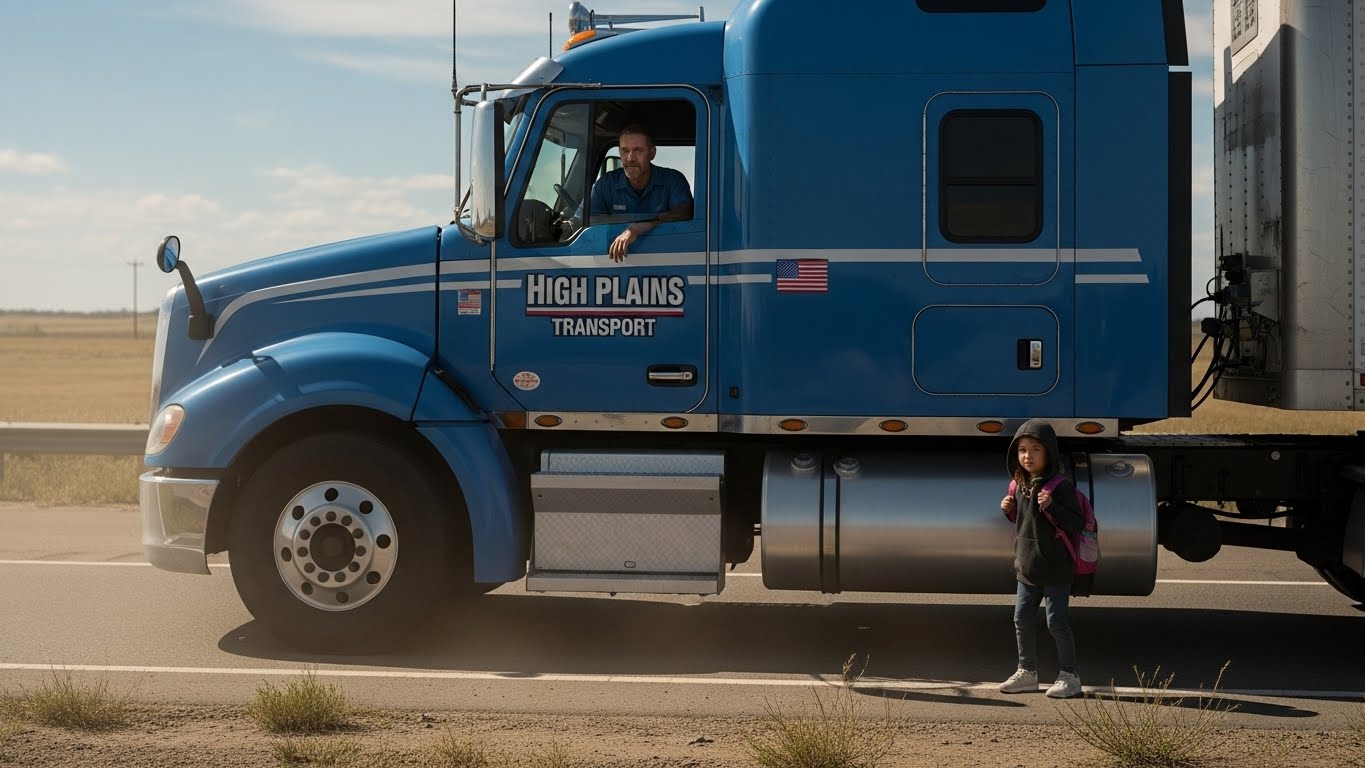
I focused on the quietest one, a man in a clean, blue uniform with a company logo that said ‘High Plains Transport’. He was meticulously checking the air pressure on his massive tires. He had a kind, weathered face and a silver wedding band. He looked trustworthy. I decided I had to risk it.
I walked up to him, keeping a respectful distance.
“Excuse me, sir,” I said, my voice trying to be as adult as possible.
He turned, startled, and looked down at me, his eyes wide. “Well, hello there, little lady. Where’s your folks?”
I took a deep breath. No more lies about sick mothers and grandmothers. This had to be the truth, or close to it.
“Sir, I’m trying to get to Denver. To my Aunt Carol. I ran away.” The words tasted like ash. I watched his face for the flicker of disgust or the immediate pull of his phone.
Instead, he just looked sad. He knelt down, bringing his face closer to mine. His name tag read ‘Earl’.
“Run away? Why would you do that, sweetie? Is someone hurting you?”
I nodded, unable to speak. The lump in my throat was too big. I just silently pulled up the sleeve of my hoodie to show the faint, fading bruise on my arm from two nights ago.
Earl’s face hardened immediately. He didn’t ask another question about my parents or the details. He just seemed to understand the gravity of the situation instantly.
He stood up and looked around the busy lot. “Alright, look here. My route takes me north, up through Oklahoma City, and then west, straight through Kansas on the I-70 corridor. I’m heading to a depot outside Colorado Springs. That’s close to Denver, but it’s not Denver. Is that good enough?”
I didn’t hesitate. “Yes, sir. Anything west.”
“You understand the risks, right? Getting in a truck with a stranger? I’m going to trust you. I need you to trust me. My wife, she volunteers at a shelter for kids. I’m not going to hurt you. But you’re going to have to be invisible. If the company finds out I’m transporting a minor without a police report, I lose my job. And if the police find you, they’ll send you right back to Atlanta.”
I nodded fiercely. “I know how to be invisible. I’m really good at it.”
Earl smiled a small, sad smile. “I bet you are. Get in. We’re moving in five minutes.”
He opened the passenger door of the massive, chrome-accented semi-truck. It was like climbing into a spaceship. The interior was spotless, smelling of coffee and the faint scent of diesel.
“Now, rule one,” Earl said as he climbed into the driver’s seat. “My CB radio code is ‘Midnight Rider.’ When I’m talking, you’re silent. Rule two: if we pull into a truck stop, you lay down on that bench behind you and cover up with that blanket. You do not, under any circumstances, let anyone see you.”
I felt a surge of adrenaline mixed with profound relief. I had a ride. A real ride, headed west. I was sitting next to a massive American flag sticker on the dashboard, a symbol of the freedom I was now dangerously close to grasping.
As the truck roared to life, pulling out onto the long ribbon of the highway, I looked back at the terminal. I was leaving the relative safety of the public transport system for the wild, high-stakes game of the American interstate. I was eight years old, riding shotgun in a big rig, running from the only home I had ever known. The thought was terrifying, but the silence inside the cab, broken only by the low rumble of the engine, was the most peaceful sound I had heard in years. I had officially become a fugitive.
Chapter 6: The Long Haul to Hope
The next two days blurred into an endless panorama of sky and asphalt. We drove through the sun-baked plains of Oklahoma, where the land was flat and the sky was immense, then into the golden wheat fields of Kansas. Earl was a man of quiet routine. He had an old-school way about him—always checking his mirrors, always polite on the CB radio. He didn’t press me for details, which I was deeply grateful for. He just treated me like a weary co-pilot.
He’d talk sometimes, mostly about the road. “See those lights, Maya? That’s where the world changes. You got mountains up ahead. They’ll chew you up and spit you out if you don’t respect them.”
He’d buy me dinner at truck stops—greasy burgers, warm fries—and bring it back to the truck. I’d sit on the bench and eat, covered by a heavy, scratchy wool blanket, the air thick with the smell of the truck stop diner. I was always hiding, but the fear was different now. It was no longer the paralyzing terror of waiting for the next blow; it was the tense, focused anxiety of a mission.
On the second night, somewhere deep in the middle of Kansas, Earl asked me the one question I hadn’t prepared for.
“Maya, when your parents find out, they’re not just going to report you missing. They’re going to report me for kidnapping. They’ll say I lured you away. Are you sure you’re ready for the consequences, both for you and for me?”
I knew he was right. I pulled out my tattered copy of The Secret Garden and showed him the faint, blurry picture of my Aunt Carol tucked inside.
“I have to get to her, Earl. They hit me. They lock me in the closet. They told me I’m worthless. If I go back, it won’t just be the hitting. It’ll be worse. They’ll be embarrassed, and they’ll take it out on me for making them look bad to the neighbors.” My voice was shaking, but I forced the words out. “If they find you, tell them the truth. Tell them I begged you. Tell them I threatened to run into traffic if you didn’t help. I’ll write it down. I’ll make a sworn statement.”
Earl pulled the truck over to the side of a deserted rest area, shutting off the engine. The sudden silence was absolute. He turned and looked at me, a long, searching look.
“No, you won’t,” he finally said, his voice heavy with resignation. “You’re a kid. They won’t believe you. But you know what? Doesn’t matter. Some things are worth losing your job over. You sleep now, kid. We’re in Colorado by morning.”
His decision, his quiet act of faith in a scared, bruised eight-year-old, felt like a lifeline. He wasn’t just driving me; he was taking on my fear, my risk, and my entire impossible journey.
I finally slept, a deep, exhausted sleep, curled up on the bench behind the seats, the rhythmic purr of the truck engine lulling me.
I woke to the sight of mountains. Massive, snow-capped peaks piercing the bright blue sky. The Rockies. We were finally in Colorado.
The landscape was a dramatic contrast to the flat fields of the Midwest. The air felt cleaner, colder, and sharper. My heart pounded with renewed anticipation. We were nearing Colorado Springs, where Earl’s delivery depot was located.
“Okay, Maya, here’s the plan,” Earl said, checking his mirrors one last time as we exited the highway. “I can’t drive into Denver. Too busy. Too many cameras. Too many chances of being spotted. The depot is just outside the Springs. I’m going to drop the trailer, and then I’m going to drive you to a spot I know. It’s a small, family-owned gas station called The Peak Stop. It’s on the old interstate route, about fifty miles outside of Denver. From there, you can catch a local commuter bus that runs straight into the city center.”
It was meticulous planning, another layer of risk Earl was taking to ensure my freedom.
The final hour in the truck was the most nerve-wracking. Every police car, every slow-moving minivan, felt like a threat. My stomach was a knot of anxiety. I kept repeating Aunt Carol’s name like a mantra: Carol. Carol. Carol.
When we pulled up to The Peak Stop, a brightly painted, slightly run-down station nestled against a backdrop of towering pines, Earl turned off the engine.
“This is it, Maya,” he said. He reached into his wallet and pulled out a stack of bills—mostly fives and tens. “Here. This isn’t a lot, but it’s enough for the bus and a few meals. Don’t tell anyone where you got it. Don’t tell anyone about the truck. You’re on your own from here. Stay safe.”
I stared at the money—easily another fifty dollars. He was risking his livelihood, and now his savings, for me.
“Thank you, Earl,” I choked out, tears finally blurring my vision. “I won’t ever forget you.”
He didn’t say goodbye. He just gave me a quick, firm hug—the first non-violent, genuinely warm touch I’d had in years. He opened the door, and I scrambled down, clutching my backpack.
I didn’t look back until the sound of his big rig had faded completely into the mountain air. I was standing alone at the edge of a new state, with a small backpack, some stolen cash, and a profound debt to a complete stranger. The next bus to Denver was due in 30 minutes. I had to make the last leap.
Chapter 7: The Final Approach
The local commuter bus to Denver was small, smelling faintly of stale coffee and mountain air. It was nothing like the massive, impersonal Greyhound. It was filled with locals, mostly older people and a few college students. I took a seat by the window and watched the landscape shift from dense pine forest to the sprawling, modern outskirts of a major city.
The closer we got to Denver, the more intense my anxiety became. I was afraid of Denver itself—the crowded streets, the noise, the potential for someone to recognize my desperate, lost face from a missing person report.
My parents, I knew, would be frantic by now. They wouldn’t be worried about me; they’d be worried about their reputation. They’d have called the police, spinning a perfect lie about the ‘unstable’ child who ran away, perhaps making up a story about a predatory stranger they feared had lured me. They would be portraying themselves as the victimized, heartbroken parents of Oak Crest.
I knew the police would be looking for me at bus stations, train stations, and airports. They’d be looking for a child who looked scared and lost. I tried to look bored, like a normal kid waiting for her destination.
Aunt Carol lived in a neighborhood called Highlands, known for its charming, older houses and local coffee shops. I had the address written on the inside cover of The Secret Garden.
The bus dropped me off in the busy heart of Denver, a chaos of rushing people and city noise. I pulled my hood up, kept my head down, and started walking. The fear was a physical pressure, a constant vice squeezing my chest.
I stopped in a small convenience store, bought a bottle of water, and, using the payphone outside (a relic I was lucky to find), I decided to make the terrifying call. I only had two dimes left. I had to make this count.
I dialed Aunt Carol’s number. It rang once. Twice. My heart pounded against my ribs. Three times. I was about to hang up, convinced I had risked everything for a dead end, when a woman’s voice, clear and slightly sharp, answered.
“Hello?”
I swallowed, my throat dry as the Kansas plains.
“Aunt Carol?” I whispered.
There was a moment of silence on the other end. “Who is this? How did you get this number?”
“It’s Maya. Mom’s daughter. I… I’m here. In Denver. I ran away.”
The silence this time was deep, profound. I could hear my own ragged breathing over the static of the phone line.
“Maya,” she finally said, her voice dropping to a low, intense whisper. “Are you safe? Where are you right now?”
I gave her the address of the intersection. I didn’t give her details about my parents. I didn’t need to. The simple fact that I was in Denver, alone, was enough.
“Stay there. Do not move. Do not talk to anyone. I’m leaving now. It will take me 15 minutes. Maya, are you sure you’re alone?”
“Yes. Please hurry.”
The fifteen minutes felt like fifteen years. Every car that slowed down, every person who glanced my way, felt like an emissary of my past. I watched the clock on the payphone tick down, my eyes darting nervously.
Then, a small, slightly dented gray sedan pulled up to the curb. The woman behind the wheel was instantly recognizable, even after all these years. Her hair was shorter, wispier, but her eyes—those kind, laughing eyes—were the same. Aunt Carol.
She didn’t shout my name. She didn’t jump out dramatically. She simply opened the passenger door and looked at me.
“Get in, Maya. Quickly. Now.”
I didn’t hesitate. I scrambled into the car, pulling my backpack in after me. As soon as I slammed the door shut, Aunt Carol sped away from the curb.
I was safe. The sheer relief was so overwhelming that it almost paralyzed me. But then, Aunt Carol’s voice cut through the silence, sharp and professional.
“They’ve already called me, Maya. Your mother. She called my work number an hour ago, frantic. She knew I was the only person you might run to. She wasn’t worried about you. She was trying to get ahead of the story. She said, and I quote, ‘If you see her, send her back immediately, or I’ll call the police on you for abduction.’”
My parents were already covering their tracks. They were already creating a narrative of a vengeful sister and a runaway child. My heart sank. I had reached my sanctuary, but the siege was far from over.
Chapter 8: The Price of Silence
Aunt Carol’s house was a cozy, colorful bungalow, a direct opposite to the sterile perfection of my Oak Crest home. It smelled of cinnamon and old books. She led me straight to the kitchen table, where a plate of warm cookies and a glass of milk were waiting, as if she had been expecting a runaway eight-year-old.
“Okay, Maya. We don’t have much time. Sit down, eat something, and tell me everything. Start from the night you left.”
I told her the story—the laundry room, the sixty dollars, the Quick Stop, Darlene, Jess, and finally, Earl, the trucker. As I spoke, the adrenaline began to fade, replaced by a crushing wave of exhaustion and pain. I showed her the bruises.
Aunt Carol listened without interruption, her face growing paler and colder with every word. When I finished, she walked straight to a cabinet, pulled out a phone, and hesitated.
“I have two calls to make, Maya. The first is to the local police. I have to report your presence here. If I don’t, your mother will make good on her threat to charge me with abduction. I have to protect myself to protect you. I will tell them the truth: that you are a runaway and that you are bruised, and that you are under my care. I will tell them you fear for your life if you return.”
I burst into tears. “They’ll send me back! They’ll always believe the parents!”
She knelt down and took my hands, her eyes fiercely determined. “Not if I stop them. I am going to call my lawyer, Mr. Chen. He is one of the best family law attorneys in Denver. He will be on the line when I call the police. I will not let them near you until a judge is involved. This is not just a runaway case, Maya. This is a child welfare case. We will fight them. We will fight the American system that defaults to believing the parents are innocent.”
It was a terrifying thought: trading one battle for a legal war. But for the first time in my life, I wasn’t fighting alone.
The police arrived 45 minutes later—two plainclothes officers. Aunt Carol, cool and composed, sat me down in the living room. Mr. Chen was on the speakerphone.
The officers were skeptical. They had a missing person report from David and Sarah, who were already on a plane, portraying themselves as frantic parents.
“Ma’am, the parents claim the child is mentally distressed and has a tendency to fabricate stories,” the female officer, Detective Harris, said stiffly. “They are high-standing members of their community. We have an obligation to return the child to their custody.”
“And I have an obligation to this child,” Aunt Carol retorted, her voice shaking with controlled anger. “Look at her. She is eight years old and ran five states away. This is not a child with a psychiatric problem, Detective. This is a child in fear. She has bruises. My lawyer is on the line, and I am formally reporting suspected child abuse and neglect. We demand a full investigation by Colorado Child Protective Services before she is allowed within a hundred miles of those monsters.”
The next few hours were a whirlwind of questions, documented photographs of my bruises, and legal maneuvering. Detective Harris finally seemed swayed, her professional skepticism yielding to the undeniable reality of a quiet, bruised girl and the ferocious, protective stance of her aunt.
The ultimate compromise: I would be placed in protective custody—in a quiet room at a local children’s center—until a Colorado judge could issue an emergency temporary custody order to Aunt Carol. It was still custody, but it was custody away from my parents.
As the police car drove me away, I looked back. Aunt Carol was standing on her porch, her face pale but resolute. She gave me a small wave, a promise of a future.
That night, lying on a thin, clean cot in the children’s center, I finally felt the weight lift. I was safe. The flight was over, but the fight had just begun.
A week later, Aunt Carol was granted temporary custody. The investigation into David and Sarah began, spanning state lines and shattering their pristine reputation in Oak Crest. The narrative of the perfect American family had cracked, exposing the ugly truth beneath. The truth was simple: I wasn’t running from home. I was running to a life where I could simply be an eight-year-old girl, not a punching bag.
My journey wasn’t a fairy tale. It was a testament to the random, profound kindness of strangers—a bus driver, a fellow traveler, a trucker—who saw a desperate child and chose compassion over convenience. My parents lost their custody. They lost their veneer of respectability. I lost my childhood, but I gained my freedom, and the fierce, unbreakable love of an Aunt who taught me that the truest form of the American dream isn’t a big house, but the courage to leave the nightmare behind.