My Daughter Was Being Drowned in a School Sink by the Football Captain. They Thought She Was Weak. They Didn’t Know Her Father Was a 4-Star General Watching From the Shadows. Today, the Bathroom Door Didn’t Just Open. It Was Taken Off Its Hinges.
Chapter 1: The Burner Phone
The Situation Room is designed to be the quietest place on Earth, even when the world outside is burning. The air conditioning hums at a frequency engineered to be ignored. The wood paneling absorbs sound. The men and women sitting around the massive oval table control the fate of nations, and usually, the only sound is the shuffling of classified papers or the click of a PowerPoint slide.

I was sitting at the head of the table’s right flank. As a 4-Star General and the Commander of Central Operations, my word usually carried the weight of a gavel. We were discussing a high-stakes extraction in the Middle East. Maps were projected on the screens. Casualty projections were being debated like baseball stats.
But my mind wasn’t on the desert. It was on a feeling I couldn’t shake. A knot in my gut that I hadn’t felt since I was a Captain leading Recon Marines in Fallujah.
Then, it happened.
A vibration against my thigh.
It wasn’t my secure government-issued smartphone. That device was currently locked in a lead-lined box in the anteroom, stripped of its battery. No, this vibration came from the cheap, plastic burner phone tucked deep into my uniform pocket.
The room seemed to stop.
I had bought that phone at a Walmart in Virginia three months ago. I paid cash. I registered it under a fake name. Only one person in the world had the number.
Maya.
My sixteen-year-old daughter.
When we moved to D.C. so I could take this post, Maya had begged for a normal life. She didn’t want the Marine guards at the driveway. She didn’t want the armored convoys dropping her off at school. She wanted to be Maya Sterling, the cello player, not “General Sterling’s kid.”
I gave her that. I enrolled her in Arlington Prep, the most prestigious private school in the district, under my middle name. To the school administration, I was just a “Defense Consultant.” Boring. Safe. Invisible.
But I gave her the burner phone with one rule: “You never call this number. You never text this number. Unless you are in danger that you cannot escape.”
I reached into my pocket. The movement was small, but in a room full of paranoid generals and intelligence officers, it drew eyes.
The Secretary of Defense stopped mid-sentence. “General Sterling? Is there an issue?”
I ignored him. I flipped the cheap plastic lid open. The screen was low-resolution, glowing with a pale blue light. There was a single text message.
Bathroom.
That was it.
One word.
But to a father who has spent thirty years decoding threats, that one word was louder than a siren. It didn’t say “Meet me in the bathroom.” It didn’t say “I’m hiding in the bathroom.”
It was a distress beacon. It was a coordinate.
My heart didn’t race. It stopped. Then, it restarted with a violent, hydraulic thud that pushed adrenaline into every capillary of my body. The tactical map on the screen in front of me dissolved. The faces of the Joint Chiefs blurred.
All I could see was Maya. Maya, who wouldn’t hurt a fly. Maya, who cried when she watched sad movies. Maya, who was currently trapped.
I stood up.
The sound of my chair screeching against the floor was violent. It shattered the decorum of the room.
“General?” The Secretary’s voice was sharper now, laced with irritation. “We are in the middle of a briefing. Sit down.”
“No,” I said.
My voice was low. It wasn’t the voice of a colleague. It was the voice of a predator who had just caught a scent.
I gathered my cover—my hat—from the table. My movements were precise, robotic.
“I am leaving,” I stated.
“Leaving?” An Admiral across the table scoffed. “You can’t just leave. We have a drone strike pending authorization in twenty minutes. You are the ranking officer for this sector.”
I looked at him. I really looked at him. I let the mask of the polite bureaucrat slip, revealing the man who had earned his stars in the mud and the blood of places these men only saw on satellite feeds.
“Admiral,” I said, leaning forward, my knuckles white on the mahogany table. “If a nuclear warhead was inbound for D.C., I would stay in this chair. If the President himself ordered me to stay, I would consider it. But my daughter just signaled a Code Red. So, unless you want to physically restrain me—and I highly advise against that—I am walking out that door.”
Silence. Absolute, suffocating silence.
They saw it in my eyes. They saw the shift. They weren’t looking at a General anymore. They were looking at a father who was about to burn the world down.
I didn’t wait for permission. I turned on my heel and walked.
“General Sterling!” the Secretary shouted. “This will go on your record!”
“Put it in the file,” I said without looking back.
I burst through the heavy double doors into the hallway. The Marine guards snapped to attention, their eyes widening as they saw the expression on my face.
“Miller!” I roared.
My driver, Master Sergeant Miller, was leaning against the wall, drinking a coffee. He was a former Ranger, a man I’d pulled out of a burning Humvee in ’08. He knew me better than anyone.
He took one look at me—at the vein throbbing in my temple, at the way my hands were clenched into fists—and he dropped the coffee. It splashed onto the pristine floor, but he was already moving.
“Car,” he said. That was all.
We hit the corridor at a run. I wasn’t running like a politician late for a photo op. I was running like I was under fire. My dress shoes slammed against the linoleum. Civilians and staffers dove out of the way, clutching their binders to their chests.
We burst out of the Pentagon’s side exit and into the humid Virginia air. The black government SUV was waiting. Miller vaulted into the driver’s seat. I threw myself into the back.
“Arlington Prep,” I commanded. “We have zero time.”
“Traffic is gridlocked on the 395, General,” Miller said, his hands flying over the dashboard controls.
“I don’t care about traffic,” I growled, pulling out the burner phone again, staring at that single word. Bathroom. “Use the siren. Use the sidewalk. I don’t care if you have to drive through the lobby of the Capitol building. Get me to my daughter.”
Miller nodded. He flipped a switch. The red and blue lights hidden in the grill exploded to life. The siren wailed, a guttural scream that matched the one in my head.
The engine roared. The tires smoked.
And we were gone.
Chapter 2: The Hallway
The drive was a blur of terrified commuters and blaring horns. Miller drove with the precision of a surgeon and the aggression of a tank commander. We mounted curbs. We forced a delivery truck into a ditch. At one point, we were doing eighty miles per hour down the shoulder of the highway.
I sat in the back, gripping the leather seat until I heard the stitching pop.
My mind was racing through scenarios. Why the bathroom?
Bullying?
A sexual assault?
A school shooter?
The possibilities were a kaleidoscope of horrors. Arlington Prep was supposed to be safe. It cost fifty thousand dollars a year. It had gates, guards, cameras. It was supposed to be the sanctuary where Maya could escape the shadow of my career.
But walls don’t keep out evil. Sometimes, they just lock it in with you.
“Three minutes out, General,” Miller called from the front.
“Faster,” I whispered.
We crested the hill, and the school came into view. It looked like a castle—red brick, white pillars, sprawling green lawns. It looked perfect.
It looked like a lie.
We hit the main gate without slowing down. The security guard, a heavy-set man in a cheap uniform, stepped out of his booth, holding up a hand.
“Ram it,” I said.
Miller didn’t flinch. He swerved the SUV around the lowered barrier arm, clipping the side of the guard booth. Sparks flew. The guard dove into the bushes. We fishtailed onto the main driveway, tearing up the pristine grass, leaving deep ruts of mud in our wake.
Students were walking between buildings. They froze, staring at the black monster of a car roaring toward the main entrance.
Miller slammed on the brakes right at the foot of the grand staircase. The car skidded sideways, coming to a halt inches from the bottom step.
I kicked the door open.
“Stay with the vehicle,” I barked.
“Sir, protocol—”
“To hell with protocol!”
I sprinted up the stairs, taking them three at a time. I was a fifty-year-old man, but rage is a powerful fuel. I felt weightless.
I burst through the main doors.
The air inside was cool and smelled of floor wax and expensive perfume. It was quiet. Too quiet. Classes were in session. The hallways were long, polished corridors lined with lockers and trophy cases.
I stopped for a split second, orienting myself. Maya had sent me a picture of her schedule on the first day. Third period. AP History. East Wing.
The girls’ restroom nearest the East Wing.
I turned right and ran.
My combat boots, usually muffled by the noise of a military base, sounded like gunshots on the terrazzo floor. Teachers peered out of classroom windows, their faces pale. I ignored them. I was a missile locked onto a target.
As I rounded the corner to the East Wing, I heard it.
Laughter.
It wasn’t the innocent laughter of teenagers sharing a joke. It was sharp. Jagged. It was the sound of a pack of hyenas circling a wounded gazelle.
And underneath the laughter, a sound that made my soul freeze.
Splash.
Gasp.
Splash.
It was the sound of water. The sound of drowning.
The noise was coming from the heavy oak door at the end of the hall. The sign on the door said “Ladies.”
I didn’t slow down. I accelerated.
I didn’t think about the legal consequences. I didn’t think about my career. I didn’t think about the fact that I was a grown man about to storm a high school girls’ bathroom.
I only thought about Maya.
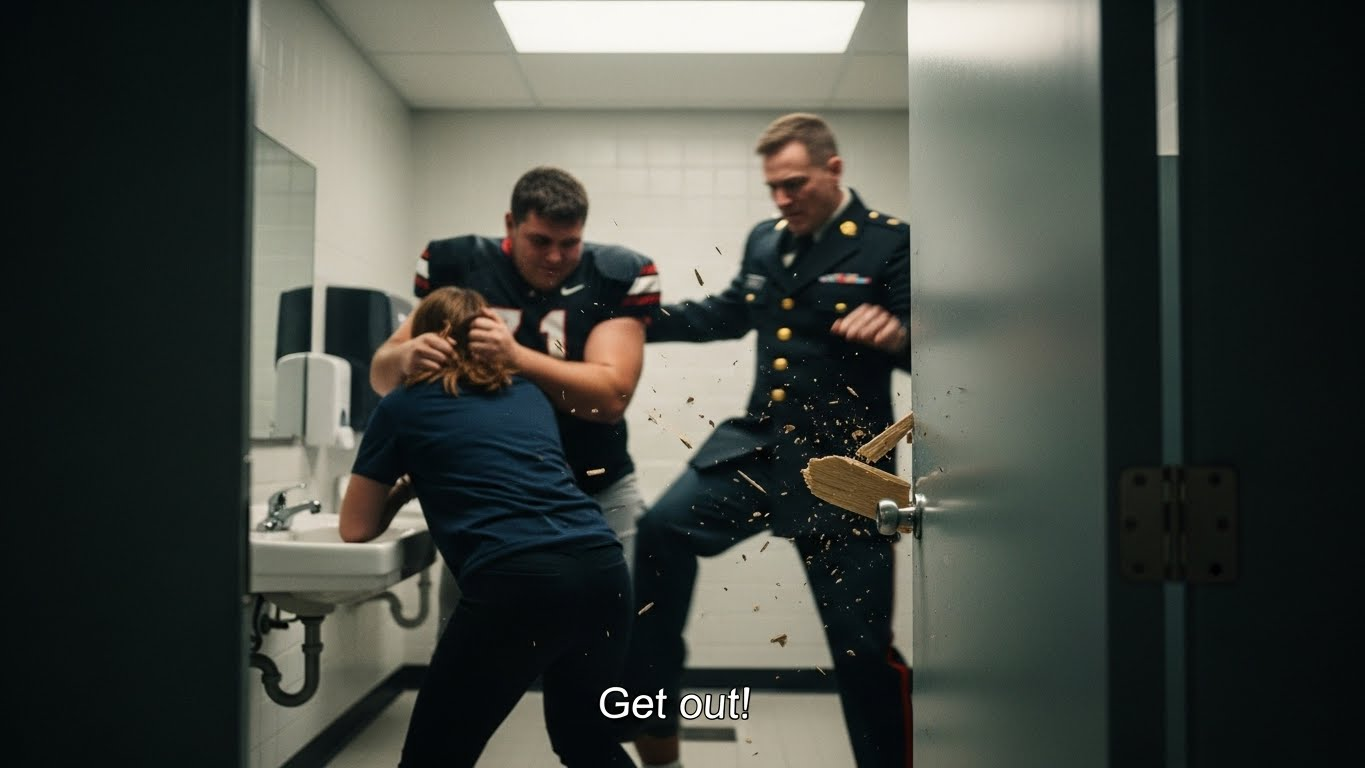
I hit the door at full speed. I didn’t use the handle. I used my boot. I channeled every ounce of strength, every push-up, every moment of training into a front kick that struck the wood right next to the lock.
CRACK.
The sound was like a gunshot. The wood splintered. The frame gave way. The door flew inward, banging violently against the tiled wall, swinging on one hinge.
The scene inside froze instantly.
The air was thick with the smell of fake strawberries and humidity. Three girls were leaning against the counter, holding their phones up, recording. They were laughing.
And there, at the end sink, was the source of the nightmare.
A boy.
He was huge—clearly a linebacker. He wore a varsity jacket with “Captain” stitched on the back. His muscles were bunched under the fabric.
He had his large hand wrapped around the back of a girl’s neck. He was forcing her face down into a sink filled to the brim with water.
Her hair was wet, matted against her skull. Her hands were gripping the porcelain sink, her knuckles white, her fingernails scratching uselessly for purchase. She was thrashing, but she was small. And he was big.
“Hold her down, Trent!” one of the girls squealed, giggling. “Look at her bubbles!”
The boy, Trent, looked up as the door exploded inward. He blinked, startled by the noise, but his hand didn’t move. He kept my daughter’s face underwater.
He saw me. He saw a man in a full military dress uniform, chest covered in ribbons, standing in the doorway like the angel of death.
But Trent was arrogant. He was the king of this school. He had never faced a consequence in his life.
“What the hell?” he sneered, a smirk playing on his lips. “Get out of here, you creep. This is private.”
He pushed Maya’s head down harder.
A switch flipped in my brain. The world went gray. The only thing in color was him.
I didn’t speak. I didn’t warn him.
I crossed the distance between the door and the sink in two strides.
“Get… off… her,” I whispered.
The air in the room seemed to vanish. The girls dropped their phones. The smirk on Trent’s face faltered for a fraction of a second, but it was too late.
He had touched my daughter. He had tried to hurt my blood.
And now, he was going to learn exactly why the enemies of this country feared the name Sterling.
Chapter 3: Zero Tolerance
The distance between the door and the sink was twelve feet. I covered it in less than a second.
Trent, the boy with the varsity jacket and the cruel smirk, didn’t even have time to process the threat. He saw a man in a uniform, yes, but his brain was wired for entitlement, not survival. He thought he was untouchable. He thought his father’s money and his status as the football captain were shields that could stop anything.
He was wrong.
I didn’t punch him. Punching is for brawlers. I am a soldier. I needed to neutralize the threat and secure the hostage.
My left hand shot out, grabbing his wrist—the one holding my daughter’s neck. I didn’t just pull. I applied a pressure point technique I learned from a South Korean instructor twenty years ago. I dug my thumb into the nerve cluster between his radius and ulna.
Trent screamed.
It was a high-pitched, pathetic sound that didn’t match his size. His hand spasmed open instantly, releasing Maya.
With my right hand, I grabbed the collar of his expensive jacket. I used his own momentum and his sudden loss of balance against him. I spun him around, slamming him back-first into the tiled wall.
THUD.
The impact shook the mirrors. The three girls who had been laughing and recording screamed, dropping their phones. They scrambled backward, tripping over each other in their haste to get away from the whirlwind of violence that had just entered their sanctuary.
“Don’t move,” I barked at them. It wasn’t a request. It was a command. They froze, huddled in the corner, terror replacing the amusement on their faces.
I turned my attention back to the sink.
Maya pulled her head out of the water. She was gasping, choking, sucking in air with desperate, heaving sobs. Her hair was plastered to her face. Mascara was running down her cheeks.
“Maya,” I said, my voice dropping an octave, softening instantly. “Maya, look at me.”
She turned, her eyes wide and bloodshot. She coughed, expelling water from her lungs. When she saw me, she didn’t look relieved immediately. She looked shocked.
“Dad?” she croaked. “You… you’re in uniform.”
“I’m here, baby. I’m here.”
I reached out to steady her, but movement in my peripheral vision caught my attention.
Trent was recovering. His shock was turning into teenage aggression. He pushed himself off the wall, his face red with embarrassment and rage. He clenched his fists.
“You’re crazy!” he shouted, stepping toward me. “You can’t touch me! Do you know who my dad is? I’m going to sue you! I’m going to—”
He swung at me. A clumsy, telegraphed haymaker aimed at my jaw.
It was almost insulting.
I didn’t even flinch. I simply stepped inside his guard, blocked his arm with my forearm, and drove my open palm into his solar plexus.
He folded like a cheap lawn chair.
All the air left his body in a wheezing whoosh. He dropped to his knees, clutching his stomach, his eyes bulging. He gasped for air that wouldn’t come.
I knelt down so I was eye-level with him. The medals on my chest chimed softly—the only sound in the room besides Maya’s weeping.
“I don’t care who your father is,” I whispered, my face inches from his. “But I promise you, by the time the sun sets today, your father is going to wish he never met me.”
I grabbed his chin, forcing him to look at me.
“You like drowning people?” I asked, my voice terrifyingly calm. “You like making people feel helpless?”
He shook his head frantically, tears streaming down his face now. The bully was gone. Only a terrified child remained.
“Dad, stop!” Maya sobbed, grabbing my arm. “Please, just take me home.”
Her touch broke the trance. The red haze in my vision receded slightly. I looked at her—wet, shivering, humiliated. My heart broke a thousand times over in that single second.
I stood up and took off my dress coat. I wrapped the heavy jacket around her shoulders. It was adorned with four silver stars on each shoulder, rank insignias that commanded the respect of armies. Now, it was just a blanket to keep my daughter warm.
“We’re leaving,” I said.
I looked at the girls in the corner. They were trembling.
“Pick up your phones,” I ordered.
They hesitated.
“PICK THEM UP!” I roared.
They scrambled to grab their devices.
“Unlock them. Delete the video. And then go to the trash can and delete it from the ‘Recently Deleted’ folder. I am watching.”
They did it with shaking hands. I watched every swipe, ensuring the footage of my daughter’s torture was erased from existence.
“If I ever,” I said, leaning in, “and I mean ever, hear that you spoke a word of this to anyone, or if I find out you laughed while he hurt her again… I will find you. Do you understand?”
“Yes,” they squeaked in unison.
“Get out.”
They ran. They didn’t walk; they sprinted out of the bathroom like the building was on fire.
I put my arm around Maya. She buried her face in my chest, sobbing into my white dress shirt.
“I’ve got you,” I whispered, stroking her wet hair. “I’ve got you.”
We walked out of the bathroom and into the hallway.
But the hallway was no longer empty.
Chapter 4: The Chain of Command
The noise of the door breaking and the screaming had drawn a crowd. Students were lining the lockers, whispering, phones out. Teachers were trying to herd them back into classrooms, but the spectacle was too great.
And standing right in front of us, blocking our path, was a short, balding man in a tailored suit. He looked like he cost money.
It was Principal Higgins.
Behind him were two of the school’s security guards—the “mall cop” types who carried flashlights and walked with a swagger they hadn’t earned.
Higgins looked at the shattered door of the girls’ bathroom. He looked at Trent, who was crawling out into the hallway, wheezing and clutching his stomach. Then he looked at me—a giant of a man in a full military dress uniform, supporting a soaking wet, crying girl.
“What is the meaning of this?” Higgins demanded, his voice shrill. “Who are you? You just assaulted a student!”
He pointed at Trent.
“That young man is Trent Sterling! His father is on the Board of Trustees! You have made a grave mistake, sir!”
I didn’t stop walking. I guided Maya forward.
“Move,” I said.
“Security!” Higgins shouted. “Stop him! Detain this man until the police arrive!”
The two guards stepped forward. One of them reached for his belt, where a can of pepper spray hung.
“Sir, stay right there,” the guard said, trying to sound authoritative. “Put your hands up.”
I stopped. I gently moved Maya behind me.
I looked at the guard. Then I looked at the ribbons on my chest. Silver Star. Purple Heart. Navy Cross.
“Son,” I said, my voice carrying down the silent hallway. “I have commanded battalions in active war zones. I have stared down insurgents, warlords, and terrorists. Do you really think you and your flashlight are going to stop me?”
The guard hesitated. He looked at my shoulders. He counted the stars.
One. Two. Three. Four.
His eyes widened. He took a step back.
“That’s… that’s a General,” he whispered to his partner.
“I don’t care if he’s the President!” Higgins yelled, his face turning purple. “He broke down a door! He assaulted a student! I want him in handcuffs!”
“Principal Higgins,” I said, my voice cutting through his hysteria. “My name is General Marcus Sterling. Commander of Central Operations. The girl shivering behind me is my daughter.”
The crowd of students gasped. The whispers exploded. General Sterling? The ghost? Maya’s dad is a General?
Higgins blinked. “Mr… Mr. Sterling? But your file says—”
“My file says what I want it to say,” I interrupted. “I enrolled her here because I was told this school was safe. I was told it was elite.”
I pointed back at the bathroom, where Trent was finally standing up, leaning against the wall, glaring at me with hatred.
“Is that what you call elite?” I asked, my voice rising. “A boy drowning a girl in a sink while an audience laughs? Is that the culture you’re protecting, Higgins?”
“Now, see here,” Higgins stammered, sweating. “Trent is a… high-spirited boy. I’m sure it was just horseplay. Roughhousing. You didn’t need to destroy school property.”
“Horseplay,” I repeated. The word tasted like bile. “He was holding her head underwater. She was choking.”
“We will investigate,” Higgins said dismissively, regaining some of his arrogance. “But right now, you are trespassing. You need to leave before I press charges for the damage and the assault on a minor.”
He stepped in front of me again, puffing out his chest.
“You think your uniform gives you the right to do whatever you want? In this school, I am the authority. Not you.”
I stared at him. I was about to explain to him exactly how the chain of command worked in the real world when the glass doors at the end of the hallway burst open.
“CLEAR THE HALL!” a voice boomed.
It was Master Sergeant Miller.
But he wasn’t alone.
Miller had called it in.
Behind him were four Military Police officers, fully armed, wearing tactical vests. They weren’t school security. They were federal assets. They moved with a fluidity and precision that made the school guards look like children playing dress-up.
They jogged down the hall, their boots thundering. The students parted like the Red Sea.
“Secure the perimeter!” Miller shouted.
The MPs formed a semi-circle around me and Maya, facing outward, hands resting near their sidearms.
Higgins went pale. He stumbled back, nearly tripping over his own feet.
“What… what is this?” Higgins squeaked. “You can’t bring soldiers into a school!”
Miller stepped up to me and saluted crisp and sharp.
“General. Perimeter secure. Vehicle is ready for extraction.”
I returned the salute.
“At ease, Sergeant.”
I looked down at Higgins. The little man was shaking now. He realized, finally, that he was playing a game he didn’t understand.
“Principal Higgins,” I said, adjusting my cuffs. “You mentioned the police. That’s a great idea. I’ll have the Pentagon’s legal team contact the local authorities. We’ll be filing charges for attempted murder, assault, and negligence.”
“Attempted murder?” Higgins gasped. “That’s absurd! It was a prank!”
“We’ll see what a jury thinks when they see the bruising on her neck,” I said coldly.
I turned to Trent, who was watching from the doorway, his face pale as a ghost as he stared at the armed soldiers.
“And you,” I called out to him. “Tell your father to check his bank accounts. And his security clearance. War has just been declared.”
I turned to Maya. She was staring at me, her eyes wide. She had never seen this side of me. She had only known the dad who made pancakes on Sundays and fell asleep watching the History Channel. She had never seen the General.
“Let’s go home, Maya,” I said softly.
I guided her through the phalanx of soldiers. We walked down the hallway, the only sound the rhythmic thud of our boots. No one spoke. No one laughed.
As we reached the exit, I looked back one last time. Every phone was out. Every eye was on us.
They thought she was weak. They thought she was nobody.
Now they knew.
Maya Sterling was the daughter of the storm. And the storm had just made landfall.
Chapter 5: The Safe House
The ride back to our house was silent. Not the comfortable silence of a long road trip, but the heavy, suffocating silence that follows an explosion.
Miller drove the SUV with a gentleness that contradicted how he had driven to the school. He avoided potholes. He took corners slowly. He knew the cargo in the back seat was fragile.
I sat next to Maya, my arm around her. She had stopped crying, which worried me more than the tears. She was staring out the window, her eyes glazed over, shivering despite the climate control being set to seventy-five degrees.
We lived in a quiet cul-de-sac in Northern Virginia. To the neighbors, I was a boring consultant. To the mailman, we were just another family.
But as Miller pulled into the driveway, the illusion of normalcy felt like a cruel joke.
“I’ll stay in the car, General,” Miller said softly as he put the vehicle in park. “I’ll monitor the perimeter.”
“Thank you, Miller.”
I guided Maya inside. The house was exactly as we had left it that morning. Coffee cup in the sink. Her cello standing in the corner of the living room. It looked like a home, but right now, it felt like a triage unit.
I sat her down on the sofa and went to the kitchen. My hands, which had been steady enough to disarm bombs in the past, were trembling as I filled a glass with water. I grabbed a bag of frozen peas from the freezer—we didn’t have ice packs.
When I came back, she was looking at her hands.
“I’m sorry, Dad,” she whispered.
The words hit me harder than any bullet ever could.
I dropped to my knees in front of her. “Sorry? Maya, you have nothing to be sorry for. Nothing.”
“I… I should have fought back,” she said, her voice cracking. “I’m a General’s daughter. I should be tough. But I just… I froze.”
“Listen to me,” I said, taking her hands in mine. They were cold. “Freezing is a survival response. You stayed alive. You called for help. That is exactly what you were supposed to do. You were brave.”
She looked at me, tears welling up again. “They’ve been doing it for months, Dad.”
The air left my lungs.
“What?”
“Trent and his friends,” she said, looking down. “It started with notes. Then tripping me in the hall. Then stealing my cello bow. They said… they said if I told anyone, they’d make sure everyone knew I was a charity case. They said their dads own the school.”
“Why didn’t you tell me?” I asked, my voice breaking.
“Because you’re finally home,” she sobbed. “You were deployed for three years. You finally got a desk job. You looked happy. I didn’t want to be the reason you had to go to war again.”
I pulled her into a hug, burying my face in her shoulder so she wouldn’t see the tears in my own eyes. I had spent my life protecting the nation, securing borders, hunting down threats thousands of miles away.
And the enemy had been right here. Under my roof. Eating away at my daughter’s spirit while I sat in meetings.
“I am never too busy for you,” I whispered fiercely. “And I am always ready for war.”
I pulled away and looked her in the eye.
“Go upstairs. Take a hot shower. Put on your most comfortable pajamas. I’m going to make you grilled cheese, just how you like it. Okay?”
She nodded weakly and headed up the stairs.
As soon as her bedroom door clicked shut, the softness left my face. The father disappeared. The General returned.
I walked into my home office and locked the door.
My personal phone—the one registered to my real name—started ringing. It wasn’t a number I recognized, but the area code was local. D.C. elite.
I answered.
“Sterling,” I said.
“You have a hell of a lot of nerve,” a voice boomed on the other end. It was deep, polished, and dripping with entitlement.
“Who is this?”
“This is Richard Halloway,” the voice spat. “Trent’s father. And the man who is about to ruin your life.”
Chapter 6: The Declaration
Richard Halloway. The name was familiar. Not from the battlefield, but from the donor lists and defense contractor galas I was forced to attend. He was the CEO of Halloway Dynamics, a massive private defense firm. He supplied the military with drones that cost too much and didn’t work half the time. He was a billionaire. He had senators in his pocket and judges on his speed dial.
“Mr. Halloway,” I said, my voice dropping to a dangerously low register. “I was expecting your call.”
“You assaulted my son,” Halloway shouted. “I just got off the phone with the Principal. You broke into a school, destroyed property, and physically attacked a minor. Trent has a bruised ego and a bruised chest. I’m having my lawyers draft the lawsuit as we speak. You’ll be court-martialed before the week is out.”
I leaned back in my leather chair. I didn’t shout. I didn’t bluster.
“Did your son tell you what he was doing when I walked in?” I asked.
“He said they were goofing around in the bathroom! A prank involving water!”
“He was drowning my daughter,” I corrected him. “He had his hand on her neck. He was holding her face underwater in a sink while she gasped for air. That’s not a prank, Richard. That’s attempted manslaughter.”
“Bullshit!” Halloway roared. “My son is a varsity athlete. He’s a good kid. Your daughter is probably some drama queen who can’t take a joke. But that doesn’t matter. What matters is that you put your hands on him.”
“I showed restraint,” I said. “If I hadn’t, your son wouldn’t be bruising. He’d be in the ICU.”
“Is that a threat, General?”
“It’s a statement of fact.”
Halloway laughed. It was a cold, ugly sound.
“You don’t get it, do you, soldier boy? You think those four stars on your shoulder make you untouchable? In D.C., money outranks rank every time. I donate three million dollars a year to Arlington Prep. I sit on the Defense Appropriations Committee’s advisory board. I can cut the budget for your entire department with a phone call.”
He paused, letting the weight of his influence hang in the air.
“Here is what is going to happen,” Halloway continued. “You are going to publicly apologize to Trent. You are going to withdraw your daughter from the school immediately. And you are going to resign your commission quietly. If you do that, I won’t press charges. If you don’t… I will strip you of everything. Your pension, your reputation, your freedom.”
I listened to him. I listened to the arrogance of a man who had never been told ‘no’ in his life. A man who raised a son to be just like him.
“Are you finished?” I asked.
“I’m waiting for your answer, General.”
“Here is my answer,” I said. “You think this is a legal battle. You think this is a PR battle. You are mistaken.”
I opened the drawer of my desk and pulled out a secure, encrypted hard drive.
“This is a combat operation,” I said. “You have threatened my family. You have attacked my blood. I don’t care about your money. I don’t care about your politicians. I have spent thirty years dismantling regimes that were scarier than you.”
“You’re insane,” Halloway scoffed.
“No,” I said. “I’m a father. And I’m going to give you one chance, Richard. Pull your son out of that school. Get him therapy. And never, ever let me see your face again.”
“Or what?” Halloway challenged.
“Or I stop playing by the rules of polite society,” I said. “And I start playing by mine.”
I hung up the phone.
My hand was still shaking, but not from fear anymore. It was adrenaline.
I didn’t call a lawyer. I didn’t call the police.
I picked up my secure satellite phone—the black brick that connected directly to the Pentagon’s covert channels.
I dialed a number that wasn’t in any phone book.
“This is Wraith,” a voice answered. Distorted. Digital.
“It’s Sterling,” I said. “I need a package.”
“Target?”
“Richard Halloway. Halloway Dynamics. And his son, Trent.”
“That’s a domestic target, General. Highly irregular. Is this official business?”
“It’s a Code Black,” I lied. Or maybe it wasn’t a lie. In my world, right now, it was the only truth that mattered. “I want everything. Financials. Emails. deleted texts. Surveillance footage. Every skeleton in his closet. Every bribe he’s ever paid. I want to know what he eats for breakfast and who he’s sleeping with.”
There was a pause on the line. Wraith was the best intelligence analyst the NSA had ever produced, currently working in a basement that didn’t technically exist.
“I can have a preliminary dossier in an hour,” Wraith said. “But General… Halloway is a big fish. If you miss, he’ll eat you alive.”
“I don’t miss,” I said.
I set the phone down.
I looked at the framed photo on my desk. It was Maya, age five, sitting on my shoulders, wearing my oversized camouflage hat. She was smiling.
Halloway thought he had leverage because he had money. He didn’t understand that a man with nothing to lose is the most dangerous creature on earth. And if he hurt my daughter again, I would burn his entire empire to the ground, dollar by dollar.
The war had begun.
Chapter 7: The Board Meeting
The summons arrived via email at 6:00 AM the next morning.
Subject: Emergency Disciplinary Hearing regarding Maya Sterling.
It was fast. Halloway moved quickly. He had called an emergency meeting of the School Board to have Maya expelled for “instigating violence” and me banned from the campus. He wanted to strike while the iron was hot, before I could mount a defense.
He expected me to show up with a lawyer. He expected me to beg.
I showed up with a briefcase and a convoy.
The meeting was held in the administration building’s grand conference room. Mahogany tables, oil paintings of past headmasters, and a view of the manicured lawn.
When I walked in, the room fell silent.
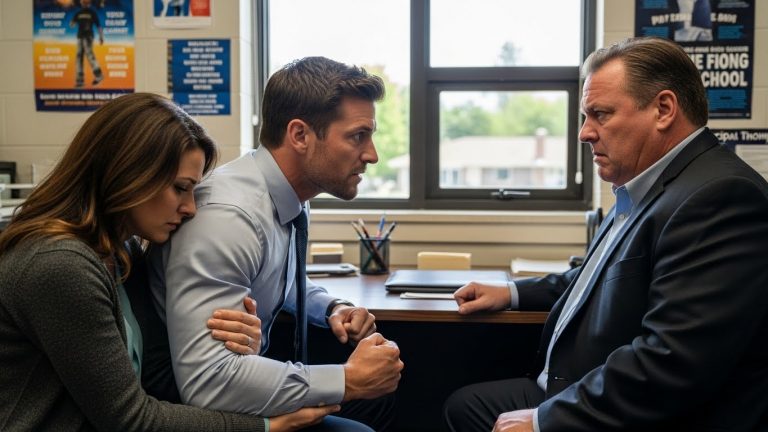
Richard Halloway sat at the head of the table. He was a silver fox, wearing a suit that cost more than a sergeant’s annual salary. Trent sat next to him, looking sullen, his arm in a dramatic sling that I knew he didn’t need. Principal Higgins was there, along with five other board members who looked uncomfortable.
“General Sterling,” Halloway said, not bothering to stand. He smiled, a shark baring its teeth. “I’m surprised you showed up. I assumed you’d be packing your bags.”
I didn’t sit in the empty chair they had placed in the center of the room like an interrogation stool. I remained standing.
“I don’t run from a fight, Halloway,” I said.
“This isn’t a fight,” Halloway scoffed. “This is a formality. Your daughter instigated an altercation. You trespassed and assaulted a student. The Board has already drafted the expulsion papers.”
He slid a document across the table.
“Sign this, withdraw her voluntarily, and maybe I won’t press criminal charges. Maybe.”
Trent looked at me and smirked. He felt safe here, surrounded by his father’s money and influence.
I walked over to the table. I picked up the expulsion papers.
The room watched, breathless.
I tore the papers in half. Then in half again. I let the confetti rain down on the polished wood.
“You seem to be under the impression,” I said, my voice filling the room, “that you are the predator here.”
Halloway’s face turned red. “Now listen here—”
“No, you listen,” I interrupted. I slammed my own heavy, steel-reinforced briefcase onto the table. The sound echoed like a gavel.
“I made a phone call last night,” I said, opening the case. “I called in a favor from the NSA’s financial crimes division.”
Halloway froze. The color drained from his face slightly.
“You see, Richard,” I continued, pulling out a thick stack of documents. “I was looking for dirt on you to get you to back off. But I found something much worse. I found treason.”
The word hung in the air.
“Halloway Dynamics supplies the guidance chips for the MK-9 Predator Drones,” I said, holding up a schematic. “Three months ago, a drone malfunctioned in Yemen. It dropped a payload on a friendly convoy. Four Marines died.”
I looked Halloway dead in the eye.
“You knew the chips were defective. You signed off on the quality control reports anyway to save twelve cents per unit. You falsified government documents.”
The board members gasped. Higgins looked like he was going to be sick.
“That’s a lie!” Halloway shouted, standing up. “That’s classified information! You can’t—”
“I am the Commander of Central Operations!” I roared, my voice shaking the windows. “I am the classification authority! And you killed my men for profit.”
I tossed a flash drive onto the table.
“That drive contains your emails authorizing the cover-up. It also contains the video files from the girls’ phones in the bathroom, which I recovered from the cloud. The ones showing your son torturing my daughter.”
I looked at Trent. The boy was shrinking in his chair, the smirk wiped clean off his face. He looked at his father, waiting for the billionaire to fix it.
But Halloway couldn’t fix this.
“The FBI is currently raiding your corporate headquarters,” I said, checking my watch. “And the MPs are waiting in the hallway.”
Halloway slumped back into his chair. He looked old. Defeated.
“You can’t do this,” he whispered. “I have friends in the Senate.”
“Not anymore,” I said. “Nobody wants to be friends with a man who sells out American soldiers.”
Chapter 8: The Walk Out
The double doors opened.
This time, it wasn’t school security. It was two agents in FBI windbreakers, flanked by four of my Military Police officers.
“Richard Halloway,” the lead agent said, stepping forward. “You are under arrest for fraud, conspiracy to commit treason, and federal racketeering.”
Halloway was hauled out of his chair. He didn’t fight. He looked at me with pure hatred, but also with fear. He finally understood the difference between a businessman and a soldier. A businessman negotiates. A soldier eliminates the threat.
As they cuffed Halloway, Trent stood up, panicked.
“Dad? Dad!” he cried out. “What about me? What about the school?”
Halloway didn’t look back at his son. He was too busy thinking about his lawyers.
I stepped in front of Trent.
He looked up at me, trembling. He was suddenly just a kid again. A cruel, misguided kid who had lost his shield.
“Your father can’t help you,” I said softly. “You’re on your own now, Trent.”
I turned to Principal Higgins and the stunned board members.
“Principal Higgins,” I said. “I expect my daughter’s record to be scrubbed clean. I expect an immediate assembly on bullying policy. And if I ever hear that another student in this school is being tormented while you turn a blind eye… I will come back. And I won’t bring a briefcase next time.”
Higgins nodded rapidly, unable to speak.
I turned and walked out of the room.
I walked down the main steps of the school. Maya was waiting for me at the bottom, sitting on a bench near Miller’s SUV. She was wearing her school uniform, her head held high, though I could see the anxiety in her grip on her backpack.
She stood up as I approached.
“Is it over?” she asked.
“It’s over,” I said. “Halloway is going to prison. Trent… well, Trent is going to learn what life is like without a silver spoon.”
Maya let out a long breath she seemed to have been holding for months.
“Did you… did you have to use the Army?” she asked, a small smile playing on her lips.
“I used the truth,” I said. “And maybe a little bit of the Army.”
I opened the car door for her.
“Dad?”
“Yeah, kiddo?”
“Everyone knows who you are now,” she said, looking at the students peering out of the windows, pointing at the General and his daughter. “I’m not ‘Maya the scholarship kid’ anymore. I’m ‘General Sterling’s daughter.'”
I looked at her. “Is that okay?”
She paused, then took my hand. She squeezed it.
“Yeah,” she said. “I think I’m okay with that. It’s kind of cool.”
We got into the car.
“Home, Miller,” I said.
“Copy that, General,” Miller replied, smiling in the rearview mirror.
As we drove away, leaving the red brick castle of Arlington Prep behind us, I realized something. I had spent my career fighting for my country, thinking that was the highest honor. I was wrong.
The greatest battle I ever fought was in a high school bathroom. And the greatest victory wasn’t a medal.
It was the smile on my daughter’s face as she realized she was safe.
They thought she was weak. They thought I was absent.
They were wrong.
And now, the whole world knew: You don’t mess with a Sterling.
[THE END]