I WAS TRAPPED. I COULDN’T SCREAM. SO I STARTED DRAWING MY TRUTH. WHAT I PUT ON PAPER WAS SO DARK, IT FORCED MY FAMILY TO CHOOSE BETWEEN THEIR SECRET AND THEIR SON.
Part 1
Chapter 1: The Weight of Nothing
My throat is a vault. It is secured with heavy steel and a lock I cannot find the key to. Inside that vault, my voice is loud. It screams, it argues, it begs. It tells secrets. But on the outside, in the sunlit world of my comfortable suburban house, I am mute.
I am Caleb, and I am ten years old.
The doctors call it “Selective Mutism,” or sometimes, “situational mutism.” My parents, Mom (Amy) and Dad (Mark), call it “The Problem.” They are frustrated, embarrassed, and tired. They have spent thousands of dollars on specialists, speech pathologists, and endless, painful testing, trying to coax the sound out. They see the silence as a failure on their part, a medical mystery they must conquer.
But the silence is not the problem. The silence is the solution.
The silence is the only space I have left that is mine. It is the fortress I retreat into when he is near.
“He” is my grandfather, Walter. He lives in the luxurious guest suite on the main floor. He is a retired lawyer, respected in the community, and impeccably dressed. To the outside world, he is a kind, frail man who needs care. To me, he is the reason my vocal cords are paralyzed with fear.
His cruelty is precise. It is quiet. It never leaves a mark visible to the naked eye. It happens in the hallway when Mom isn’t looking. A gentle hand placed too hard on the back of my neck, holding me still. A whisper of contempt as he passes my room: “Still the little coward, Caleb? Your father was always useless, too.”
My mother, Amy, refuses to see it. Walter is her father. He is the one who helps pay the mortgage and buys us expensive gifts. He is “family,” and family must be protected at all costs—especially from accusations made by a silent, problem child.
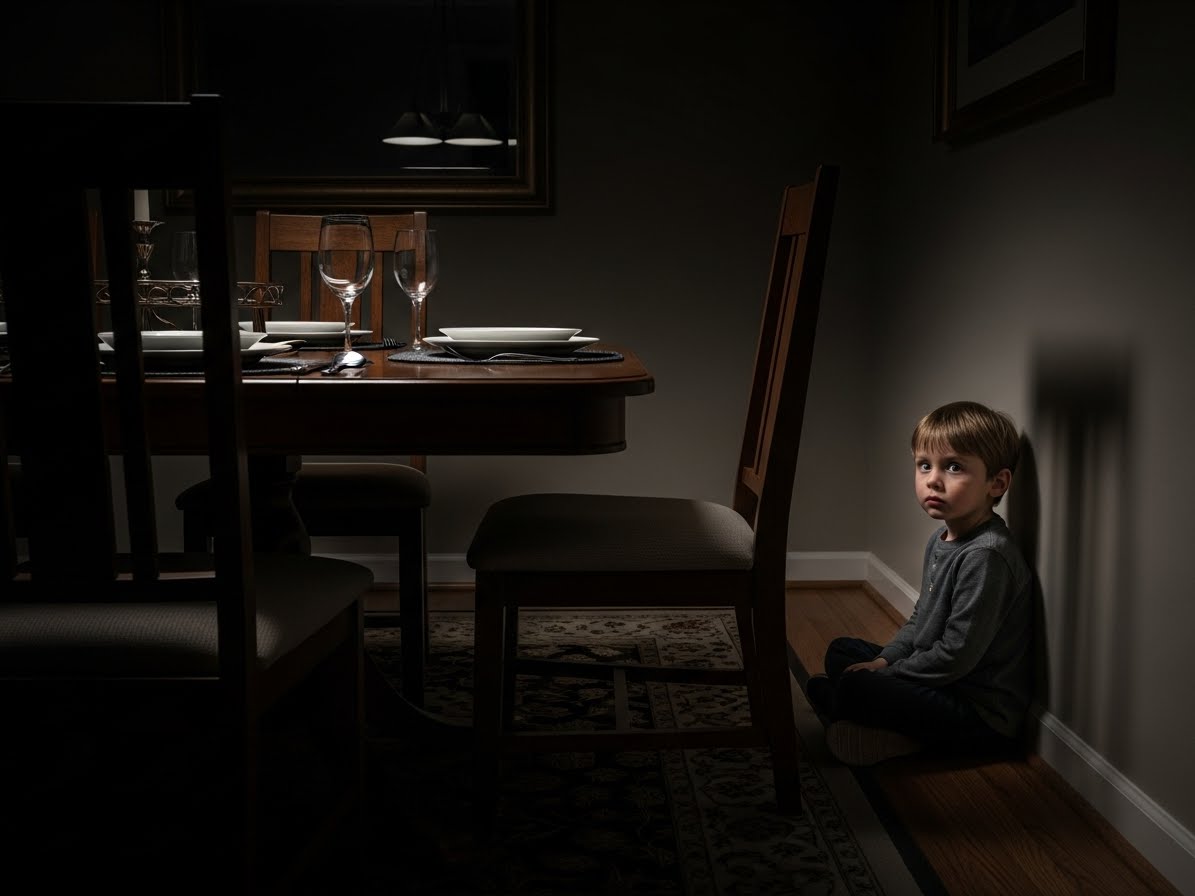
The worst part of living with Walter is the dinner table. My parents try to coax conversation, desperate to appear normal, ignoring the reality of my vacant, silent seat. Walter always looks at me when I refuse to speak. His eyes are soft, but the message is clear: You tried to tell them once, when you cried that night. See what happens when you try again.
My silence, once a symptom of paralyzing fear, has become an intentional act of protest. I cannot tell them what he does, but I can make the silence so heavy, so suffocating, that they are forced to confront the void I have become.
Chapter 2: The Therapist’s Office
My parents took me to Dr. Reyes at the local Children’s Clinic as a last resort. They told her I was stubborn, uncommunicative, and that they had exhausted all options.
Dr. Reyes was different from the others. She didn’t use fun puppets or silly voices. She sat in a chair across from me, her eyes kind but intensely focused. She was a woman who was used to listening to things that were never said.
The first session was a failure. I sat in absolute silence, staring at the worn stitching on the rug. My mother paced anxiously outside the door, likely checking her watch.
In the second session, Dr. Reyes pulled out a box of new, sharp crayons and a huge pad of paper. She didn’t ask me to talk. She didn’t force eye contact.
She just drew. She drew a picture of a house with a sun and two parents. She made it look warm, simple, and safe. Then, she slid the crayon box across the floor toward me.
I picked up a black crayon. I drew a small stick figure in the corner of her happy house. I drew it with no mouth, and its hands were taped to its sides.
Dr. Reyes looked at the drawing. She didn’t analyze it or ask me what it meant. She just added something to her drawing: a small, dark, impeccably dressed shadow, holding a thin cane, creeping toward the faceless figure.
Then, she looked up at me. And for the first time, I felt like someone was truly looking into the vault of my silence, understanding the story inside.
“Caleb,” she wrote on the paper, her handwriting neat and simple. “Your silence is very loud. It is telling me a story about a fear that is not your fault. I just need you to show me the chapters so I can protect the narrator.”
She realized my silence wasn’t a disability. It was a defense mechanism. It was an accusation.
That day, I went home with a sliver of terrifying hope. Dr. Reyes was close. But Walter was closer. And I knew that if he found out I was communicating, the silent treatment would end, replaced by a sudden, total violence I couldn’t survive.
I had to use my drawing. I had to use my silence. I had to show her the truth before my time ran out.
Part 2
Chapter 3: The Language of Hands
The therapy sessions became my secret battlefield. I spoke, but only in the language of symbols and textures.
Dr. Reyes introduced clay. While other children molded animals or food, I molded barriers. I built massive, thick walls around a tiny figure. Then, I molded a single, large hand that stretched over the walls, threatening the figure inside. The hand was always made of gray clay, the exact color of Walter’s favorite tweed jacket.
The drawings grew more explicit, but still abstract enough to be denied as fantasy. I drew faces with wide, screaming mouths—but they were always covered by a smooth, white hand. The eyes were huge, black, and focused on one corner of the page.
Dr. Reyes never asked, “Is your grandfather hurting you?” She never used the words “abuse” or “violence.” She understood that forcing me to speak the words would shatter my shield.
Instead, she asked me to use a communication board to point to feelings. Most kids pointed to “happy,” “sad,” or “bored.”
I pointed relentlessly to “frozen,” “trapped,” and “danger.”
But the key piece of evidence, the one that broke Dr. Reyes’s professional composure, came when she introduced an Augmentative and Alternative Communication (AAC) tablet—a device designed to allow non-verbal people to communicate using pre-programmed icons.
Chapter 4: The Shadow in the Corner
At home, Walter sensed the change. He saw the new determination in my eyes, the slight shift in my posture. He ramped up his campaign of psychological attrition.
He would hide my favorite books and then watch me search for them, smiling slightly when I couldn’t ask where they were.
He would follow my mother into the kitchen and tell her, loud enough for me to hear: “Amy, you need to be firmer with the boy. He’s trying to manipulate you with this silence. He needs discipline, not expensive toys.”
His primary weapon, however, was his cane. Walter didn’t need the cane for walking; he needed it for control. It was mahogany, with a brass wolf’s head handle. He would tap it on the floor when I crossed the room—a rhythmic thump, thump, thump—signaling that I was moving too fast, too slow, or simply existing incorrectly.
One afternoon, I was in the backyard, trying to read a book while sitting beneath the massive old American oak tree. Walter came outside and stood directly over me, blocking the sun.
“Why are you reading that?” he asked quietly. I didn’t answer. He waited five long minutes, his shadow enveloping me. Then, he simply reached down and ripped the pages out of the book, one by one.
I watched him. I didn’t move. I didn’t cry. I was saving my energy. I was observing.
The silent observer is the most powerful witness.
Chapter 5: The Breakthrough
The following Tuesday, I walked into Dr. Reyes’s office and saw the AAC tablet waiting.
Dr. Reyes explained that the icons represented common actions and objects. She asked me to construct a sentence describing my favorite activity.
I didn’t touch the screen. I knew a single word was not enough.
She then pulled out a sheet of vinyl magnetic tiles. Each tile had a simple verb written on it: HUG, RUN, SLEEP, YELL, HIT, CHOKE.
She told me to build a story using the tiles.
My hands moved quickly. I took the tiles for BOY and CHOKE. I placed them side-by-side.
Then, I reached for the one for MAN. I put it next to CHOKE.
Finally, I placed the tile for SISTER or MOTHER (I chose MOTHER), and then the tile for LOOK AWAY.
My final, terrifying sentence, constructed without a sound: MAN CHOKE BOY, MOTHER LOOK AWAY.
Dr. Reyes’s hand flew to her mouth. She didn’t need the sound of my voice. The sequence of words was a direct accusation. The narrative was complete: a victim, an aggressor, and the willful denial of a protector.
She gently took the phone from her desk. “Caleb,” she wrote on the whiteboard, her hand shaking. “I have to break confidentiality now. I have to call the authorities. Are you safe to go home for one more night?”
I picked up the black crayon and drew a picture of a clock. I circled the number 4:00.
Four o’clock was when Walter took his afternoon nap. That was my window.
Chapter 6: The Parental Denial
The intervention happened quickly. Dr. Reyes filed an emergency report with Child Protective Services (CPS) based on the evidence, bypassing my parents immediately.
The next day, my parents were summoned to a meeting with Dr. Reyes and the school social worker. I was brought in later.
My mother was furious, her face flushed with denial.
“This is outrageous, Dr. Reyes! My father is a seventy-year-old man! He has a bad hip! He wouldn’t hurt a fly! You are planting ideas in our son’s head because he can’t defend himself!” Amy hissed.
My father, Mark, looked utterly defeated but repeated the script: “This is a misunderstanding. Caleb is… sensitive. We’ll pull him out of this therapy. It’s clearly not helping.”
Dr. Reyes presented the evidence: the drawings, the magnetic tiles, and the hours of recorded therapy notes describing the atmosphere of fear.
“We have reason to believe Caleb is communicating the reality of emotional and physical abuse perpetrated by the Grandfather,” the social worker stated calmly.
“No!” Amy screamed. “My father is the only reason we’re afloat! You’re trying to ruin my family!”
The choice had been laid bare: the truth of their son, or the financial and emotional security of their denial. They chose the denial. They threatened legal action against the clinic.
But I had one card left.
Chapter 7: The Final Accusation
The annual school art show was that Friday. Every child was required to display one piece.
My entry was simple: a massive, seven-foot sheet of butcher paper painted entirely in black charcoal.
The entire community was there, including the principal, the superintendent, and, critically, Walter. My parents had dragged him there to prove he was a loving, normal grandfather.
Walter stood by the painting, smiling proudly at the crowd, ready to accept the praise for his family’s normalcy.
When the principal called my name, I walked onto the stage. I was dressed in a pristine white shirt, a stark contrast to the black canvas behind me.
I walked up to the black canvas. I didn’t touch it. I didn’t speak.
Then, I reached into my pocket and pulled out a small piece of chalk. White chalk against the black void.
I began to draw, quickly, silently.
I drew a single, life-sized figure of a cane. I drew the wolf’s head handle in intricate detail.
Then, I drew a large, perfect circle around the cane.
Finally, I reached out my own small hand and carefully drew a tiny line connecting the cane to the black figure I had drawn earlier in therapy—the mouthless boy.
I stepped back. The silence in the auditorium was instantaneous and crushing. Everyone understood. The cane was Walter’s symbol of control.
Walter’s kind smile vanished. He realized I had used the one tool he couldn’t take: public, non-verbal accusation.
He opened his mouth, ready to rage, but my mother placed a trembling hand on his arm. She looked at the drawing, then at me, then at the terrified look in Walter’s eyes.
She finally saw the truth that my silence had been screaming for years.
Chapter 8: The Sound of Freedom
The confrontation didn’t happen on stage. It happened later that night. The police, alerted by the social worker who had witnessed the terrifying public display, arrived at the house.
My mother, her face tear-streaked but resolved, did not defend her father. She let them take him away. The police had enough evidence from the CPS report and the visible terror in the home to secure an order of protection.
I watched Walter leave from my bedroom window. He looked up at me as he was being escorted to the car. His eyes promised retribution.
But he was gone.
My mother came into my room later. She didn’t apologize with words. She simply held me, shaking.
“I hear you, Caleb,” she whispered, her voice breaking. “I hear the silence. I’m so sorry.”
I still don’t talk much. The vault is still sealed. It will take years to find the key.
But now, the silence is different. It is no longer heavy with fear. It is light, clean, and full of potential.
Last week, I was alone in my room, tracing the outline of a drawing. I hummed a tune my father used to sing.
It was a small sound, soft and uncertain, like a bird testing its wings.
It wasn’t a scream. It wasn’t a secret.
It was the first sound of freedom. And it spoke louder than any words I could have uttered before.