My 6-Year-Old Vanished From His Bed Without a Trace. We Tore the Town Apart Looking For Him, But When We Finally Found Him, The Truth Shattered My Sanity and Revealed a Secret Our House Had Been Keeping For Decades.
PART 1: THE VANISHING
Chapter 1: The Silence
It was the silence that woke me up.
You know how it is when you’re a parent. You get used to the noise. The constant, low-level hum of life. The static of the baby monitor, the creak of floorboards settling, the heavy, rhythmic breathing of a sleeping child drifting down the hall. But that morning, at 5:43 AM, the house wasn’t just quiet. It was dead.
I rolled over, my arm brushing against the cold, empty space where my wife, Sarah, usually slept. She was already up, likely downstairs fighting with the espresso machine. I sat up, rubbing the grit from my eyes, expecting to hear the familiar Saturday morning sounds—cartoons blaring at a volume just slightly too high, the clinking of cereal bowls. Leo, my six-year-old, was essentially a rooster in human form. He was usually up with the sun.
But there was nothing. Just the heavy, oppressive sound of rain hitting the roof.
I walked down the hallway, the hardwood floorboards groaning under my feet. The house felt colder than usual, a damp chill that seemed to seep right through the drywall.
“Sarah?” I called out. My voice sounded too loud in the stillness.
She was in the kitchen, standing motionless, staring out the window into the backyard. The Oregon mist was clinging to the glass, turning the world outside into a gray, impenetrable smudge.
“Is Leo with you?” she asked. She didn’t turn around. Her voice was flat, tight.
My stomach dropped. Just a fraction. A warning shot. “No. I thought he was downstairs watching TV.”
She turned then. Her face was pale, drawn. A mug of coffee was trembling in her hand, sloshing over the rim and dripping onto the floor. She didn’t seem to notice the burn. “He’s not in his room, Mark. I checked. The bed is made.”
I frowned. “What do you mean, the bed is made?”
Leo never made his bed. Getting him to pick up a sock was a negotiation that rivaled a hostage situation.
“It’s perfect,” she whispered. “Like no one slept in it.”
I didn’t answer. I took the stairs two at a time, my heart rate spiking. I burst into his room. It smelled like him—dirty socks, crayons, and that faint, sweet scent of strawberry shampoo. But Sarah was right. The bed was pristine. The superhero sheets were pulled tight, military style. The pillows were fluffed.
And the window.
My blood ran cold. The window, which looked out over the driveway, was unlocked. It was pushed up just a crack. Maybe two inches.
“Leo!” I screamed, tearing the closet door open. Clothes, piles of plastic toys, a mountain of shoes. No Leo. I dropped to my knees, frantically looking under the bed. Dust bunnies. A lost Lego piece.
No Leo.
“Mark!” Sarah screamed from downstairs. It was a jagged, broken sound. A sound that ripped the throat out of our peaceful suburban life.
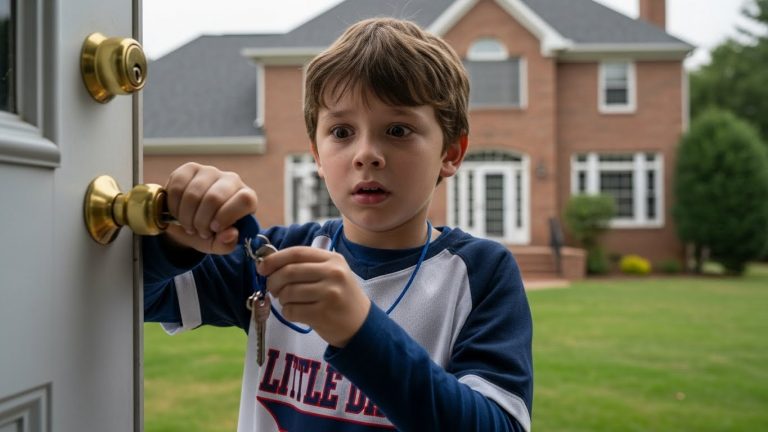
I ran down, nearly tripping over my own feet. The front door was wide open. The screen door was flapping violently in the wind, banging against the frame. Bang. Bang. Bang.
We ran into the street. It was a quiet cul-de-sac in Blackwood, just outside of Portland. The kind of place where people moved to escape the city. Where we moved to be safe. The lawns were manicured; the fences were high.
“Leo! Leo!”
Neighbors started coming out onto their porches, clutching bathrobes, looking confused and annoyed at the noise. Old Mrs. Higgins from next door squinted at us through the rain. “What’s wrong? Is there a fire?”
“He’s gone!” Sarah wailed, collapsing onto the wet pavement, the water soaking instantly into her jeans. “My baby is gone! Someone took him!”
I stood there, spinning in circles, looking at the empty street, the dark woods at the end of the block, the gray sky. I dialed 911. My fingers felt like sausages, numb and clumsy on the wet screen.
“911, what is your emergency?”
“My son,” I choked out, tears finally spilling hot down my face. “My son is missing. He was in his bed. Someone took him. Please, God, someone took him.”
Chapter 2: The First 48 Minutes
The police arrived in seven minutes. It felt like seven years.
Blue and red lights washed over our two-story craftsman house, turning the wet, manicured lawn into a surreal, strobing crime scene. Detective Miller was the lead. He was a big guy, looked like a linebacker who’d seen too much darkness and not enough sleep. He didn’t waste time with sympathy. He went straight to logistics, his voice cutting through the panic like a knife.
“Time last seen?”
“10:00 PM,” I said, my voice shaking so hard I could barely form words. “We tucked him in. Read him Goodnight Moon. He was asleep. I saw him sleeping.”
“Any signs of forced entry?”
“The window,” Sarah sobbed. She was wrapped in a shock blanket on the sofa, shivering violently despite the heating kicking on full blast. “His bedroom window was cracked open. We never open it. He has bad asthma. The pollen…”
Miller nodded, his face impassive. He scribbled in a rain-warped notebook. He signaled to a team of uniformed officers. “Grid search. Start with the backyard, expand to the woods behind the property. Get the K-9 unit out here now. I want a drone in the air if the rain clears.”
I stood in the hallway, watching them swarm my house. Strangers touching Leo’s toys. Dusting his doorframe for prints with black powder. Boots muddying the carpet. It felt like a violation, but I wanted them to tear the place apart if it meant finding him.
“Mr. Thompson,” Miller said, pulling me into the kitchen away from Sarah. The look in his eyes changed. It wasn’t helpful anymore. It was calculating. Cold. “I need to ask you some hard questions. We have to clear the family first. Statistically speaking, when a child goes missing from the home…”
“Don’t,” I snapped, stepping into his space, adrenaline overriding my fear. “Don’t you dare imply that we hurt him. I love that boy more than my own life. Check my hands! Check my car! I don’t care!”
“I have to ask, Mark. Was there trouble at home? Financial stress? Arguments? Did you or your wife discipline him last night?”
“We’re normal!” I yelled, slamming my hand on the granite counter. The sound echoed like a gunshot. “We’re a normal, boring family! We pay our taxes, we go to church, we watch football! Someone broke in and took him!”
“Dad!”
I froze. Sarah froze. Even Miller stopped writing.
It was a faint, muffled sound. Like a whimper from a great distance.
“Did you hear that?” Sarah whispered, her eyes widening.
“Dad…”
It sounded like it was coming from everywhere and nowhere at once. It was inside the walls.
“Leo?” I screamed, spinning around. “Leo, buddy, where are you? Yell loud!”
“Up,” the voice whispered. “Up here.”
We all looked at the ceiling. The attic.
But the attic hatch in the hallway was sealed shut. It had been painted over by the previous owners. We hadn’t opened it since we bought the house five years ago. There was no pull cord.
Miller drew his weapon. The energy in the room shifted instantly from investigation to tactical entry. “Stay back,” he commanded. He motioned for two officers to flank him. “Get me a crowbar.”
An officer ran in with a yellow pry bar. Miller jammed it into the seam of the attic hatch. He grunted, putting his weight into it.
The paint cracked with a loud, sickening snap. Debris rained down. Miller yanked the hatch down, and a rusty ladder slid out, dust billowing into the hallway like smoke.
Silence.
“Police!” Miller shouted up into the yawning darkness. “Come out with your hands up!”
Nothing but the sound of the wind rattling the roof tiles.
Miller climbed up, his tactical flashlight cutting through the gloom. I couldn’t wait. I pushed past the junior officers and scrambled up the ladder behind him, ignoring their shouts to stop.
“Clear,” Miller said, his voice confused.
I pulled myself up into the attic. It was cold. Freezing. The light swept over pink fiberglass insulation and wooden beams. It was empty. No Leo. No kidnapper.
“He’s not here,” Miller said, lowering his gun. “It must have been the wind, or…”
“No!” I scrambled across the beams, risking putting my foot through the ceiling. “I heard him!”
Then I saw it.
In the far corner, tucked behind the brick chimney stack where the shadows were deepest, the insulation had been matted down.
There was a small, dirty sleeping bag. Not ours. A wrapper from a candy bar. Not a brand we buy. And a drawing.
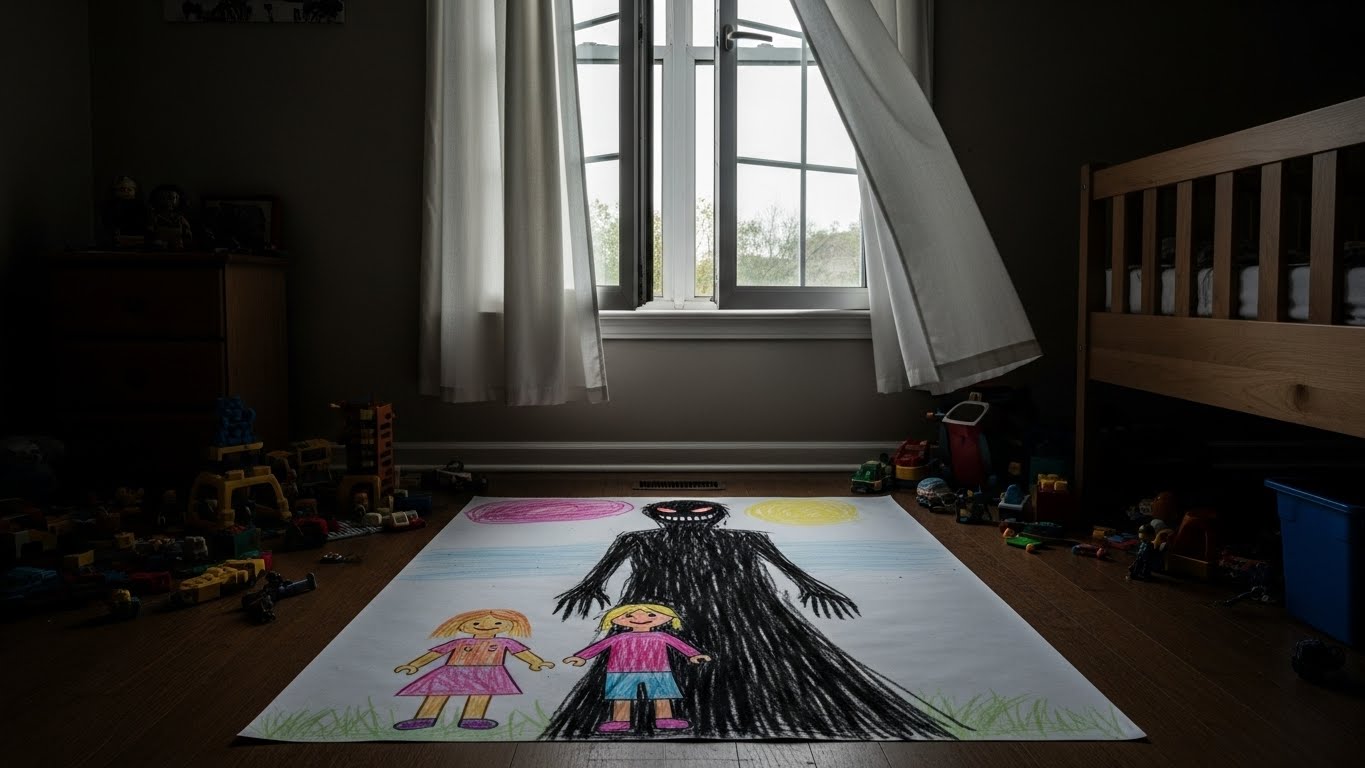
I crawled over, my heart hammering against my ribs so hard I thought it would break. I picked up the paper. It was a crude drawing on the back of a receipt, done in crayon. It showed three stick figures holding hands. Me, Sarah, and Leo.
But standing behind Leo, drawn in heavy, angry black charcoal, was a fourth figure. Tall. Long arms that dragged on the ground. And no face.
Written underneath, in Leo’s shaky, unmistakable handwriting, were two words that made my blood turn to ice:
My Friend.
“He’s not alone,” I whispered, holding the paper up to Miller. “He didn’t run away. He went with him.”
PART 2: THE WALLS HAVE EYES
Chapter 3: The Space Between
The air in the attic was thick with dust and a smell that I couldn’t place at first. It was musky, sour. Like wet dog and unwashed clothes. It was the smell of a human animal.
Detective Miller was shining his light against the far wall, where the roof slanted down to meet the floorboards. “Don’t touch anything else,” he ordered, his voice tight.
I couldn’t take my eyes off the sleeping bag. It was a child’s sleeping bag, vintage, with faded Star Wars characters on it. It looked like something from the 80s.
“How?” I choked out. “The hatch was painted shut. You had to pry it open. How did he get in here? How did Leo get in here?”
Miller didn’t answer me directly. He was running his gloved hand along the brick of the chimney stack that ran up through the center of the house. He stopped at a section of the wooden framing near the eaves.
“Here,” Miller said.
He pushed on a section of the plywood wall. It didn’t move. He pushed harder, sliding it to the left. It moved on a greased track, silent as a whisper. Behind the plywood wasn’t the outside world. It was a dark, narrow void.
“A false wall,” Miller muttered. He shone his light into the hole. “Jesus Christ.”
I peered over his shoulder. The beam of light revealed a narrow crawlspace that ran down the side of the house, between the interior drywall and the exterior siding. It was a chase, normally used for plumbing or electrical wiring, but this one had been widened.
There were rungs nailed into the studs. A ladder. Hidden inside my walls.
“It goes down,” Miller said, backing away and keying his radio. “Dispatch, I need a structural team and SWAT. We have a confirmed intruder entry point. The suspect may still be in the structure.”
My knees gave out. I sat down hard on the insulation. “In the walls?” I whispered. “Someone has been living in the walls?”
Miller turned to me, his expression grim. “Mark, look at this.”
He pointed his light at the floorboards right above where our master bedroom would be. There was a small knot in the wood. It had been drilled out.
I crawled over, my stomach churning. I put my eye to the hole.
I could see our bed. I could see the pillows where Sarah and I slept. I could see the nightstand where I kept my wallet and keys.
The angle was perfect.
“He watched us,” I said, my voice trembling with a rage so pure it felt like fire. “He watched us sleep. He watched us change.”
“And here,” Miller said, moving the light a few feet over. Another hole. This one looked down into Leo’s room.
Right at his bed.
I scrambled backward, fighting the urge to vomit. The drawing made sense now. The “Friend.” The long arms. The lack of a face. Leo had seen him. Maybe he thought it was a monster. Maybe he thought it was a dream.
“How long?” I asked. “How long has he been here?”
Miller used his pen to lift the edge of the candy wrapper found near the sleeping bag. “Based on the expiration date on this Snickers? 2018.”
My heart stopped.
“We bought the house in 2019,” I whispered.
“He didn’t break in, Mark,” Miller said, his voice dropping to a terrifyingly low volume. “He was here when you moved in. You moved in with him.”
A commotion erupted from downstairs. Sarah was screaming again.
“Mark! The TV! Look at the TV!”
I scrambled back down the attic ladder, nearly falling. I ran into the living room. Sarah was standing in front of the 65-inch flat screen, her hands covering her mouth.
The TV was on. But it wasn’t cable. It was a static-filled blue screen, the kind you see when a device is plugged into the wrong input.
Then, text appeared on the screen. typed out slowly, letter by letter, as if someone was typing it in real-time.
LEO LIKES THE RAIN.
I stared at the screen, paralyzed. “Is that… is that happening now?”
“Disconnect it!” Miller roared, charging into the room. “Don’t let him communicate!”
HE SAYS HE MISSES MOMMY.
Sarah wailed, a sound of pure agony.
BUT WE ARE GOING ON AN ADVENTURE NOW.
“Where is the signal coming from?” I shouted, grabbing the remote and trying to find the source. It was casting. Someone was casting to our TV.
“He’s close,” Miller said, drawing his gun again. “He’s within Wi-Fi range.”
BYE BYE.
The TV went black.
Chapter 4: The Tunnels
The house became a war zone. SWAT teams arrived in armored trucks, their boots heavy on our hardwood floors. They tore down the drywall in the hallway to access the hidden crawlspace.
I stood on the front lawn with Sarah, shielded by an umbrella an officer had given us. The rain was coming down harder now, washing away the world.
“They’re going to find him,” I told Sarah, gripping her wet shoulder. “They have dogs. They have thermal cameras.”
She looked at me, her eyes hollow. “He was in the walls, Mark. Every time Leo said he was scared of the monster in his room… I told him it was just his imagination. I told him to go back to sleep.” She sobbed, her body convulsing. “I fed him to the wolf.”
“No,” I said firmly. “You couldn’t have known.”
“Mr. Thompson?”
It was a young officer, looking pale. He was holding a plastic bag. Inside was a digital baby monitor—the old one we had stopped using two years ago when Leo turned four.
“Where did you find that?” I asked.
“It was in the crawlspace,” the officer said. “It was rigged up to a battery pack. It was still recording.”
Miller walked over, taking the bag. “Get the playback unit. Now.”
Ten minutes later, we were huddled in the back of the mobile command center—a massive van parked in our driveway. Monitors lined the walls. A tech guy plugged the SD card from the monitor into his computer.
“This is from last night,” the tech said. “Starting at 9:45 PM.”
On the screen, in grainy night-vision green, was Leo’s room.
We watched ourselves come in. I saw myself tuck Leo in. I saw Sarah kiss his forehead. We looked so happy. So oblivious. We left the room. The door clicked shut.
Fast forward. 10:30 PM.
Leo sat up in bed. He looked toward the closet.
He waved.
“He’s waving,” Sarah whispered. “Who is he waving at?”
The closet door didn’t open. Instead, the vent cover near the floor—the cold air return—slowly unscrewed. It happened from the inside.
A hand reached out. Pale. Long, spindly fingers.
Leo didn’t scream. He climbed out of bed, clutching his teddy bear. He walked over to the vent. He laid down on his stomach and whispered something into the hole.
Then, the wall panel behind the closet door—the one we couldn’t see from the angle of the bed—slid open.
A figure emerged.
I gasped. The figure was draped in grey rags that matched the color of the insulation. He was wearing a mask made of duct tape, with only slits for eyes. He was tall, impossibly thin, moving with a jerky, spider-like grace.
He knelt down before Leo. He was the same height as my son when kneeling.
The audio on the camera was faint, but audible.
“Is it time?” Leo asked. His voice was filled with trust.
The figure nodded. His voice was a rasp, like dry leaves skittering on pavement. “Yes, little prince. The Kingdom of Below is ready.”
“Can I bring Mr. Bear?”
“Mr. Bear is the guest of honor.”
The figure stood up. He didn’t grab Leo. He didn’t drug him. He extended a hand.
And Leo took it.
My son walked hand-in-hand with the monster into the wall. The panel slid shut. The room was empty.
“Stop it,” I said, looking away. “Turn it off.”
“Kingdom of Below,” Miller muttered. He looked at the map of the neighborhood on the main screen. “Mark, does this house have a basement?”
“No,” I said. “It’s on a slab. Just a crawlspace for the HVAC.”
“The plans show a storm shelter,” the tech guy said, pulling up the original blueprints from the 1950s. “Built during the Cold War. It was decommissioned and paved over in the 80s.”
“Where?” Miller barked.
“Directly under the backyard shed.”
Miller grabbed his radio. “All units, converge on the backyard shed. We have a subterranean structure. Proceed with extreme caution.”
I didn’t wait for permission. I ran out of the van, sprinting through the rain toward the backyard.
The shed was a rickety wooden thing where I kept the lawnmower. The door was padlocked.
“Open it!” I screamed at the SWAT officer who was trying to cut the lock with bolt cutters.
Snap. The lock fell.
The officer kicked the door open. Inside, it looked normal. Rakes, a shovel, bags of fertilizer.
“Clear the floor!” Miller ordered.
We dragged the heavy rubber mats aside. Beneath them, the concrete was cracked. And in the center, there was a heavy iron ring set into a trapdoor.
“It’s not paved over,” Miller said, unholstering his weapon. “It’s active.”
He pulled the ring. The trapdoor groaned, the rusted hinges shrieking in protest. A blast of cold, stale air hit us. It smelled of earth and rot.
Stairs led down into absolute darkness.
“Leo!” I screamed down the hole.
“Mark, stay back!” Miller grabbed my arm. “You can’t go down there.”
“That’s my son!”
“And that thing down there has had years to prepare this space. It’s a kill box. Let my men go.”
I watched as four SWAT officers, clad in heavy armor and night-vision goggles, descended into the earth. The darkness swallowed them.
For a long moment, there was nothing. Just the sound of the rain and Sarah sobbing behind me.
Then, the radio crackled.
“Talk to me,” Miller said.
“Sir…” The officer’s voice was shaking. “You need to see this. It’s not just a shelter. It’s… it’s a tunnel system.”
“Does it connect to the sewers?”
“No, sir. It connects to the other houses.”
I froze.
“Repeat?” Miller asked.
“The tunnels,” the officer said, his voice laced with disbelief. “They branch off. I’m looking at a map painted on the wall down here. There are tunnels leading to the basement of 402, 404, and 408.”
402 was Mrs. Higgins. 404 was the Smiths, a young couple with a newborn. 408 was us.
“He hasn’t just been living in our walls,” I whispered, the horror dawning on me. “He’s been living in everyone’s walls.”
“We found a room,” the officer continued. “It’s… it’s a nursery. There are toys everywhere. But no Leo. And no suspect.”
“Where does the main tunnel lead?” Miller demanded.
“It goes deep, sir. It heads west. Toward the old textile factory.”
The factory. It had been abandoned for twenty years. It was a massive, crumbling complex on the edge of town, surrounded by chain-link fences and “No Trespassing” signs.
“Load up!” Miller shouted. “He’s taking him to the factory!”
I turned to run back to the car, but something caught my eye.
On the inside of the shed door, scratched into the wood at eye level for a six-year-old, was a message.
DADDY, DON’T COME. HE IS ANGRY.
I touched the wood. It was fresh. The splinters were still wet.
“He was just here,” I whispered. “He paused to let Leo write this.”
He was taunting us. He wanted us to follow.
“Miller!” I yelled, pointing at the message. “It’s a trap! He wants us at the factory!”
Miller looked at the message, then back at the dark hole in the ground. “If he’s not in the tunnels, and he’s heading west…”
“He’s not heading west,” I said, a sudden realization hitting me like a lightning bolt. “The factory is a decoy. If he wanted to disappear, he wouldn’t go to a landmark.”
“Where then?”
I thought about the drawing. The charcoal figure. The “Friend.” And then I remembered something Leo had said weeks ago. Something I had dismissed.
My friend says he likes the boats. He says he used to work on the big boats.
“The river,” I said. “The Columbia River. It’s in the opposite direction. There’s an old dockyard near the bridge.”
Miller hesitated. “The dogs are tracking toward the woods, Mark.”
“The dogs are tracking his scent from the shed!” I argued. “But if he went into the tunnels to trick us…”
“Sir!” The radio crackled again. “We found an exit point in the tunnel. It comes out in the storm drain on Elm Street.”
Elm Street. That was toward the river.
Miller looked at me, then at his men. “Split the team. Alpha to the factory. Bravo to the river. Mark, get in the car.”
I didn’t need telling twice. I jumped into the passenger seat of Miller’s unmarked charger. He slammed the car into gear, tires spinning on the wet asphalt.
As we sped away, I looked back at my house. It looked like a skull now, the windows like dark, empty eye sockets. It had never been a home. It had been a cage. And we had just been the pets he was fattening up.
But tonight, the pets were biting back.
Chapter 5: The River of Shadows
The drive to the river was a blur of windshield wipers fighting a losing battle against the Oregon downpour. Detective Miller drove like a man possessed, weaving the heavy Charger through traffic, sirens wailing, pushing other cars onto the shoulder.
My hands were gripping the dashboard so hard my knuckles were white. “Faster,” I muttered, watching the GPS ETA tick down. “Please, just go faster.”
“We’re three minutes out,” Miller said, his eyes scanning the road ahead. “Mark, you need to listen to me. If we find him, you do not engage. You let me handle it. This guy has lived in a hole in the ground for years. He’s feral. He will be strong, and he will be fast.”
“I don’t care,” I said. “If he touches my son…”
“If you rush him, he might use Leo as a shield. Or throw him in the water. Do you understand?”
I swallowed hard, the bile rising in my throat. “I understand.”
We skidded into the entrance of the old shipyard. It was a graveyard of industry—rusted cranes looming like skeletal dinosaurs against the gray sky, shipping containers stacked in chaotic towers, and the dark, churning water of the Columbia River smashing against the rotting piers.
It was desolate. No workers. No security. Just the wind and the rain.
Miller killed the sirens. Silence rushed back in, heavy and suffocating.
“Stay close,” Miller whispered, drawing his service weapon and clicking on the tactical light.
We moved toward the water. The ground was slick with oil and mud. Every shadow looked like a man; every creak of metal sounded like a footstep.
“Leo!” I whispered, unable to help myself.
“Shh.” Miller held up a hand.
He pointed to the ground near a stack of blue shipping containers.
There, lying in a puddle of oil, was a teddy bear.
Mr. Bear.
It was soaking wet, its fur matted. One of its button eyes was missing.
I picked it up, pressing it to my chest. It was cold. “He was here,” I choked out. “He dropped it.”
“Or it was left as a marker,” Miller said grimly. “Look.”
He pointed his light further down the pier. A trail of muddy footprints led toward an old, rusted barge moored at the end of the dock. The barge was half-sunk, tilting precariously into the river.
We moved forward, guns and adrenaline leading the way. The rain was deafening now, drumming on the metal containers.
As we reached the gangplank of the barge, a flash of lightning illuminated the deck.
I saw them.
Standing near the edge of the barge, silhouetted against the storm, was the figure. He was impossibly tall, his grey rags flapping violently in the wind. He was holding Leo in his arms, rocking him gently.
Leo looked limp.
“Oh god,” I whispered. “Is he…?”
“He’s moving,” Miller said, squinting. “I see his head move. He’s alive.”
Miller raised his gun. “Police! Drop the child and get on your knees!”
The wind snatched his voice away, but the figure heard. He turned slowly. Even from fifty feet away, I could feel his gaze. The duct-tape mask was peeling in the rain, revealing patches of raw, pale skin underneath.
He didn’t drop Leo. He didn’t kneel.
He stepped closer to the edge. The dark water churned twenty feet below.
“Don’t!” I screamed, stepping out from behind cover. “Don’t hurt him! Take me! Take me instead!”
The figure tilted his head, like a curious bird.
“He is not hurt,” the figure shouted. His voice was a grinding screech, loud enough to cut through the storm. “He is sleeping. He is dreaming of the Kingdom.”
“Give him back,” I begged, walking slowly up the gangplank. The metal groaned under my feet. “He needs his mother. He needs his home.”
“Home?” The figure laughed. It was a dry, hacking sound. “You call that box a home? You leave him alone in the dark. You let him cry. I hear him. Through the walls, I hear his heart beating. I am the only one who listens.”
“I listen!” I yelled. “I’m his father!”
“Fathers protect,” the figure hissed. “I protected him from the spiders. I protected him from the cold. Now, I protect him from you.”
He took another step back. His heel was hanging off the edge of the barge.
Miller moved up beside me. “Mark, I have the shot,” he whispered. “But the wind… if I miss, or if he falls backward…”
“Don’t shoot,” I whispered back. “If he falls, Leo goes in.”
The water below was freezing and fast. If Leo fell in, burdened by wet clothes and the shock of the cold, he wouldn’t last a minute.
“Who are you?” I asked the figure, trying to keep him talking. Trying to buy time. “How do you know the tunnels?”
The figure paused. He looked down at Leo, stroking my son’s hair with a long, filthy finger.
“I built them,” he said softly. “My father and I. When the bombs were coming. We dug. We dug deep.”
“That was fifty years ago,” Miller murmured. “He’s been down there… since the 70s?”
“The bombs didn’t come,” the figure said, his voice sounding confused. “But the bad men came. The tax men. The police. So we stayed. We stayed in the veins of the house. We became the ghosts.”
He looked up at me, and for a second, the lightning lit up the slits in his mask. I saw eyes that had no color. Pupils blown wide, black pits adapted to total darkness.
“The boy is like me,” the figure said. “He sees the monsters. He needs the dark to be safe.”
“He’s not like you!” I shouted. “He’s a little boy who loves sunlight and ice cream! Give him to me!”
“No,” the figure said firmly. “The sun burns. The sun lies. We are going down. To the deep water. Where it is quiet.”
He shifted his weight. He was going to jump.
“No!” I lunged forward.
Chapter 6: The Face Beneath the Mask
The distance between us was thirty feet. I covered it in seconds, but the metal deck was slick with oil and rain.
“Mark, down!” Miller shouted.
The gunshot cracked like a whip.
The figure jerked. Miller had aimed for the shoulder, trying to disable the arm holding Leo.
But the figure didn’t drop him. Instead, he shrieked—an unearthly sound of pain and rage. He spun around, shielding Leo with his body, and swung a massive, lanky arm at me as I slid within range.
His fist connected with my jaw. It felt like being hit with a bag of rocks.
I flew backward, slamming hard onto the steel deck. Stars exploded in my vision. I tasted blood.
“Don’t touch the Prince!” the figure roared.
Miller was rushing forward now, gun drawn, but he couldn’t shoot again. The figure was holding Leo too tight, dancing on the edge of the abyss.
“Wake up, Leo!” I screamed, scrambling to my feet, ignoring the dizziness. “Leo, wake up!”
Leo stirred. His eyes fluttered open. He looked around, groggy, confused by the rain and the noise. He looked up at the mask.
“Mr. Friend?” Leo mumbled.
“Sleep, little one,” the figure rasped. “We are almost there.”
Leo looked past the mask. He saw me.
“Daddy?”
The recognition in his eyes broke the spell. Leo started to squirm. “Daddy! I want down! It’s cold!”
“Hold still!” the figure snapped, his grip tightening. “Do not look at him! He is the Enemy!”
“Let me go!” Leo screamed, kicking his legs. His small boot connected with the figure’s gunshot wound.
The figure howled, his grip loosening just for a fraction of a second.
That was all I needed.
I didn’t think. I didn’t plan. I just threw my entire body weight at the figure’s legs.
We went down hard.
The impact knocked the wind out of me. The figure was incredibly strong, writhing like a snake. He smelled of mold and old earth. He clawed at my face, his nails digging into my skin.
“Miller! Get Leo!” I screamed, grabbing the figure’s wrists.
Leo had tumbled out of his arms and was scrambling away across the wet deck, crying.
Miller scooped him up, pulling him back toward the safety of the containers. “I’ve got him! Mark, get out of there!”
But I couldn’t. The figure had wrapped his legs around my waist, crushing me. He was on top of me now, pinning me to the wet steel.
“You stole him!” the figure hissed, looming over me. “He was mine!”
He raised a fist to smash my skull in.
I reached up and grabbed the duct-tape mask. I ripped it off.
I froze.
The face underneath was the stuff of nightmares. But not because it was a monster. Because it was human.
It was a man, maybe sixty years old, but he looked ancient. His skin was translucent, blue veins pulsing visibly beneath the surface. He had no eyebrows, no hair. His teeth were filed to points—or maybe they had just rotted that way.
But his eyes… his eyes were white. Blind. Or nearly blind.
“The light,” he whimpered, shielding his face as the lightning flashed again. “It burns!”
He was a creature of the dark. The ambient light from the city, the lightning—it was agonizing to him.
I took advantage of his distraction. I punched him in the throat.
He gagged, falling back. I scrambled out from under him, gasping for air.
“Stay down!” Miller shouted, aiming his gun at the man. “On your stomach! Now!”
The man curled into a fetal position, weeping. It wasn’t a cry of pain. It was a cry of heartbreak.
“I just wanted a friend,” he sobbed into the rain. “Everyone leaves. Everyone dies. I just wanted a friend.”
I stood there, panting, wiping blood from my mouth. I looked at this broken thing. This man who had lived in the crawlspaces of our suburb for decades, watching families grow, steal, love, and leave, while he rotted in the dark.
He wasn’t a monster. He was a ghost we had all created.
“It’s over,” I said, my voice hoarse.
Miller moved in to cuff him. The man didn’t resist. He just kept crying about the light.
I turned and ran to Miller’s car where he had placed Leo.
I ripped the door open. Leo was sitting in the back seat, wrapped in Miller’s jacket, clutching the one-eyed teddy bear.
“Daddy!” he cried, reaching for me.
I pulled him into my arms, burying my face in his wet neck. I sobbed. I cried harder than I have ever cried in my life. I smelled the rain and the mud on him, but underneath that, he still smelled like strawberries.
“I’ve got you,” I whispered. “I’ve got you. I’m never letting go.”
“Mr. Friend is sad,” Leo whispered against my shoulder. “He hurt his arm.”
I pulled back, looking at my son. “He’s not a friend, Leo. He’s… he’s a sick man.”
“He told me stories,” Leo said. “About the Before Time. When the houses weren’t there. He said he was waiting for the fire to stop.”
I closed my eyes. The fire. The nuclear paranoia of the Cold War. His father had dragged him underground to save him from a fire that never came, and he had stayed there, waiting, until his mind fractured.
“Mark,” Miller said, appearing at the door. He looked shaken. “Ambulance is two minutes out. The suspect is in custody. But… you need to see this.”
“See what?” I asked, not wanting to let go of Leo.
“He had a pocket inside his rags,” Miller said. He held up a plastic Ziploc bag.
Inside were photos. Polaroids. Hundreds of them.
They were photos of children. Sleeping in their beds. Playing in their rooms. Decades of children.
“Leo wasn’t the first friend,” Miller said quietly. “He’s been ‘befriending’ kids in this neighborhood for forty years. He just… never took one out of the house before.”
I felt a chill that had nothing to do with the rain.
“Why Leo?” I asked. “Why did he take Leo?”
Miller turned the bag over. On the back of the last photo—a picture of Leo sleeping—it said:
THE WALLS ARE FALLING. THE SAFE PLACE IS GONE. WE MUST LEAVE.
“He wasn’t kidnapping him for fun,” Miller said. “He thought the house was being destroyed. He thought he was saving him.”
“Destroyed?” I frowned. “What are you talking about?”
“Mark,” Miller said. “Did you schedule a renovation? A contractor?”
“Yeah,” I said. “We were going to knock down the wall between the kitchen and the living room next week. We just got the permits.”
Miller nodded. “He heard you. He heard you planning to tear down his home. His tunnels. He panicked.”
I looked back at the barge, where the police were hauling the weeping man away.
He had terrorized us. He had almost killed my son. But in his twisted, broken mind, he was just a refugee fleeing a demolished home, trying to save the only thing he loved.
It didn’t make it right. But it made it tragic.
Chapter 7: The Museum of Stolen Moments
The hospital waiting room smelled of antiseptic and stale coffee—a sharp contrast to the mud and rot of the riverbank.
Leo was fine. Physically, at least. He had mild hypothermia and some bruising on his wrists where the man—Elias Vance, as the police identified him—had held him too tight. But he was warm now, sleeping in a hospital bed with Sarah curled up beside him, refusing to let go of his hand even for a second.
I couldn’t sleep. The adrenaline had crashed, leaving me jittery and hollow.
Detective Miller found me in the cafeteria, staring at a vending machine. He looked exhausted, his suit ruined, mud drying on his shoes.
“You need to go home, Mark,” he said gently. “Get some rest. We have officers posted at the boy’s door.”
“Home?” I laughed, a bitter, jagged sound. “I don’t have a home, Miller. I have a termite mound. I have a viewing box.”
Miller sighed and handed me a cup of lukewarm water. “We finished the sweep of the tunnels. The structural engineers are calling it a marvel of insanity. It runs under the entire block. He didn’t just dig it; he reinforced it. He tapped into the power grids of three different houses. He was siphoning your water.”
“I want to see it,” I said.
“No, you don’t.”
“I have to,” I insisted, turning to face him. “I have to know what he saw. I have to know how close he was.”
Miller hesitated, then nodded. “Meet me there in an hour. But prepare yourself. It’s… intense.”
Returning to the house was like walking onto a movie set after the horror film had wrapped. The front door was taped off. Police floodlights illuminated the yard.
Miller led me to the shed in the backyard. The trapdoor was open.
“We pumped fresh air in,” Miller said, handing me a flashlight. “Watch your head.”
We descended into the earth.
The air grew cool and damp. The tunnel was narrow, shored up with stolen lumber and old street signs. It was claustrophobic, pressing in on all sides.
We walked for maybe fifty feet until the tunnel widened into a small, circular chamber directly beneath my living room.
“This was his main hub,” Miller said.
I swept my light around the room, and my breath hitched.
It was a living space. A ragged mattress in the corner. A hot plate rigged to a car battery. But it was the walls that made my skin crawl.
They were covered in shelves. And on the shelves was a museum of our lives.
There was a jar filled with baby teeth. Leo’s teeth. The ones we thought the Tooth Fairy had collected from under his pillow. Elias had taken them.
There was a lock of Sarah’s hair, tied with a red ribbon.
There were broken toys I had thrown in the trash years ago, carefully repaired with glue and tape.
And the journals.
Stacks of composition notebooks lined the floor. I picked one up, my hands trembling. The date on the cover was from three years ago.
October 14th: The Father is angry today. Work stress. He yelled at the Mother about the electric bill. I turned off my heater to save them money. I am a good helper.
November 2nd: The Little Prince has a cough. I put extra insulation under his floorboards to keep him warm. I sang the lullaby through the vent. He stopped crying.
December 25th: They got him a bike. He is too small for it. He will fall. I must watch him when he rides.
I dropped the book. I felt sick.
“He thought he was part of the family,” I whispered. “He thought he was… taking care of us.”
“He was delusional,” Miller said. “He’s been down here since his father died in ’88. He’s never paid taxes, never had a job, never spoken to a soul except the children he whispered to through the vents. He lived off your scraps and your leaked Wi-Fi.”
I walked over to a periscope-like device rigged with mirrors and PVC pipe. I looked through it.
It gave a perfect, fisheye view of our dining room table.
I saw the empty chairs. I saw the ghost of every dinner we’d eaten, every argument we’d had, every intimate moment Sarah and I had shared over a bottle of wine.
He had been there for all of it. A silent, uninvited guest at the head of the table.
“He knew us better than we knew ourselves,” I said, backing away. “He knew my passwords. He knew Sarah’s cycle. He knew Leo’s fears.”
“He’s gone now, Mark,” Miller said firmly. “He’s in a secure psychiatric ward at the state hospital. He’ll never get out.”
“It doesn’t matter,” I said, shaking my head. “The house… it remembers him. I can feel him in the dirt.”
I climbed back up the ladder, gasping for the fresh, rain-washed air of the backyard. I looked at my house—the dream home we had saved for years to buy.
It looked like a corpse.
“Burn it,” I said.
Miller looked at me. “What?”
“I’m not selling it to some other poor family,” I said, staring at the dark windows. “I’m not letting anyone else sleep in that nest. I want it leveled. I want the tunnels filled with concrete.”
“Mark, that’s a financial disaster.”
“I don’t care,” I said, walking toward my car. “It’s not a house. It’s a cage. And I’m done being the pet.”
Chapter 8: The Echo of the Walls
We never spent another night in that house.
We stayed in a hotel for two weeks, then rented a condo downtown—on the 20th floor. High up. No crawlspaces. No attics. Just steel and glass and sky.
The story went viral, of course. “The Boy in the Walls.” “The Phantom of Portland.” True crime podcasts dissected our lives. Strangers sent us letters—some supportive, some calling us negligent for not hearing a man living inches from our heads.
They didn’t understand. Silence isn’t empty. Silence is just a canvas for what you want to hear. We wanted to hear safety, so that’s what we heard. We ignored the creaks. We ignored the missing food. We rationalized the unexplainable because the alternative was too terrifying to consider.
Leo recovered faster than we did. Children are resilient, plastic creatures. To him, “Mr. Friend” was just a weird memory, a scary adventure that faded a little more each day.
But the trauma lingered in the small moments.
One night, six months later, I found Leo sitting in the hallway of the condo, pressing his ear against the wall.
My heart stopped. “Leo? What are you doing?”
He looked up at me, his eyes wide and innocent. “Just listening.”
“Listening for what?” I asked, kneeling down, fighting the panic rising in my chest.
“To see if the new walls have friends,” he said.
I pulled him into a hug, squeezing him tight. “No, buddy. These walls are solid. Just concrete. No friends inside.”
“Okay,” he said, shrugging. He ran off to play video games.
But I stayed there. I pressed my own ear to the cold drywall. I listened.
I heard the hum of the elevator. The wind against the glass. The muffled bass of a neighbor’s stereo.
Normal sounds. Safe sounds.
But late at night, when Sarah is asleep and the city below is quiet, I still wake up at 5:43 AM. I lie there in the dark, staring at the vent on the ceiling.
I think about Elias Vance.
He died three months after his arrest. The doctors said his heart gave out, but I know the truth. The light killed him. The exposure. He was a creature of the deep, a mushroom that withered in the sun.
Before he died, he sent a letter to me. It was scribbled in crayon, barely legible.
Dear Father,
I am sorry I scared you. I only wanted to save the Prince. The walls were falling.
Please check the vents in the new high tower. The wind is cold up there. Make sure he wears socks.
Your Neighbor, Elias.
I burned the letter. But I couldn’t burn the memory.
Now, whenever I enter a room, I check the corners. I check the closets. When we visit friends, I find myself tapping on their walls, listening for that hollow sound that indicates a void.
I look at the perfect suburban houses with their manicured lawns and their dark windows, and I wonder who else is watching.
Because that’s the thing about safety. It’s an illusion. A thin layer of drywall between you and the monsters.
And sometimes, the monsters aren’t under the bed.
Sometimes, they are the bed. They are the floorboards. They are the house itself, wrapping its arms around you, digesting you slowly while you sleep.
So do me a favor. Tonight, when you turn off the lights and the house settles into that heavy, comfortable silence…
Listen.
Listen closely.
Is that the wind rattling the gutter? Is that the house cooling down?
Or is it the sound of someone shifting their weight in the crawlspace, waiting for you to close your eyes so they can come out and watch their family sleep?
THE END.