My Husband Threw Me Out in a Blizzard for Being “Barren.” I Thought My Life Was Over Until a Stranger with Three Kids Asked One Question That Changed Everything.
Chapter 1: The Discard Pile
The sound of the deadbolt sliding into place was the loudest thing I had ever heard. It echoed in the marrow of my bones, louder than the Chicago wind screaming through the leafless maples, louder than the blood pounding in my ears.
Click.
That was it. Three years of marriage. Five years of knowing each other. Tens of thousands of dollars in medical bills. All of it, ended with a mechanical click.
I stood on the front porch of the colonial-style house in Evanston. The porch I had swept that morning. The door I had painted a cheerful red last summer to signify luck and welcome. Now, it was just a barrier between me and the only life I knew.
“Mark!” I screamed, the wind snatching the name from my lips and tearing it away. I hammered my fist against the wood until my knuckles grazed. “Mark, open the door! It’s ten degrees out here! You can’t do this!”
“I can,” his voice came from the other side. He didn’t even open the peephole. “I own the house, Clara. It’s in my name. The pre-nup was clear. Infidelity or irreconcilable differences. And believe me, this is irreconcilable.”
“I didn’t cheat on you!” I choked out, tears instantly freezing on my cheeks.
“You cheated me out of a legacy,” he spat back. “I wanted a family. You told me we could work on it. But you’re broken, Clara. The doctor said it last week. ‘Poor ovarian reserve.’ You’re dry. You’re a factory with no inventory.”
I gasped, the cruelty of it feeling like a physical blow to the stomach. “I am your wife! I am a human being!”
“You’re a liability,” he said coldly. “I’m thirty-eight. I don’t have time to waste on science projects that fail. I met someone, Clara. She’s twenty-four. She’s… viable. Now get off my porch before I call the cops for trespassing.”
I heard his footsteps retreat down the hallway. The familiar creak of the floorboards near the kitchen. He was going to pour himself a scotch. He was going to sit in the leather armchair I bought him and watch the game.
I was outside. He was inside.
I looked down at my feet. The duffel bag sat there, dusting over with white powder. He had packed it for me. I didn’t even know what was in it.
I reached for my phone with trembling fingers. I needed an Uber. I needed a hotel.
Face ID recognized. I tapped the banking app.
Alert: Access Denied. Joint Account Frozen.
I stared at the screen. My personal savings? Transferred out yesterday. He had planned this. He had been moving money while I was crying over the last negative pregnancy test.
I had forty dollars in cash in my wallet. Maybe enough for a motel on the outskirts, but not tonight. It was the Friday before Christmas. Everything was booked or surged to triple prices.
I grabbed the handle of the duffel bag. It was heavy.
I walked down the driveway, sliding slightly on the black ice. The neighborhood was picture-perfect. Wreaths on every door. Inflatable Santa Clauses waving from snowy lawns. Golden lights twinkling in windows where families were eating dinner, arguing over remote controls, being normal.
I felt like a ghost haunting the living.
I walked for three blocks until my legs began to burn. The wind cut through my thin wool sweater—I hadn’t even had time to grab my parka. Mark had literally shoved me out while I was folding laundry.
I reached the bus stop on the corner of Maple and 4th. There was a metal bench under a plexiglass shelter. It offered zero protection from the cold, but it was a place to sit.
I sat.
I pulled my knees up to my chest, trying to make myself small.
Infertility.
The word had defined my existence for two years. The shots. The bruising on my stomach. The mood swings. The hope that bloomed every month only to be crushed by a single red line.
And through it all, I thought we were a team. I thought Mark held my hand because he loved me, not the potential baby inside me.
I was wrong.
I looked at the grey sky. The snow was falling faster now, thick heavy flakes that muffled the sound of the city.
I was twenty-eight years old. I had no job—Mark had insisted I quit to “reduce stress” for the treatments. I had no home. I had no money.
I was nothing.
The cold began to feel different. It stopped stinging. It started to feel like a heavy, warm blanket. My eyelids grew heavy.
Just sleep, a voice whispered in my head. Just close your eyes. When you wake up, it won’t hurt anymore.
I let my head droop forward. The world faded to white.
Chapter 2: The Rescue
“Daddy, is she a statue?”
The voice was tiny, curious, and very close.
“No, stupid, statues don’t wear sweaters,” a boy’s voice replied. “She’s a lady. But she looks dead.”
“Sam! Don’t say that!”
The voices pulled me back from the edge of the void. I gasped, sucking in a lungful of freezing air that made me cough violently.
I opened my eyes.
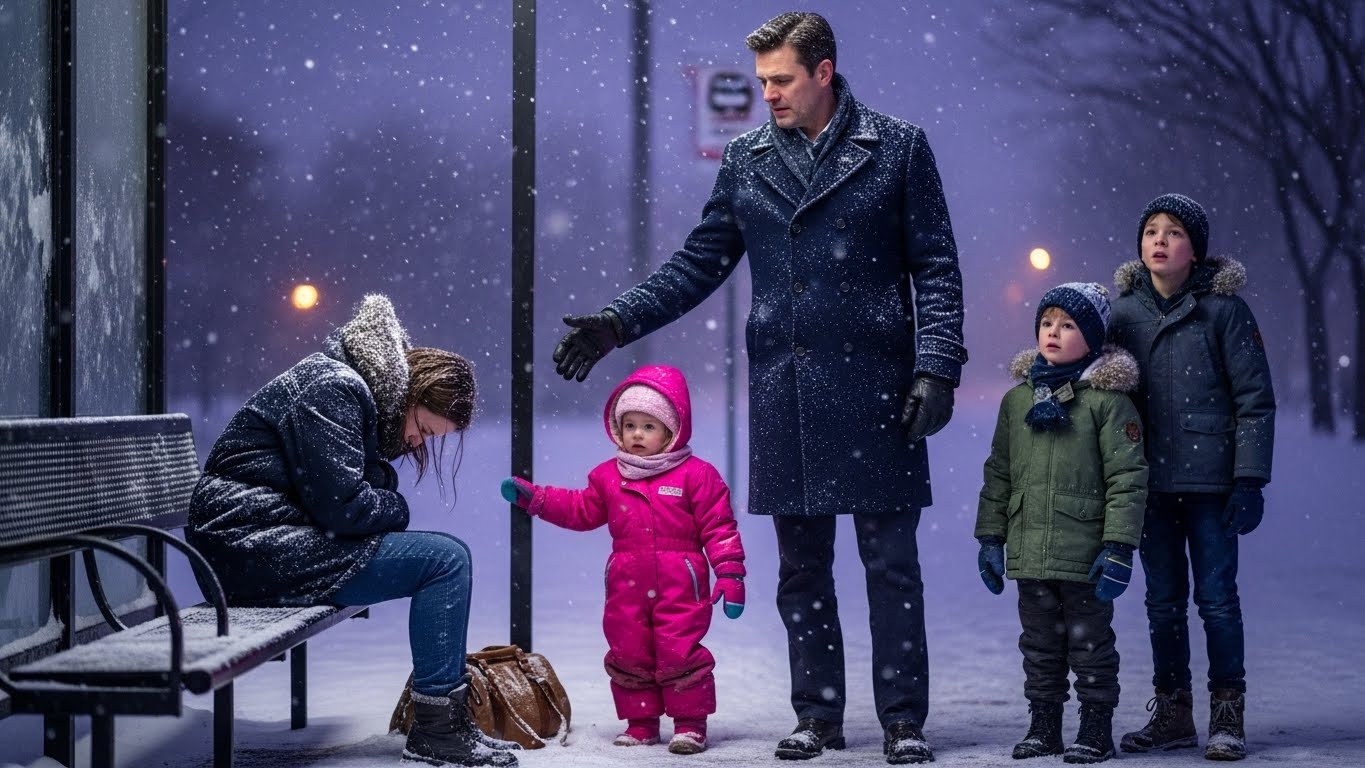
The world was blurry at first. Then, colors sharpened. Bright pink. Kelly green. Navy blue.
Standing in front of me was a wall of people.
“See? She coughed,” the man’s voice was deep, resonant, and calm. “She’s not dead, Sam.”
I blinked, trying to focus.
A man was crouching in front of me. He was close enough that I could smell him—cedarwood, expensive tobacco, and winter air. He had dark, messy hair and eyes the color of warm amber. He looked tired, but kind.
Behind him stood three children. A little girl in pink who looked about six. A boy in green, maybe eight. And a teenage boy, looking awkward in a hoodie under a coat, holding a sled.
“Hi,” the man said. He stayed crouched, keeping his eye level with mine so he wouldn’t tower over me. “I’m Jon. Are you waiting for the 402 bus?”
I nodded slowly, my neck stiff. “Y-yes.”
He grimaced slightly, a look of genuine apology on his face. “I just checked the transit app. The 402 is cancelled. The plows haven’t cleared the route yet. They aren’t running until morning.”
The news hit me like a physical weight. “Morning?” I whispered.
“Yeah,” he said. He looked at my arms, which were wrapped around my torso, shivering violently. “And you… you aren’t dressed for this weather. Where is your coat?”
I looked down at my olive-green sweater. “I… I left in a hurry.”
“She’s turning purple, Dad,” the little girl said. She stepped forward and poked my knee with a gloved finger. “Lady, you’re an popsicle.”
“Emilia, don’t poke people,” Jon said gently. He looked back at me. “Look, I don’t mean to pry. But you can’t stay here. The temperature is dropping to minus fifteen tonight. You will freeze to death.”
“I have nowhere to go,” I said. My voice was flat. The truth just fell out. I was too tired to lie.
Jon looked at me. Really looked at me. He didn’t look at my body like Mark used to. He looked at my face, my eyes. He seemed to be calculating something.
“Okay,” he said. He stood up. He was very tall. “We live two blocks away. The corner house. We’re walking home now because the SUV got stuck in a drift. Come with us.”
“What?” I shrank back against the bench.
“Come home with us,” he repeated. “Get warm. Eat some food. We have a guest room. You can stay the night.”
“You don’t know me,” I stammered, my teeth chatting. “I could be… crazy. I could be a thief.”
“Are you?” he asked.
“No.”
“Well, I’m not a murderer, so we’re off to a good start,” he said with a half-smile. “And honestly? You look like you couldn’t hurt a fly right now. You’re the one in danger.”
I looked at the kids. They were watching me with wide, innocent eyes.
“We have lasagna,” the boy in green said. “It’s leftovers, but it’s good.”
“And Dad makes good hot chocolate,” the teen mumbled, shuffling his feet. “Real chocolate, not the powder stuff.”
Jon took off his coat.
Before I could process what was happening, he draped the heavy navy wool over my shoulders. It was warm from his body heat. It enveloped me, smelling of safety.
“Please,” Jon said. “Let us help. If you want to leave after you warm up, I’ll call you a car. But don’t stay on this bench.”
I tried to stand. My legs were numb. I stumbled forward.
Jon caught me instantly. His grip was firm but gentle. He steadied me, holding my arm.
“I’ve got you,” he said.
We walked through the snow. The journey was a blur of white wind and the crunch of boots on ice. I focused entirely on putting one foot in front of the other. The little girl, Emilia, walked beside me, holding the edge of the coat Jon had given me, as if leading me home.
We turned the corner and I saw it. A large brick house with warm, golden light spilling from every window. It looked like a beacon in the storm.
Jon unlocked the front door and ushered us inside.
The warmth hit me like a physical wall. The air smelled of cinnamon and garlic. It was messy inside—shoes kicked off in the hallway, backpacks thrown on the stairs—but it felt… alive.
“Shoes off, guys,” Jon commanded. “Sam, go get the thick wool blankets from the linen closet. Alex, put the kettle on. Em, get the guest slippers.”
The kids scattered like a well-drilled team.
Jon turned to me. He helped me out of his coat and hung it up. I stood there in the foyer, shivering, dripping melted snow onto his hardwood floor.
“I’m sorry about the floor,” I whispered.
“Floors dry,” he said. “People don’t.”
He guided me to the living room and sat me in front of a roaring gas fireplace.
Sam ran in and dumped a pile of blankets on me. Em appeared with fuzzy slippers that looked like bears.
“These were Mom’s,” she said matter-of-factly.
I froze. I looked at Jon.
He gave a tight, small smile. “It’s okay. She would want you to use them.”
I put the slippers on. I wrapped the blankets around me.
For the first time in three years, the cold in my chest began to thaw. But as the physical cold left, the emotional pain rushed back in to fill the space.
I was sitting in a stranger’s house, wearing a dead woman’s slippers, while my husband celebrated his freedom a few miles away.
“Here,” Jon said, handing me a steaming mug.
I took a sip. Rich, dark chocolate.
“Thank you,” I said, looking up at him. “Why are you doing this?”
Jon sat on the coffee table opposite me, leaning forward, his elbows on his knees.
“Because,” he said quietly, “I know what it looks like when someone has lost everything. And I know you can’t survive it alone.”
I looked into his eyes and realized: he wasn’t just talking about me. He was talking about himself.
Chapter 3: The Fractured Reflection
The house eventually settled into a heavy, rhythmic silence.
The children—Emilia, Sam, and the teenager, Alex—had retreated upstairs hours ago. I had heard the muffled sounds of teeth brushing, the thud of dropped books, and then, quiet.
I sat on the beige sofa, still wrapped in the wool blanket. The fire had burned down to glowing embers, casting long, dancing shadows across the room.
Jon walked in from the kitchen. He had changed into a grey t-shirt and flannel pajama pants. He held two mugs of tea.
“Chamomile,” he said softly, setting one down on the coaster in front of me. “It helps with the shock.”
“Thank you,” I whispered. I felt small. Smaller than I had out in the snow.
He sat in the leather armchair adjacent to the sofa. He didn’t stare. He just watched the fire, giving me space to breathe.
“You don’t have to talk,” he said, his voice low. “But sometimes, keeping it inside is colder than the snow.”
I looked at the steam rising from the mug. I traced the rim with my finger.
“He threw me out,” I said. The words tasted like ash. “My husband. Mark. He… he wants children.”
Jon didn’t interrupt. He didn’t gasp. He just listened.
“I can’t have them,” I continued, my voice cracking. “We tried for three years. IVF. Hormones. Specialists. Every month was a funeral for a life that never began. And today… today he decided he was done mourning. He wants a new wife. One that works.”
I finally looked up at Jon. I expected pity. I hated pity.
But I didn’t see pity in his amber eyes. I saw anger. A deep, simmering protectiveness.
“He called me broken,” I confessed, the tears finally spilling over. “He said I was a factory with no inventory. That I failed as a woman.”
Jon set his mug down with a sharp clink.
“That,” Jon said, his voice hard as stone, “is the stupidest thing I have ever heard.”
He leaned forward, engaging me fully.
“Look at those photos on the mantle,” he pointed.
I looked. Dozens of framed pictures. School portraits. Vacation shots. Candid moments of laughter.
“My wife, Sarah, and I,” Jon began, “we tried for ten years. Unexplained infertility. We went through the hell you’re describing. The needles. The debt. The heartbreak.”
I wiped my eyes. “You did?”
“We did,” he nodded. “And you know what we realized? Being a parent isn’t about biology. It’s not about DNA. It’s about showing up.”
He pointed to the photo of the teenager, Alex.
“We adopted Alex when he was six. He had been in four foster homes. He didn’t speak for six months.”
He pointed to the middle boy. “Sam came to us as a baby. Neonatal withdrawal. He screamed for weeks.”
Then the little girl. “Emilia was a private adoption. Her birth mom was sixteen and scared.”
Jon looked back at me, his gaze piercing.
“They are my children,” he said fiercely. “In every way that matters. Biology is just chemistry. Family is a choice. You are not broken because your body doesn’t do one specific thing. You are broken because a man who promised to love you conditionally made you feel that way.”
I felt a crack in my chest. Not a breaking crack, but a shifting one. Like ice breaking on a frozen lake to let the water flow.
“He reduced you to a womb,” Jon said. “But you are a person. You are Clara.”
I buried my face in my hands and sobbed. I cried for the baby I never had. I cried for the marriage I lost. But mostly, I cried because a stranger in a snowstorm saw more worth in me in three hours than my husband had in three years.
Jon moved to the sofa. He didn’t hug me—he respected the boundary—but he sat close enough that I could feel his presence. He put a hand on my shoulder.
“Let it out,” he whispered. “You’re safe here.”
And for the first time that night, I believed him.
Chapter 4: The Chaos of warmth
I woke up to the smell of burning toast.
For a second, I didn’t know where I was. The ceiling was unfamiliar—crown molding, painted a soft cream. The bed was huge, drowning in pillows.
Then, the memory of the blizzard rushed back. The bus stop. Jon.
I sat up. Sunlight was streaming through the curtains, but it was that blinding, cold winter sun. Outside, the world was buried. The snow had drifted halfway up the window pane.
I looked at the bedside table. My clothes from yesterday—dried and folded—sat in a neat pile. But there was also a note.
“Help yourself to anything in the closet. Sarah was a hoarder of comfy sweaters. She’d be mad if they went to waste. – Jon”
I hesitated, then opened the closet door. It smelled like lavender sachets. I chose a thick, oversized grey cardigan and a pair of leggings. They fit loosely, but they were warm.
I walked downstairs, following the sound of chaos.
“Dad! The toaster is smoking again!” “Where is my other sock? I can’t find my green sock!” “I’m hungry! I want pancakes, not charcoal!”
I stood in the doorway of the kitchen. It was a disaster zone.
Jon was on the phone, a laptop open on the granite island, wearing pajama pants and a dress shirt. He looked harried.
“Yes, the Q4 reports are coming,” he was saying into his headset, while simultaneously trying to scrape burnt black crust off a piece of toast with a butter knife. “No, I can’t come in. We are snowed in. Yes, I know the investors are waiting.”
Emilia was sitting on the counter, swinging her legs. Sam was rummaging through a laundry basket on the floor. Alex, the teenager, was staring moodily into an empty fridge.
“We have no milk,” Alex announced. “This house is a prison.”
Jon looked ready to snap. He covered the microphone. “Alex, use water for the oatmeal. Sam, wear a blue sock, who cares? Emilia, get off the counter.”
Nobody moved.
I stepped forward. I didn’t think. Instinct just took over.
“I’ve got it,” I said softy.
Jon whipped his head around. His eyes widened when he saw me. He looked relieved.
I walked over to the stove. I took the burnt toast from his hand and tossed it in the trash.
“Go take your call,” I whispered to him.
“Are you sure?” he mouthed.
I nodded.
Jon grabbed his laptop and retreated to his office, shutting the door.
The kitchen went silent. Three pairs of eyes stared at me.
“Who are you again?” Sam asked, squinting.
“I’m Clara,” I said. “And I’m going to make pancakes. Real ones. Not burnt ones.”
“We don’t have milk,” Alex said, crossing his arms. “Dad forgot to shop before the storm.”
I opened the pantry. I scanned the shelves. “Do you have sour cream? Or yogurt?”
“Maybe?” Alex shrugged.
I found a tub of vanilla yogurt in the back of the fridge. “Perfect. Yogurt pancakes are fluffier anyway.”
For the next hour, I wasn’t the barren woman. I wasn’t the divorcee. I was a conductor in a symphony of flour and sugar.
I put Sam to work mixing the dry ingredients. I had Emilia set the table. Even Alex, skeptical as he was, helped me flip the cakes on the griddle.
By the time Jon came back out, an hour later, the kitchen was clean. The kids were sitting at the table, eating a stack of golden-brown pancakes. The smell of burning was gone, replaced by vanilla and maple syrup.
Jon stopped in the doorway. He looked at the scene like he was witnessing a miracle.
“Did you… did you do this?” he asked, looking at me.
“I just mixed some stuff,” I said, suddenly shy. “I hope you don’t mind. I found the mix in the pantry.”
Jon walked over to the table and stole a piece of pancake from Emilia’s plate. She giggled.
He tasted it and closed his eyes.
“Oh my god,” he groaned. “This is edible. Actually, this is amazing.”
“Clara is a chef,” Emilia declared. “She uses the secret yogurt.”
Jon looked at me, a genuine smile breaking across his tired face. “Thank you, Clara. Seriously. I was about to lose my mind.”
“It’s the least I could do,” I said. “You saved my life.”
We were snowed in for three more days.
Those days were a blur of domestic intimacy that felt dangerously comfortable. I wasn’t a guest; I became a part of the machinery.
I noticed things.
I noticed that Alex acted tough but read comic books under his covers with a flashlight. I noticed that Sam was brilliant but disorganized; his mind moved faster than his hands. I noticed that Emilia missed her mom desperately and clung to any female presence like a lifeline.
And I noticed Jon.
I noticed how he looked at his kids with a mixture of overwhelming love and terrified exhaustion. He was drowning. He was a CEO of a major tech firm, trying to be a mom and a dad, grieving his wife, and keeping a household running.
He was a good man. A lonely man.
And I found myself waking up earlier each day, just to make sure his coffee was ready before he started his calls.
Chapter 5: The Proposal
On the fifth day, the plows came.
The sound of scraping metal against asphalt woke us up. The sun was bright, melting the icicles on the eaves. The world was reopening.
Which meant my time was up.
I packed the duffel bag. It didn’t take long. I folded the borrowed clothes and placed them on the bed. I put on my own jeans and the thin sweater I had arrived in.
I walked downstairs. The house was quiet. The kids were at school—buses were running again.
Jon was in the kitchen, staring into a mug of coffee. He looked up when I entered. His face fell when he saw the bag in my hand.
“You’re leaving,” he stated.
“The roads are clear,” I said, forcing a smile. “I can’t intrude forever. You’ve been… you’ve been an angel, Jon. I don’t know how to thank you.”
“Where will you go?” he asked. He didn’t move.
“I have a cousin in Ohio,” I lied. I didn’t have a cousin in Ohio. I had a credit card with a $500 limit and a fear of freezing to death. “I’ll figure it out.”
Jon set his mug down. He walked around the island and stood between me and the door.
“Don’t go,” he said.
My heart hammered. “Jon, I have to. I’m a stranger. This is… this isn’t my life.”
“It could be,” he said.
He took a breath, running a hand through his hair.
“Look, Clara. I’m good at business. I can run a company of five hundred people. But this?” He gestured around the kitchen, at the piles of mail, the schedule on the fridge, the empty space where a mother used to be. “I am failing at this. My kids are eating cereal for dinner. I’m missing meetings because I can’t find soccer cleats. I am lonely, and my kids are lonely.”
He looked me in the eye.
“I saw you these past few days. The way you got Alex to talk. The way Em brushed her hair because you showed her how. The way the house… breathed again.”
“Jon…”
“I have a proposal,” he said, his voice business-like but his eyes pleading. “Stay. Not as a guest. As a… manager. A partner in this house.”
I stared at him. “A nanny?”
“More than that,” he said. “I need someone to help me run this life. I’ll pay you. A salary. Full benefits. You have the guest suite. You have a car to use. You can save money, figure out what you want to do next. Go back to school. Whatever.”
He stepped closer.
“Please. I’m not asking for charity. I’m asking for help. And I think… I think you need this too. You need a place to heal. A place where you are needed.”
Needed.
The word echoed. Mark had told me I was useless. Useless because my womb was empty.
Jon was telling me I was essential.
I looked at the duffel bag. It contained the wreckage of my old life.
Then I looked at the fridge. Emilia had drawn a picture yesterday. It was a stick figure of a man, three kids, and a woman with long brown hair labeled “Clara.”
“It wouldn’t be weird?” I asked, my voice trembling.
“It would be unconventional,” Jon smiled. “But my life has been unconventional for a long time. What do you say?”
I thought of the cold bus stop. I thought of the warmth of this kitchen.
I dropped the duffel bag.
“Okay,” I whispered. “I’ll stay.”
Jon let out a breath he seemed to have been holding for days.
“Good,” he said. “Good. Now… do you know how to get gum out of hair? Because Emilia has a situation.”
I laughed. It was the first time I had genuinely laughed in months.
“I can handle that,” I said.
And just like that, I wasn’t the ex-wife. I wasn’t the failure.
I was Clara. And I was home.
Chapter 6: The Unwritten Contract
Weeks turned into months, and the snow outside the windows melted into the slush of February, then the green buds of April.
I fell into a rhythm that felt less like a job and more like a second chance at life.
The “nanny” title was a formality, something we used for tax forms. In reality, I became the family’s center of gravity. I learned that Alex needed space before he would talk about his day, usually while I was chopping vegetables for dinner. I learned that Sam needed his back scratched to fall asleep. I learned that Emilia needed her clothes laid out the night before to avoid a morning meltdown.
But the biggest learning curve was Jon.
Living with a man you aren’t married to, sharing the intimacy of raising children without the romance, was a delicate dance.
We spent our evenings in the living room after the kids were asleep. He would work on his laptop; I would read or study.
I had taken his advice. I started looking into online degrees. I had always wanted to be a teacher before Mark told me it was a waste of time, that my “job” was to be a mother.
One Tuesday night in late April, Jon found me at the kitchen island, surrounded by brochures for early childhood education programs.
He poured two glasses of wine—a ritual we had developed—and slid one toward me.
“University of Illinois?” he asked, glancing at the pamphlet.
“Maybe,” I said, feeling that old insecurity creep up. Mark’s voice echoed in my head: You’re not smart enough for that. Stick to the house.
“I’m just… looking. It’s expensive. And I don’t know if I have the brainpower anymore. It’s been years since I wrote an essay.”
Jon took a sip of wine, leaning against the counter. He looked different now than the man I met in the snow. The dark circles under his eyes were gone. He laughed more. He looked younger.
“Clara,” he said. “You manage the schedules of three chaotic children, a depressed CEO, and a household budget. You realized Sam had a gluten sensitivity before his pediatrician did. You helped Alex pass Algebra. Do not tell me you aren’t smart enough.”
I looked down at the brochure. “I’m scared,” I admitted. “I’m scared to try something new and fail. I’ve failed at so much already.”
Jon walked around the island. He stood next to me, his presence warm and solid.
“You didn’t fail,” he said firmly. “You survived. There is a difference. And this? This isn’t failing. This is growing.”
He pulled out his phone.
“Apply,” he said. “I’ll cover the tuition. Call it a bonus. Call it professional development. I don’t care. Just do it.”
“I can’t take more money from you, Jon.”
“You aren’t taking,” he said, his voice dropping an octave, becoming serious. “You are investing. And I believe in the investment.”
He looked at me then, and the air in the kitchen changed. It grew heavy, charged with something we hadn’t acknowledged yet. For a second, I thought he was going to kiss me. I wanted him to. God, I wanted him to.
But he pulled back, respecting the line we hadn’t crossed.
“You’re a natural teacher, Clara,” he said, clearing his throat. “The kids… they’re blossoming because of you. Alex smiled in a photo yesterday. Do you know how rare that is?”
I smiled. “He just needed someone to listen to his rant about Marvel movies.”
“He needed a mom,” Jon corrected. “Or… something like it.”
That night, I filled out the application. I wrote my essay about the bus stop. About the cold. About how the warmth of a stranger’s kindness thawed not just my body, but my ambition.
I got in.
When the acceptance letter came three weeks later, I didn’t call my parents (who had sided with Mark). I didn’t call my old friends.
I waited for Jon to come home.
When he walked through the door, shaking off the May rain, I held up the envelope.
He dropped his briefcase. He didn’t say a word. He just grabbed me and spun me around, lifting me off my feet.
“I knew it!” he laughed, setting me down but not letting go of my waist. “I knew it.”
We stood there in the foyer, chest to chest, breathing hard. The laughter died down, replaced by that intense, magnetic pull again.
“Clara,” he whispered. His eyes searched mine.
“Dad! Did you buy pizza?” Sam yelled from the living room, breaking the spell.
Jon let go, stepping back with a flustered smile. “Yeah. Yeah, buddy. Pizza’s coming.”
But as he walked away, I saw the look on his face. It wasn’t just gratitude anymore. It was hunger.
Chapter 7: The Ultimatum
Summer hit Chicago with humid intensity.
Life was good. Better than good—it was vibrant. I was studying part-time, working for the family, and feeling more like myself than I ever had with Mark.
But happiness, I had learned, is fragile.
It was a Tuesday in August. The air conditioning was humming. The kids were at a sleepaway camp for the week—a rare moment of quiet in the Rivas household.
Jon came home early. That was the first sign something was wrong.
He walked into the kitchen, loosened his tie, and didn’t greet me with his usual smile. He looked pale. He looked like the man I met at the bus stop—burdened.
“What’s wrong?” I asked, closing my textbook.
He poured himself a glass of water and drank it in one go. He gripped the edge of the sink, staring out at the backyard where the fireflies were starting to blink.
“The board voted,” he said. “They want to open the new headquarters in New York. Brooklyn.”
“Oh,” I said. “That’s… big. Congratulations?”
He turned to me. “They want me to lead it, Clara. On the ground. For at least a year, maybe permanently.”
My stomach dropped. The floor felt like it was tilting.
“New York,” I repeated. “That’s… far.”
“It’s a thousand miles,” he said.
“So,” I tried to keep my voice steady, tried to be the supportive employee. “What does that mean? Do you commute? Do we… do I stay here with the kids?”
“I can’t be away from them,” Jon said immediately. “Not after losing Sarah. I can’t be a weekend dad. They need me.”
“So you’re moving,” I said. The words felt like broken glass in my throat.
“I have to,” he said.
Silence stretched between us. The kitchen clock ticked loudly.
My mind raced. I would have to move out. Find a cheap apartment. Maybe I could transfer my credits to a local community college. I’d have to find a new job.
The thought of leaving Alex, Sam, and Emilia tore at my heart. But the thought of leaving Jon? That felt like dying.
“I’ll… I’ll start packing my things,” I whispered, looking down at my hands. “I can probably find a place by the end of the month.”
“What?” Jon looked confused. “Why would you pack?”
“You’re moving to New York,” I said, fighting back tears. “I can’t… I can’t live in this house alone, Jon. And I assume you won’t need a house manager in a city apartment.”
Jon crossed the room in two long strides. He grabbed my hands.
“Clara, look at me.”
I looked up. His eyes were fierce.
“I’m not leaving you behind,” he said. “I want you to come.”
“To New York?” I blinked. “To be the nanny?”
He let out a frustrated groan. “No. Not as the nanny. God, Clara, are you blind?”
He took a breath, his thumbs tracing circles on my knuckles.
“I don’t want you to come because I need someone to cook pasta. I can hire a chef. I don’t want you to come because I need someone to drive the kids. I can hire a driver.”
He paused, his voice trembling slightly.
“I want you to come because I wake up every morning excited to see you. I want you to come because when something good happens, you’re the first person I want to tell. I want you to come because… I’m in love with you.”
The world stopped.
“You… what?”
“I love you,” he said, the words rushing out now. “I tried to stop it. I thought it was too soon. I thought it was unfair to you, to the kids. But these last six months? They’ve been the happiest of my life. You didn’t just fix my house, Clara. You fixed my heart.”
I stared at him, stunned.
“But…” I stammered. “But the infertility. You know I can’t… I can’t give you more children. Mark said—”
“Forget Mark!” Jon interrupted, his voice rising passionately. “I don’t care about your uterus, Clara! I care about you. I care about your laugh. I care about how smart you are. I care about the way you love my children as if they were your own.”
He cupped my face.
“I have three children. I don’t need more. What I need is a partner. A best friend. A love. I want that to be you.”
The tears finally fell, hot and fast.
“I love you too,” I choked out. “I’ve loved you since you gave me your coat.”
Jon didn’t wait. He kissed me.
It wasn’t a tentative kiss. It was a kiss of relief, of promise, of six months of pent-up longing. It tasted like wine and hope.
When we pulled apart, we were both breathless.
“So,” he grinned, his forehead resting against mine. “New York?”
I laughed through my tears. “New York.”
Chapter 8: The Graduation
New York was loud, cramped, and chaotic. And it was perfect.
We moved into a brownstone in Brooklyn. The kids complained about the smaller rooms for exactly two weeks before falling in love with the city.
I finished my degree online while helping the kids navigate the subway system. Jon’s company thrived, but he kept his promise—he was home for dinner every night.
We didn’t rush marriage. We didn’t need to. We were a family in every way that counted.
But two years later, on a crisp October afternoon in Central Park, Jon dropped to one knee while we were walking the dog.
Emilia screamed. Sam started filming with his phone. Alex just nodded, looking like he’d known for weeks (he had).
“Clara Benítez,” Jon said, holding out a vintage diamond ring. “Will you make it official?”
“Yes,” I said. “A thousand times yes.”
We got married at City Hall. No big fanfare. Just us and the kids.
Years flew by.
Life wasn’t perfect. We had fights. We had teenage rebellions. We had health scares. But through it all, we had the anchor of that snowy night.
Then came the day I had been dreading and dreaming of.
Emilia’s high school graduation.
We sat in the auditorium, fanning ourselves with programs. Jon sat to my right, holding my hand tightly. Alex, now a twenty-four-year-old software engineer, sat on my left. Sam, in college for graphic design, was taking photos.
They called her name. “Emilia Rivas.”
She walked across the stage, confident and radiant in her gown. She wasn’t the little girl in the pink snowsuit anymore. She was a woman.
She walked to the podium. She was the Valedictorian.
“Good afternoon,” she spoke into the microphone. Her eyes scanned the crowd until they found us.
“My speech today is about value,” she began. “We live in a world that tries to tell us our value is based on data. Grades. Likes. Income. Biology.”
I squeezed Jon’s hand.
“When I was six years old,” Emilia continued, “my dad saved a woman from a snowstorm. She was freezing. She had been thrown out of her home because she was told she had no value. She was told that because she couldn’t produce a child, she was ‘broken.'”
The auditorium went silent.
“But that woman,” Emilia’s voice wavered slightly, then strengthened. “She came into our broken home and glued us back together. She taught me how to do math. She taught me how to braid hair. She taught me that being a mother isn’t about biology—it’s about showing up when it’s hard. It’s about love.”
She looked directly at me.
“My mom, Clara Rivas, is the most complete, whole person I know. She taught me that the worst things that happen to us—the storms, the rejections—are sometimes just the transport system to get us to where we truly belong.”
Tears streamed down my face. I didn’t bother wiping them away.
“So,” Emilia concluded. “Don’t let anyone define your worth. You are not a checklist. You are not a body part. You are the love you give. Thank you.”
The crowd erupted. Jon pulled me into his side, kissing my temple.
“She’s right, you know,” he whispered.
“I know,” I whispered back.
I thought about Mark. I heard he had remarried, had a child, and got divorced again. He was still chasing a picture-perfect life.
I looked at my messy, loud, beautiful family.
I remembered the bus stop. The cold. The feeling of being trash.
I looked at the ring on my finger. I looked at the degree on my wall at home. I looked at the three children who called me Mom.
I wasn’t broken. I never was. I was just a seed that had been planted in the wrong soil. And once I was moved to a place with warmth, and love, and light…
I bloomed.